Script customization has become the defining factor in AI receptionist adoption. Businesses no longer want a bot that simply picks up. They want one that speaks their brand's language, handles industry-specific logic, and routes callers without friction. The call center AI market reflects this shift: Grand View Research projects it will grow from $2B in 2024 to over $7B by 2030, driven largely by demand for more intelligent, configurable call handling.
This guide covers what script customization actually means, which services do it best, and how to choose the right one for your business.
Hear how a customized AI receptionist actually sounds. Listen to Sample AI Call
Key Takeaways
- AI virtual receptionist script customization gives businesses direct control over what the AI says, how it routes calls, and when it escalates to a live agent
- The best services combine LLM-powered responses, real-time editing, CRM integrations, and compliance support
- Key criteria: call-flow depth, integration compatibility, voice quality, analytics, and compliance readiness
- Top services covered: Eva Speaks, Retell AI, Smith.ai, My AI Front Desk, and Dialpad
- Choosing the right fit depends on business size, call complexity, and whether you need a managed or self-serve model
What Is AI Virtual Receptionist Script Customization?
Script customization is the ability to configure what an AI receptionist says, how it responds to different caller intents, how it routes calls, and when it hands off to a human — all through configurable rules rather than rigid, out-of-the-box menus.
Template-Based vs. Customizable AI Receptionists
The gap between template-based and fully customizable systems is significant — and directly affects caller experience:
| Feature | Template-Based | Fully Customizable |
|---|---|---|
| Conversation flow | Fixed, linear menus | Multi-branch conditional logic |
| Response generation | Pre-set phrases | LLM-powered dynamic responses |
| Routing rules | Basic department routing | Intent-based, time-aware, caller-type routing |
| Script updates | Manual, often delayed | Real-time editing |
| CRM connection | Limited or none | Native integrations |
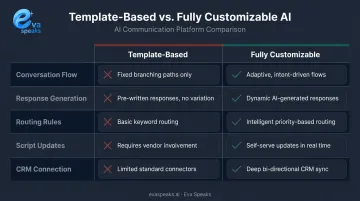
A template-based system sounds robotic and frustrates callers who don't fit the preset options. A customizable system recognizes that a caller asking about an "urgent repair" needs different handling than one asking to "schedule a quote" — and routes each accordingly.
Industries That Need Deep Customization
Not every business needs the same depth of script logic. These verticals benefit most:
- Healthcare: HIPAA-compliant intake scripts, appointment booking, triage routing
- Legal: Case screening, urgency detection, lead qualification flows
- Real estate: Buyer qualification, showing scheduling, seller inquiry routing
- Home services: After-hours dispatch, emergency vs. standard service triage
Each requires different language, different escalation triggers, and different compliance guardrails. The more specialized the caller workflow, the more a generic out-of-the-box script will fall short.
AI vs. Live vs. Basic IVR: Customization at a Glance
Not all receptionist options offer the same degree of configurability. Here is how AI-native, human-with-script, and basic IVR receptionists compare on the dimensions that matter most for script customization:
| AI-Native (EvaSpeaks) | Human Receptionist with Script | Basic IVR Auto-Attendant | |
|---|---|---|---|
| Features | LLM-driven conversation, unlimited custom flows, no-code editor | Follows written scripts, adaptive in conversation | Pre-recorded prompts, DTMF branching |
| Best-fit Business Size | SMB to mid-market | Any size | Very small businesses |
| Key Strengths | Deep customization, updates in minutes, 24/7 | Human warmth within custom script | Zero cost |
| Implementation Complexity | Low - no-code script builder | Medium - training required | None |
| Integration Capability | CRM, scheduling, EHR, industry-specific native | Manual | None |
See how businesses in your industry are customizing their AI. See Industry Use Cases
Top Rated AI Virtual Receptionist Script Customization Services
The services below were selected based on script flexibility, call-flow depth, integration ecosystem, voice quality, and suitability across business sizes and industries. Each entry includes key differentiators, best-fit use cases, and current pricing to help you compare quickly.
Eva Speaks
Eva Speaks is an AI-powered communication solutions provider built around customizable call-flow scripts, LLM integration, and real-time AI responses. The platform gives businesses full control over how their AI receptionist greets, routes, and handles inbound calls — without locking them into a rigid menu structure.
Key differentiators include:
- LLM integration that enables dynamic, context-aware responses rather than static pre-set answers
- Configurable routing rules and AI-enabled transcription for continuous script refinement from real call data
- After-hours configurations with scripts distinct from business-hours flows
- Customer data controls, including the option to opt out of AI model training
| Feature | Details |
|---|---|
| Key Features | Customizable call-flow scripts, LLM-powered real-time responses, AI call handling and transcription, configurable routing rules, after-hours script configuration |
| Best For | Businesses seeking AI communication solutions with deep script customization and LLM-driven call handling |
| Pricing Model | Contact Eva Speaks directly at evaspeaks.ai for current pricing |
See Eva Speaks handle a call with your own script. Request Live Demo
Retell AI
Retell AI is an AI voice platform built for teams that need both no-code simplicity and developer-level depth. Its drag-and-drop conversation flow builder makes it accessible to operations teams and clinic administrators, while a full API layer lets developers extend functionality without limits.
Key differentiators include ~600ms response latency, conditional branching within flows, post-call analytics dashboards, and out-of-the-box SOC 2 Type II and HIPAA compliance with a self-service BAA portal. New users start with $10 in free credits, and the platform supports 31+ languages — making it a strong fit for multilingual teams.
| Feature | Details |
|---|---|
| Key Features | Drag-and-drop flow builder, 31+ language support, post-call analysis, warm transfer with context, knowledge base integration |
| Best For | Teams needing customizable, compliant receptionist scripts at scale with both no-code and API access |
| Pricing Model | Starts at $0.07/min for voice infrastructure; total cost varies by LLM and voice configuration |
Smith.ai
Smith.ai operates a hybrid model: AI handles routine calls, while live North American-based receptionists step in for nuanced interactions. Detailed playbooks define exactly what the AI says and when a human takes over — giving professional services firms the precision of scripted automation with the empathy of human backup.
The platform supports deep tone and escalation customization by caller type, native CRM integrations (Clio, Salesforce, HubSpot), and 24/7 coverage. It's particularly well-suited to law firms and medical practices where caller trust is non-negotiable.
| Feature | Details |
|---|---|
| Key Features | Hybrid AI + human model, customizable tone and escalation logic, multilingual support, per-call pricing, CRM integrations |
| Best For | Law firms, medical practices, and professional services needing scripted AI coverage with human fallback |
| Pricing Model | AI-only plans from $95/month; live receptionist plans from $300/month for 30 calls |
My AI Front Desk
My AI Front Desk is built for small businesses that need professional AI reception without a technical team. Users build automated call flows, FAQs, and booking confirmations through a drag-and-drop interface and can be live in a single afternoon.
Integrations include Google Calendar, HubSpot, Salesforce, and Zapier (with access to 9,000+ apps). Tone presets help smaller teams sound polished and on-brand, and analytics highlight which responses drive better outcomes. Pricing starts with a free tier, with paid plans from $79/month billed annually.
| Feature | Details |
|---|---|
| Key Features | No-code drag-and-drop script builder, tone presets, analytics, Google Calendar and HubSpot integration, Zapier connectivity |
| Best For | Small businesses and solo operators wanting professional AI reception without technical setup |
| Pricing Model | Free tier available; Business-in-a-Box from $79/month (annual) or $99/month |
Dialpad
Dialpad's voice intelligence engine transcribes and analyzes calls in real time, then feeds that data back into script performance metrics. Rather than building scripts once and leaving outcomes to chance, teams get ongoing, evidence-based feedback to continuously improve how their AI receptionist performs.
Differentiators include AI-powered post-call summaries, sentiment analysis to flag frustrated callers before they churn, multi-level auto attendant customization, and omnichannel support across voice, SMS, chat, WhatsApp, Instagram, and email.
| Feature | Details |
|---|---|
| Key Features | Real-time transcription, AI script feedback, sentiment analysis, multi-level auto attendant, omnichannel support |
| Best For | Data-driven teams that want evidence-based script optimization and modern AI-assisted call handling |
| Pricing Model | Per-user subscription; small business plans from $15/month — visit Dialpad's pricing page for full tier details |
What to Look for in an AI Virtual Receptionist Script Customization Service
Script Flexibility and Call-Flow Depth
This is the most important factor. Strong customization platforms typically offer:
- Multi-branch conditional flows — the AI should respond differently based on caller input, not just follow a linear path
- LLM-powered responses — dynamic answers beat pre-set menus for caller satisfaction
- Real-time script editing — update greetings, FAQs, or routing logic without downtime
- A/B testing — some platforms let you test different greetings or routing paths to see what converts better
Integration and Compliance Compatibility
A script is only as useful as the systems it connects to. Check that your platform covers:
- CRM connectors — Salesforce, HubSpot, Zoho, Clio
- Calendar integrations — Google Calendar, Calendly
- Compliance certifications — HIPAA for healthcare, SOC 2 for data-sensitive workflows
HHS requires covered entities to have written business associate agreements with any vendor handling protected health information. For healthcare and legal clients, this isn't optional — it's a hard requirement before deployment.
Analytics, Voice Quality, and Scalability
The best platforms don't just run scripts — they help you improve them. Key metrics to monitor:
- First-call resolution rates — industry average is under 70%; top-performing platforms reach 80%+, and every 1% improvement reduces operating costs by 1%
- Escalation frequency — high escalation rates signal script gaps
- Caller sentiment — platforms like Dialpad flag frustrated callers in real time
Voice quality matters more than most buyers expect. A robotic-sounding AI creates friction regardless of how well the script is written — evaluate naturalness during any trial period before committing.
Scalability is the other variable worth stress-testing early. Confirm the platform can handle volume spikes without triggering cost overruns or degraded response times.
Want a script built for your specific call scenarios? Get a Customized Workflow Recommendation
How We Chose the Best AI Virtual Receptionist Script Customization Services
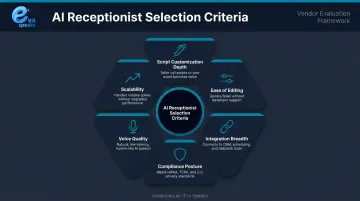
Services were evaluated on six criteria:
- Script customization depth — LLM-powered vs. template-only
- Ease of editing and deployment — no-code options vs. developer dependency
- Integration breadth — CRM, calendar, and third-party app support
- Compliance posture — HIPAA, SOC 2, and data residency
- Voice quality — naturalness and available voice profiles
- Scalability — pricing model behavior at higher call volumes
The more relevant question is whether the platform's scripting model matches your actual call complexity. A solo legal practice with complex intake logic has different needs than a retail chain with simple FAQ routing.
Each of these factors maps directly to a business outcome — because the right fit on paper means little if the platform can't handle your specific call flows:
- Deeper script customization → fewer transfers, higher first-call resolution
- Strong analytics → continuous improvement instead of static deployment
- Compliance readiness → no regulatory exposure in healthcare or legal
- Scalable pricing → no surprise cost spikes as call volume grows
Conclusion
Script customization isn't a cosmetic feature — it's the operational core of any AI virtual receptionist deployment. The right service should let a business shape every greeting, routing path, escalation trigger, and response tone to reflect its brand and serve its callers effectively.
When evaluating platforms, look beyond the current feature list. Can scripts evolve as the business grows? Does the platform's analytics surface gaps over time? Will pricing remain sustainable at higher call volumes?
For businesses seeking LLM-powered, customizable call-flow scripts with real-time AI responses, Eva Speaks is worth evaluating closely. Its integration of large language models with configurable routing rules and AI-enabled transcription gives businesses the tools to build a receptionist that reflects their brand voice and handles callers the way they'd want. For organizations that have tried rigid template-based systems and found them frustrating to adapt, Eva Speaks' configuration model addresses that directly — the call-flow logic can be updated in the dashboard without waiting on a vendor support queue or an engineering sprint. See how Eva Speaks handles script customization and call-flow configuration at evaspeaks.ai.
Frequently Asked Questions
Frequently Asked Questions
Is there a free AI receptionist?
Retell AI offers $10 in free credits for new users, and My AI Front Desk has a free tier. Goodcall also offers a trial period. Most production-grade services move to paid plans quickly, so test against your real call volume before assuming a free tier will cover ongoing needs.
What is the best greeting for an AI receptionist?
A strong greeting is short, natural-sounding, and immediately action-oriented: state the business name, confirm you can help, and prompt the caller's need. Avoid long introductions or robotic phrasing — Google's Conversation Design guidelines recommend brevity and relevance to keep callers engaged.
What is AI virtual receptionist script customization?
It's the ability to configure what the AI says, how it branches conversations based on caller intent, when it escalates to a human, and how it routes calls — as opposed to fixed, template-only systems where every caller follows the same linear path regardless of their actual need.
How much does AI virtual receptionist script customization cost?
Flat monthly plans start around $79–$99/month for SMB tools (My AI Front Desk, Goodcall), while per-minute models like Retell AI start at $0.07/min. Factor in LLM usage, integrations, and compliance add-ons like HIPAA BAAs for a true cost picture.
Can AI virtual receptionist scripts be updated in real time?
The best platforms — including Retell AI, My AI Front Desk, and Eva Speaks — support configuration updates without taking the system offline, allowing businesses to adjust routing logic, update greetings, or add FAQ responses as needs change.
What industries benefit most from customized AI receptionist scripts?
Healthcare (HIPAA-compliant intake and triage), legal (lead qualification and urgency routing), real estate (buyer screening flows), and home services (after-hours dispatch) show the clearest ROI from customized scripts. Each vertical requires distinct language, escalation logic, and compliance configurations that generic templates can't provide.