Introduction
Two-thirds of consumers cite waiting on hold or repeating information to multiple agents as their top service grievance — and according to HubSpot, 80% of consumers have abandoned a business relationship entirely after a poor experience. In most cases, the root cause isn't headcount — it's a poorly configured call queue.
Solving this no longer requires an enterprise budget. In 2026, affordable queue management systems bring call routing, IVR, callback queuing, and real-time analytics to small and mid-sized businesses — many starting at free or under $20 per agent per month.
This guide covers what call queue management is, which five platforms deliver the best value for SMBs, and what features to prioritize before committing to a platform.
Key Takeaways
- Call queue management routes inbound calls to the right agents using rules like arrival order, caller intent, or skill match — reducing wait times and missed calls
- Affordable options exist starting at free — including generous tiers from Bitrix24, CloudTalk, and LiveAgent
- Core features to prioritize: IVR, skills-based routing, callback queuing, real-time analytics, and CRM integrations
- The five best affordable options in 2026: Zoho Desk, CloudTalk, LiveAgent, CallHippo, and Bitrix24
- Verify that your chosen entry tier actually includes the queue features you need before committing
What Is Call Queue Management?
Call queue management is the process of organizing inbound calls into a virtual line and routing them to available agents based on predefined rules — arrival order, caller intent, or agent skill. It's distinct from basic call routing, which only determines where a call goes. Queue management governs how calls wait and are prioritized before they ever reach an agent.
That distinction matters operationally. Poor queue configuration creates a compounding problem:
- Misrouted calls increase handle time and frustrate callers before an agent even picks up
- Uneven agent workloads drive abandonment rates past acceptable thresholds
- Customers who hang up rarely call back in a better mood
HDI benchmarks an optimal abandoned-call rate at 4%–7% — most businesses without structured queue management sit well above that range.
Those operational stakes shaped how the five systems below were evaluated — each was selected for strong queue management capabilities at pricing accessible without an enterprise budget, covering free tiers through mid-range plans.
See how AI takes queue management beyond traditional software. Explore AI Call Automation
Best Affordable Queue Management Systems in 2026
These five platforms were chosen for genuine affordability, queue feature depth, ease of setup, and suitability for small-to-mid-sized teams.
Here is how AI-native, cloud-based, and basic queue management options compare for budget-conscious businesses:
| AI-Native (EvaSpeaks) | Affordable Cloud Queue (Freshdesk, CloudTalk) | Basic IVR Queue | |
|---|---|---|---|
| Features | AI containment + queue, warm transfer, CRM sync, 24/7 | ACD, basic queue management, reporting | Hold queue, DTMF routing, voicemail |
| Best-fit Business Size | SMB to mid-market | SMB to mid-market | Any size |
| Key Strengths | AI reduces queue load, predictable cost, fast deploy | Affordable, proven, easy to use | Low cost, simple |
| Implementation Complexity | Low | Low | Medium |
| Integration Capability | CRM, scheduling, ticketing native | CRM, helpdesk | Limited |
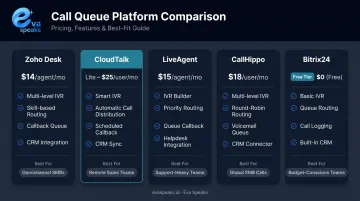
Zoho Desk
Zoho Desk is a customer support platform built for growing businesses, offering multichannel queue management across phone, email, and chat. Its tight integration with the broader Zoho ecosystem — including Zoho CRM — makes it a natural fit for teams already invested in that stack.
The platform's flexible pricing tiers scale with team size, and customizable workflows let businesses define their own queue rules and escalation paths. Note that skills-based routing and multi-level IVR are Enterprise-tier features — they're not available on entry plans.
| Pricing | Free forever (3 users); paid tiers start at approximately $5/user/month billed annually (pricing varies by region — confirm USD rate on the official Zoho Desk pricing page before purchasing) |
| Key Features | Multichannel queuing, workflow automation, built-in analytics, Zoho CRM integration; skills-based routing and multi-level IVR at Enterprise tier |
| Best For | Small to mid-sized teams already using the Zoho product suite; businesses wanting combined CRM and queue management |
CloudTalk
CloudTalk is a cloud-based call center platform designed for distributed and remote teams. It supports international calling, automated queue management, and CRM integrations including Salesforce and Zendesk.
Among the five platforms reviewed, the Lite plan at $19/user/month (billed annually) delivers the most complete entry-tier queue feature set — including call queues, VIP queues, queue callback, IVR, skill-based routing, real-time wallboards, and local numbers in 160+ countries.
| Pricing | Lite: $19/user/month (annual) / $27/user/month (monthly); Starter: $25/user/month annual; 14-day free trial available |
| Key Features | Automated call routing, call queues, VIP queues, queue callback, IVR, skill-based routing, real-time wallboards, call recording, CRM integrations, international numbers (160+ countries) |
| Best For | Remote or distributed small teams; businesses handling cross-border calls who need a budget-friendly but scalable solution |
Watch how an AI call queue flow works in real time. Watch AI Call Flow Demo
LiveAgent
LiveAgent is a help desk and call center platform known for its simplicity and fast setup. It combines inbound call management, queue handling, callback capabilities, and email and chat support in a single interface.
The platform offers a 30-day free trial with no credit card required. Call center functionality — including IVR, call queueing, call routing, and in-call recordings — unlocks at the Medium plan ($29/agent/month annual). Mobile apps for iOS and Android are included across all paid subscriptions.
| Pricing | Small Business: $15/agent/month (annual) / $19/agent/month (monthly); Medium Business: $29/agent/month (annual) — call center and IVR start here; 30-day free trial |
| Key Features | Call queue management, IVR, call routing and transfers, in-call recording, callback system, email and chat integration, mobile apps, reporting dashboards (Medium and above) |
| Best For | Small businesses wanting an all-in-one support platform; teams that can start on a trial and move to Medium once call volume justifies it |
CallHippo
CallHippo is a virtual phone system positioned specifically as a cost-effective option for small and growing businesses. It offers call queuing, IVR, and call distribution features at competitive per-agent pricing.
CallHippo's Basic plan is free for the first six months only — after that, an upgrade is required. The Starter tier at $18/user/month covers telephony and basic analytics, but IVR, call queuing, and call distribution only appear in higher-tier plans. If those features are essential from day one, budget for at least the Professional tier.
| Pricing | Basic: $0 (first 6 months only); Starter: $18/user/month (annual); Professional: $30/user/month (annual); 10-day free trial available |
| Key Features | IVR (higher tiers), call queuing (higher tiers), call distribution, busy call handling, agent performance analytics, CRM integrations |
| Best For | Small businesses and startups willing to grow into higher tiers; teams that need dedicated call center functionality and want a low starting cost |
Bitrix24
Bitrix24 is a broad business management platform with a full-featured call center and CRM module built in. Its free plan supports unlimited users and includes basic CRM — a stronger free-tier starting point than any other platform on this list.
For teams that want to consolidate call management, project management, and internal communications under one roof, Bitrix24 is the most cost-efficient starting point on this list. The first paid tier (Basic at $49/month for 5 users) unlocks telephony, sales pipelines, and email integration.
| Pricing | Free: unlimited users, basic CRM; Basic: $49/month (annual) for 5 users — telephony unlocks here |
| Key Features | Multi-queue management, real-time reporting, unlimited agents on free tier, built-in CRM, internal communications tools, project management |
| Best For | Growing businesses wanting a free or low-cost solution that combines call queuing, CRM, and team collaboration in one platform |
Key Features to Look for in Affordable Queue Management Software
Not all "affordable" queue management tools are built equally. Before committing to a platform, verify that these core capabilities are included at the price tier you're actually buying — not locked behind a plan two levels up.
The Non-Negotiable Three
Any queue management system worth deploying should include:
- IVR (Interactive Voice Response) — lets callers self-serve or qualify their intent before reaching an agent, reducing misrouted calls
- Skills-based or priority routing — matches callers to agents best suited for the inquiry; poorly configured routing can actually move callers backward in queue as higher-priority contacts arrive
- Callback queuing — allows customers to hang up and receive a return call without losing their place; the CFI Group scores customer satisfaction with callback options at 73 out of 100 in its 2022 Contact Center Satisfaction Index
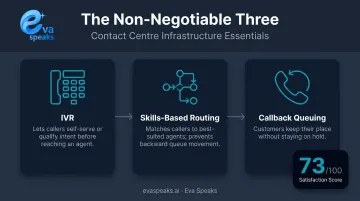
Omitting any of these three creates measurable gaps in service quality that show up directly in your abandonment rate and resolution metrics. Those gaps tend to compound — and the right infrastructure is what prevents them from doing so.
See it live for your specific call volume. Request Live Demo
Integration and Infrastructure Requirements
Queue software needs to connect with the tools your agents already use. At minimum, look for:
- CRM or helpdesk integration — agents see caller history without switching systems mid-conversation
- Cloud-based architecture — required for remote or hybrid teams; on-premise-only platforms create access gaps
- API or webhook support — enables custom connections to ticketing systems, scheduling tools, or analytics platforms
Reporting Metrics That Actually Matter
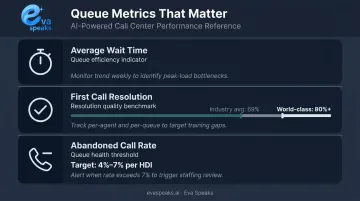
SQM Group's 2024 FCR benchmark puts the industry average First Call Resolution rate at 69%, with good performance defined as 70%–79% and world-class at 80%+. Only 5% of call centers reach world-class FCR. Every 1% improvement in FCR can reduce operating costs by 1% and improve customer satisfaction by 1%.
The three metrics your queue software must track at minimum:
- Average Wait Time (AWT) — direct indicator of queue efficiency
- First Call Resolution (FCR) — measures whether the routing logic is working
- Abandoned Call Rate — benchmark target is 4%–7% per HDI; above that signals a queue configuration problem
How We Chose These Affordable Queue Management Systems
Systems were evaluated on four criteria:
- Pricing transparency — genuine affordability at small-to-mid-sized business scale, not just a headline free tier that locks key features behind expensive upgrades
- Core queue feature depth — routing, IVR, callbacks, and reporting available at a realistic entry price point
- Setup accessibility — deployable without dedicated IT resources
- CRM and integration compatibility — connectable to the tools teams already use
The most common mistake buyers make is choosing software based on the lowest advertised price without checking whether that tier actually includes the features they need. CloudTalk's Lite plan is the clearest example of strong entry-tier depth; LiveAgent and CallHippo both require stepping up to a mid-tier plan before full call center functionality activates.
That said, pricing and feature tiers aren't the only lever worth evaluating. AI-powered call handling is now accessible at affordable price points and can extend what a queue management system does. For businesses looking to reduce queue volume before it builds, a tool like EvaSpeaks handles incoming calls conversationally using LLM-based processing, applies customizable routing rules, and delivers real-time transcription — working alongside your existing platform rather than replacing it. EvaSpeaks is designed to layer on top of current phone systems, which means businesses don't need to change their core call infrastructure to start seeing queue reduction benefits.
Have questions about which queue system fits your needs? Talk to an AI Communication Expert
Conclusion
Affordable queue management software has matured significantly. The five platforms above — Zoho Desk, CloudTalk, LiveAgent, CallHippo, and Bitrix24 — each offer real routing intelligence, analytics, and integration capabilities without enterprise-level budgets. CloudTalk delivers the strongest entry-tier queue feature set; Bitrix24 offers the most generous free plan; LiveAgent suits teams that want simplicity with room to grow.
The right choice depends on your team size, the integrations you need, and — critically — which features are actually available at the price point you're buying, not just on the feature marketing page.
Test free trials before committing, and evaluate whether each system can scale with call volume growth over the next 12–18 months. For businesses that want to go beyond basic queue management as they scale, Eva Speaks adds AI-powered call answering, automated routing, and real-time transcription on top of your existing queue system — handling volume your team can't reach manually. Visit evaspeaks.ai to learn more.
Frequently Asked Questions
What is call queue management?
Call queue management is the process of organizing inbound calls into a virtual line and routing them to available agents based on rules like arrival order, caller intent, or agent skill. It differs from basic call routing in that it governs how calls wait and are prioritized — not just their final destination.
What is the best queue management strategy?
The best strategy depends on call type diversity and team structure. Skills-based routing is most effective for improving first call resolution, while callback queuing is one of the highest-impact changes for reducing abandonment. Most businesses benefit from combining both rather than relying on a single approach like FIFO.
What is a warm transfer in a call center?
A warm transfer occurs when an agent stays on the line to introduce the caller and provide context to the receiving agent before disconnecting. This contrasts with a cold transfer, where the caller is forwarded without any handoff explanation — and warm transfers reduce the frustration of callers repeating themselves.
How much does affordable call queue management software typically cost?
Pricing varies widely. Bitrix24 offers a free plan with unlimited users; CloudTalk, LiveAgent, and CallHippo start between $15–$19/user/month billed annually for entry paid tiers. Verify current pricing directly with each vendor before purchasing, as rates change.
Can small businesses benefit from call queue management systems?
Yes. Queue management reduces missed calls, lowers abandonment rates, and ensures customers reach the right person faster. Modern cloud-based systems require no specialized infrastructure and are practical for businesses with as few as two or three agents handling inbound calls.