Introduction
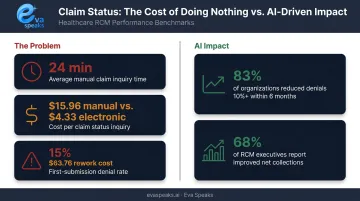
Healthcare billing teams spend a staggering amount of time on the phone with payers. According to the 2023 CAQH Index Report, the average manual claim status inquiry takes 24 minutes — and with nearly 205 million manual medical claim status transactions processed in 2023, that adds up fast. The same report pegs the cost of a manual claim status check at $15.96, versus $4.33 for electronic equivalents, putting total industry spending on medical claim status inquiries at $12.5 billion annually.
AI voice agents are changing this equation. These systems autonomously place calls to payer lines, navigate IVR trees, sit on hold, and extract structured claim data — no billing specialist required. Organizations using them report:
- Faster denial resolution with fewer follow-up calls
- Reduced cost-to-collect as manual inquiry volume drops
- Staff freed to focus on appeals, exceptions, and patient communication
This article breaks down the top five AI voice agent platforms for claim status calls, the key criteria to evaluate before purchasing, and how to match a platform to your RCM workflow.
See how AI handles healthcare claim calls in action. Watch AI Call Flow Demo
Key Takeaways
- AI voice agents automate the full claim status call — IVR navigation, hold time, payer conversation, and data extraction
- Top platforms: Eva Speaks, Voicegain (Casey), Prosper AI, Hyro, and Retell AI
- Key buying criteria: HIPAA/BAA readiness, payer IVR navigation, billing system integrations, call flow configuration, and RCM production references
- Best fit varies by organization type: TPA, health plan, hospital, or mid-market billing company
- Pricing follows per-minute or enterprise contract models; confirm included features vs. add-on costs before signing
What Are AI Voice Agents for Healthcare Claim Status Calls?
An AI voice agent for claim status calls is an automated system that handles the entire payer phone interaction without human staff on the line. It authenticates as an authorized caller, navigates payer IVR menus, and waits on hold. Once connected, it converses with payer reps or automated systems and extracts structured claim data — status, denial codes, next action steps — directly into downstream RCM workflows.
This is a fundamentally different use case from general healthcare voice AI (appointment scheduling, patient intake). Claim status calls require:
- Hold-time tolerance — the agent must stay active during multi-minute payer queues without disconnecting
- Multi-level IVR navigation — payer IVR trees vary significantly and change without notice
- Billing terminology accuracy — claim IDs, NPI numbers, EOBs, and denial codes must be captured correctly
- Structured data extraction — output needs to feed PM systems, billing software, or clearinghouses automatically
Getting those requirements right has measurable payoff. Black Book Research reported in 2025 that 83% of healthcare organizations said AI-driven automation reduced claim denials by at least 10% within six months, and 68% of RCM executives reported improved net collections. Meanwhile, HFMA data shows commercial payers deny roughly 15% of claims on first submission, with rework costing up to $63.76 per denial — making faster, automated follow-up a clear financial priority.
Here is how AI voice agents, traditional IVR, and human agents compare for handling healthcare claim status calls:
| AI Voice Agent (EvaSpeaks) | Traditional Healthcare IVR | Human Agent | |
|---|---|---|---|
| Features | Natural language claim status, eligibility check, payer system integration | DTMF menus, static claim status | Full conversation, exception handling |
| Best-fit Business Size | Medical practices to large billing departments | Enterprise health systems | Any size |
| Key Strengths | 24/7, no hold time, consistent, instant payer data | Widely deployed, predictable | Complex disputes, appeals |
| Implementation Complexity | Low - payer API connectors | High - IT-dependent | None (hire) |
| Integration Capability | EHR, billing software, payer portals | Custom dev required | Manual lookup |
Top 5 AI Voice Agents for Healthcare Claim Status Calls
Each platform below was evaluated on five criteria:
- HIPAA/BAA readiness
- Payer IVR navigation capability
- Billing and PM system integration depth
- Call-flow script customizability
- Documented production use in claims or RCM workflows
Eva Speaks
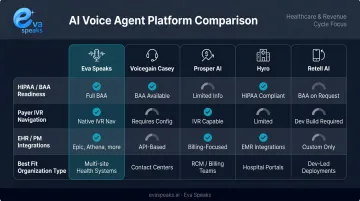
RCM teams dealing with payer call variability need scripting they can actually control. EvaSpeaks is built around that premise — a customizable, LLM-integrated call handling platform with configurable call-flow architecture designed for tailored payer interactions. Because payer IVR paths change without notice, EvaSpeaks' script customization model — which allows RCM operations staff to update call logic without developer involvement — means billing teams can respond to payer changes quickly rather than waiting for a software update.
For claim status workflows, Eva Speaks' call-flow script customization allows RCM teams to map payer-specific IVR paths and conversation logic. Its LLM integration enables multi-turn, natural language handling across both IVR and live representative interactions. Data is primarily stored in U.S. data centers, and customers can opt out of data use for AI model training — a relevant consideration for PHI-sensitive workflows.
For HIPAA compliance specifics, BAA availability, and payer IVR technical details, contact Eva Speaks directly at privacy@evaspeaks.ai.
| Category | Details |
|---|---|
| Key Features | Customizable call-flow scripts, LLM-powered conversation, real-time AI responses, call transcription, third-party integrations |
| HIPAA/Compliance | HIPAA-aligned infrastructure; U.S. data residency; BAA availability — verify directly with Eva Speaks |
| Best Fit | RCM teams, billing companies, and health systems needing flexible, scriptable claim status automation |
Voicegain (Casey)
Launched in April 2025, Casey is Voicegain's generative AI voice agent built specifically for health plan and TPA call centers. It targets payer-side organizations managing high volumes of inbound claim status and eligibility inquiries.
Casey integrates directly with member and eligibility databases and connects to CCaaS platforms including Five9 and Genesys Cloud (with RingCentral, NICE CXone, and Dialpad planned). On handoff to a live agent, it fires a screen-pop so the caller never repeats information. Real-time agent assist is available for escalated calls. Ridge Administrative Services is a named production customer using Casey to replace traditional IVR. Voicegain is SOC 2 Type 2 certified and states HIPAA compliance on its Casey page; confirm BAA availability directly.
| Category | Details |
|---|---|
| Key Features | Claim status + eligibility automation, CCaaS integration (Five9, Genesys Cloud), screen-pop handoff, real-time agent assist, post-call sentiment scoring |
| HIPAA/Compliance | SOC 2 Type 2 certified; HIPAA-eligible; confirm BAA directly |
| Best Fit | TPAs and health plans with high-volume inbound claim status and eligibility inquiry lines |
Prosper AI
Prosper AI is a healthcare-native voice agent platform built for patient access and RCM workflows — claims follow-up, eligibility verification, and prior authorization — with connections to 80+ EHR and PM systems.
For claim status specifically, Prosper can check claims older than 30 days and gather denial information for resubmission. Its integration breadth means the agent can pre-load claim data before the call begins, shortening the actual conversation. A no-code call-flow builder lets non-technical RCM operations staff configure and iterate on scripts. Northeast OB/GYN is a named production customer with documented 40% operational cost reduction and 24/7 coverage. Prosper's Privacy Policy references BAA-governed PHI processing; request subprocessor flow-down BAA documentation for telephony layers.
| Category | Details |
|---|---|
| Key Features | 80+ EHR/PM/payer integrations, no-code call-flow builder, claims follow-up + prior auth automation, real-time eligibility verification |
| HIPAA/Compliance | HIPAA-eligible; BAA referenced in Privacy Policy; verify subprocessor telephony BAAs |
| Best Fit | Hospitals and medical groups with complex, multi-payer claim follow-up workflows |
Hyro
Hyro is a healthcare voice AI platform deployed at 45+ health systems, including Intermountain Health, Weill Cornell Medicine, Baptist Health, and Montefiore. It integrates with both Epic and Cerner and automates over 85% of routine patient calls in production.
For claims-adjacent use cases, Hyro's workflow-first architecture can move a single call session through identity verification, eligibility check, and claim status inquiry without losing context. Multilingual support extends usability across diverse patient and provider populations. Its compliance infrastructure is built for large health systems with strict governance requirements. Note: Hyro's public documentation emphasizes patient access and scheduling; verify claims-specific workflow depth directly. It's overkill for smaller billing operations or standalone billing companies.
| Category | Details |
|---|---|
| Key Features | End-to-end journey orchestration, Epic/Cerner integration, multilingual support, eligibility + claims workflow templates, enterprise QA |
| HIPAA/Compliance | HIPAA-eligible; SOC 2-certified security infrastructure; confirm BAA availability |
| Best Fit | Large health systems and hospital networks needing high-scale claims and eligibility automation |
Retell AI
Retell AI is a configurable voice agent builder with healthcare-specific capabilities — SOC 2 Type 1 and Type 2 certified, HIPAA-eligible, and BAA-available through its Trust Center. Its drag-and-drop agent builder lets RCM teams build and iterate on claim status call flows quickly.
Custom LLM support means organizations can bring their own model or use a provider-tuned model for billing terminology accuracy. Usage-based pricing ($0.07–$0.31/minute on pay-as-you-go) makes it accessible for mid-market billing companies. Named healthcare customers include Medical Data Systems, Pine Park Health, and GiftHealth. Because Retell relies on third-party telephony and ASR infrastructure, confirm subprocessor BAA coverage before deploying in PHI-bearing workflows.
| Category | Details |
|---|---|
| Key Features | Drag-and-drop call-flow builder, custom LLM support, upgraded ASR engine (50+ languages), post-call analysis, usage-based pricing |
| HIPAA/Compliance | SOC 2 Type 1 & 2 certified; HIPAA-eligible; BAA available via Trust Center; verify subprocessor coverage |
| Best Fit | Mid-market RCM teams and billing companies needing fast deployment without enterprise overhead |
How We Chose the Best AI Voice Agents for Claim Status Calls
Most general AI voice agent reviews miss what actually makes or breaks a claim status deployment. A tool that performs well for appointment scheduling often fails on payer calls — the IVR structures are unpredictable, conversations with live reps are unscripted, hold times can exceed 30 minutes, and the output needs to be structured data, not just a transcript.
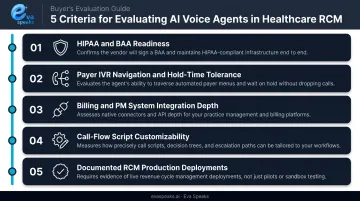
The five factors that drove this evaluation:
HIPAA and BAA readiness — subprocessor flow-down BAAs must cover ASR, LLM, TTS, and telephony layers. A vendor BAA that stops at the platform level leaves PHI exposure gaps across every downstream component.
Payer IVR navigation and hold-time tolerance — the agent must detect DTMF prompts, traverse multi-level menus, and remain active through extended hold queues without timing out or dropping the call.
Billing and PM system integration depth — pre-call data access shortens conversation time; post-call structured logging to PM systems or billing software closes the RCM loop without manual re-entry.
Call-flow script customizability — payer IVR paths vary and change without notice. Teams need to update scripts quickly, with no engineering support required.
Documented RCM production deployments — not healthcare intake or scheduling, but actual claims or eligibility workflows running in production, with verifiable outcomes.
The most common buyer mistake is selecting a platform based on scheduling performance, then finding it can't handle the open-ended, variable nature of live payer conversations. Claim status calls are a different problem entirely.
Explore how other healthcare organizations use AI voice agents. See Industry Use Cases
Conclusion
Claim status calls are repetitive, time-consuming, and expensive — and they're accelerating in volume as denial rates climb. The AHA reported hospitals spend $40 billion annually on billing and collections, and commercial payer denial rates increased over 20% in a single year. Automating claim status follow-up is no longer an experiment; it's an operational necessity.
The right platform depends on your organization type and call volume:
- TPAs and health plans should look hard at Voicegain Casey
- Large hospital networks with Epic or Cerner should evaluate Hyro
- Multi-payer medical groups with complex follow-up needs will find Prosper AI's integration breadth valuable
- Mid-market billing companies wanting fast, configurable deployment should consider Retell AI
Want a workflow built for your claims process? Get a Customized Workflow Recommendation
Before committing to any vendor, run three checks:
- Test IVR navigation against your highest-volume payers
- Request documented RCM production references
- Get subprocessor BAA details in writing
Eva Speaks builds LLM-powered call handling with customizable scripts and real-time response tuned for payer interaction patterns — giving RCM teams a configurable option that adjusts to their specific payer mix. Request a demo to see it in action.
Frequently Asked Questions
What is an AI voice agent for healthcare claim status calls?
AI voice agents are automated systems that call payer phone lines, navigate IVR menus, wait on hold, and extract structured claim status information, replacing the manual work typically done by billing staff or RCM specialists. The agent handles the entire phone interaction end-to-end with no human on the line.
Can AI voice agents navigate payer IVR systems automatically?
Yes — production-ready platforms support payer IVR navigation by recognizing menu prompts and entering appropriate keypad or voice responses. Performance varies by payer and platform, so test against your highest-volume payers before full deployment.
Are AI voice agents for claim status calls HIPAA-compliant?
HIPAA compliance is a framework, not a certification. Confirm the vendor will sign a BAA covering all subprocessors (ASR, LLM, TTS, telephony), and verify that PHI handling, data residency, and retention policies are documented in writing.
How do AI voice agents handle long hold times when calling payers?
Purpose-built platforms keep calls active during extended waits using call progress detection and silence monitoring, resuming conversation automatically once a payer rep or automated system responds. Standard voice bots without this logic will disconnect or time out.
What integrations should an AI voice agent for claim status have?
At minimum: practice management systems, billing software, clearinghouses, and payer databases. Pre-call integrations load claim data before dialing; post-call integrations log structured status outcomes automatically so nothing falls through the cracks.
How much do AI voice agents for healthcare claim status calls cost?
Pricing follows either usage-based (per-minute) or enterprise contract models. Retell AI publishes rates of $0.07–$0.31/minute; most enterprise platforms require a custom quote. Clarify what's bundled versus billed separately — STT, TTS, LLM inference, and telephony are often separate line items.