Introduction
Service businesses run on phone calls. A potential customer calls about a burst pipe, a heating outage, or a same-day appointment — and what happens in the next 30 seconds determines whether that job gets booked or walks straight to a competitor.
The problem is measurable. According to CallRail's 2025 benchmark data, 28% of all business calls go unanswered — and for home services specifically, that number sits at 14%. Meanwhile, Invoca's 2025 home services report, based on over 60 million calls, found that only 55% of callers actually reach a live person, despite 46% of qualified leads converting during the call itself.
That gap is why modern call management systems have moved well beyond simple call routing. The best platforms now cover the full intake-to-dispatch cycle — handling caller qualification, job logging, and dispatch handoff without manual handoffs slowing things down.
This article profiles the five best call management systems for intake-to-dispatch workflows in 2026, plus a breakdown of the decision criteria most relevant to service-based operations. Service businesses interested in seeing AI-powered intake automation in action can Explore AI Call Automation before reading the full platform breakdowns.
Key Takeaways
- 28% of business calls go unanswered — a call management system's first job is closing that gap
- Top 2026 picks: RingCentral (best overall), Dialpad (AI documentation), Eva Speaks (AI-native call flow), Nextiva (high-volume virtual agents), Genesys Cloud (enterprise routing)
- Must-have features in 2026: AI transcription, customizable call-flow scripts, skills-based routing, CRM/dispatch integration
- The right system fits your workflow first, call volume second
- Paying for features you don't use while missing dispatch integrations you need is the most common selection mistake
What Is a Call Management System for Intake to Dispatch?
A call management system for intake-to-dispatch is software that receives, qualifies, routes, and logs incoming calls — moving service requests from first contact to the right agent or field team without manual handoffs or data loss along the way.
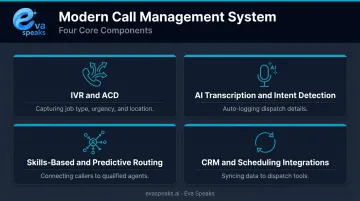
The scope has expanded well beyond basic IVR menus. Modern platforms now combine:
- IVR and ACD — capturing job type, urgency, and location before routing
- AI transcription and intent detection — logging dispatch-relevant details automatically during the call
- Skills-based and predictive routing — connecting callers to the most qualified person, not just whoever's available
- CRM and scheduling integrations — syncing call data directly to the tools dispatch teams already use
This makes call management systems core operational infrastructure for field service, home services, healthcare, and legal businesses — industries where a mishandled call means a lost job and a lost customer.
The five systems below were selected for their ability to handle the full intake-to-dispatch cycle: qualifying callers, routing accurately, capturing job details, and handing off cleanly to operations or field teams.
Best Call Management Systems for Intake to Dispatch in 2026
RingCentral
RingCentral is one of the most widely adopted cloud communications platforms in the US, serving businesses of all sizes. Its suite includes multi-level IVR, skills-based routing, automatic call distribution (ACD), and over 500 pre-built integrations — more than most competitors by a significant margin.
For intake-to-dispatch specifically, two capabilities stand out. First, the Visual Call Flow Editor lets teams configure routing logic across auto attendants, hunt groups, and schedules without writing code. Second, its AI Assistant captures call notes and live transcriptions automatically — reducing the manual step between a call ending and a job being logged.
With up to 250 voice menus and submenus per account, its multi-level IVR scales well for businesses with multiple service lines or departments.
| Feature | Detail |
|---|---|
| Key Capabilities | Multi-level IVR, skills-based routing, ACD, AI call summaries, visual call flow designer, 500+ integrations |
| Pricing | Contact RingCentral directly for current 2026 pricing — base prices were not publicly confirmed at time of writing |
| Best For | SMBs and mid-market businesses needing an all-in-one system with strong CRM integration and minimal IT overhead |
Dialpad
Dialpad is an AI-first communications platform built for customer-facing teams. Its standout capability for intake workflows is real-time transcription combined with live sentiment analysis — supervisors can see how a call is trending while it's still happening.
During intake, three AI features reduce errors and speed up job qualification:
- Real-time transcription captures addresses, job type, and urgency as the caller speaks
- AI Live Coach Cards surface relevant talking points and workflows for agents mid-call
- Live speech coaching flags when agents are talking too fast or dominating the conversation
Skills-based routing assigns callers based on agent proficiency ratings (scored 0–100), so calls reach the most qualified intake rep rather than just the next available one.
| Feature | Detail |
|---|---|
| Key Capabilities | Real-time transcription, sentiment analysis, AI Live Coach Cards, speech coaching, skills-based routing, unlimited ring groups |
| Pricing | Plans start at approximately $15/user/month (annual billing); confirm current 2026 pricing on Dialpad's website |
| Best For | Teams where accurate call documentation is critical and agents need AI support to capture job details without slowing the conversation |
Eva Speaks
Eva Speaks is a communication platform built specifically for automating call handling from first contact through dispatch handoff. It uses large language models (LLMs) alongside speech-to-text and text-to-speech technologies to deliver real-time AI responses during calls — not just after them.
Unlike general-purpose VoIP platforms, Eva Speaks lets businesses configure exactly how every call is handled at each stage: greeting, qualification questions, routing rules, office hours, and escalation triggers. That configurability — combined with full call transcription — makes it a fit for service businesses that need consistent, repeatable intake without expanding their call team at the same rate.
Its LLM integration means the AI handles natural caller language and routes based on intent rather than keypad input — not just rigid menu trees.
| Feature | Detail |
|---|---|
| Key Capabilities | AI-enabled call handling, real-time AI responses, LLM integration, customizable call-flow scripts, routing rules, call transcription |
| Pricing | Contact Eva Speaks directly for pricing tailored to business size and call volume — reach out at privacy@evaspeaks.ai |
| Best For | Businesses seeking to automate intake workflows with AI-driven call handling while maintaining flexible, customizable routing logic for dispatch handoffs |
You can Watch AI Call Flow Demo to see how Eva Speaks handles a realistic intake-to-dispatch call scenario.
Nextiva
Nextiva is a unified cloud communications platform combining VoIP, an AI receptionist (IVA), and omnichannel support. It's particularly well-suited for high-volume intake environments where not every call requires a live agent — but every call must be handled without slipping through the cracks.
Its XBert AI Receptionist answers calls and books appointments 24/7, handling routine intake tasks without agent involvement. This frees live staff to focus on complex or urgent dispatch decisions rather than routine qualification calls.
Pricing transparency is a genuine advantage here: Nextiva publishes its plans publicly, which makes budget planning straightforward compared to platforms that require a sales call to get a quote.
| Feature | Detail |
|---|---|
| Key Capabilities | AI Receptionist (IVA), skills-based routing, customizable IVR, up to 10,000 toll-free minutes (select plans), omnichannel support, built-in surveys |
| Pricing | Core $15/user/month, Engage $25/user/month, Scale $75/user/month (annual billing) |
| Best For | High-volume service businesses needing virtual agent automation for routine intake while maintaining live escalation paths for complex or urgent dispatch requests |
Genesys Cloud
Genesys Cloud is a full-featured contact center platform built for organizations with complex intake workflows, multiple service lines, or distributed dispatch teams. It was recognized as a Leader in both the 2025 Gartner Magic Quadrant for CCaaS and The Forrester Wave: CCaaS, Q2 2025.
Its differentiator is predictive routing — using historical and real-time data to match callers with the agent most likely to resolve their issue, not just whoever is available. For dispatch operations with multiple job types, urgency levels, or geographic territories, that distinction translates directly into faster first-contact resolution.
Workforce management (WFM) capabilities — forecasting, scheduling, and intraday adherence — give operations leaders visibility into staffing against intake volume, which matters when call surges can create dispatch backlogs.
| Feature | Detail |
|---|---|
| Key Capabilities | Predictive routing, workforce management, personalized scripts, omnichannel IVR, analytics and reporting, Agent Copilot |
| Pricing | CX 1: $75, CX 2: $115, CX 3: $155, CX 4: $240 per user/month (annual commitment) |
| Best For | Enterprise and mid-to-large service organizations with complex, multi-department intake-to-dispatch workflows requiring data-driven routing and workforce planning |
Here is how the leading call management systems for intake and dispatch compare:
| EvaSpeaks (AI-Native) | RingCentral (UCaaS) | Genesys Cloud (Enterprise CCaaS) | |
|---|---|---|---|
| Best-fit Business Size | SMB to mid-market | Any size | Large enterprise |
| Key Strengths | AI handles intake 24/7, CRM auto-log, fast deploy | Full UCaaS suite, mobile, familiar | Full enterprise CCaaS, IVR, workforce mgmt |
| Implementation Complexity | Low - hours to days | Low to Medium | High - months |
| Integration Capability | CRM, scheduling, ticketing native | RingCentral ecosystem | Deep but custom-dev heavy |
How We Chose These Systems
Systems were assessed on how well they support the full intake-to-dispatch cycle — not just call volume handling, but caller qualification accuracy, routing intelligence, dispatch integration depth, and ease of configuration.
The common selection mistake is choosing based on brand recognition or total feature count without verifying whether the platform actually connects to existing scheduling or field service tools. A system that answers every call but can't pass job details to your dispatch platform leaves half the workflow still broken.
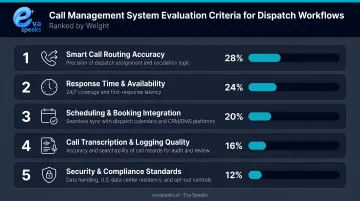
Evaluation criteria, in order of weight:
- AI and automation capability — does the system reduce manual intake steps through transcription, intent detection, or virtual agents?
- Routing flexibility — skills-based, intent-based, and time-based routing options
- CRM and dispatch integration depth — native integrations or verified API connectivity with field service and scheduling tools
- Pricing transparency and scalability — can you forecast costs as call volume grows?
- Agent usability — a system that agents find cumbersome will be underused regardless of its features
Of those five criteria, one carries extra weight for dispatch-specific workflows: the ability to capture structured job data during the call, not after it.
Most general-purpose VoIP platforms log call metadata — duration, caller ID, recording. That's useful, but it's not the same as capturing address, job type, urgency, and customer history while the call is live and syncing it to dispatch before the call ends. Eva Speaks is built around that distinction specifically — its customizable call-flow scripts and routing rules are designed to structure intake data in real time, not reconstruct it from a recording afterward. For service businesses that don't have a large IT team, Eva Speaks' call-flow configuration is handled through a dashboard rather than requiring code changes, which means field service companies can adjust intake questions and routing rules themselves as service offerings evolve. Dispatch-focused operations can Get a Customized Workflow Recommendation based on their specific call types and dispatch process.
Conclusion
Choosing the right call management system for intake to dispatch in 2026 comes down to fit — your call volume, your dispatch process, and the tools your team already relies on.
Before committing, assess current capabilities alongside how well the system scales, handles AI-driven interactions, and connects with your existing platforms. Use free trials and demos to test real intake scenarios, not polished walkthroughs. A system that handles a scripted demo call cleanly may behave differently when a caller asks an unexpected question mid-intake.
If intake automation is the priority, that's where the right AI platform makes the biggest difference. Eva Speaks offers customizable call-flow scripts and real-time AI responses built specifically for intake-to-dispatch workflows. Contact privacy@evaspeaks.ai to see how it works for your operation, or Request Live Demo to walk through a live intake scenario matched to your service type.
Frequently Asked Questions
What is a call management system?
A call management system is software that routes, tracks, and manages incoming and outgoing business calls using tools like IVR, ACD, and call queues. It ensures callers reach the right agent or department efficiently while capturing data for performance monitoring and service improvement.
What are inbound CX tools?
Inbound CX (customer experience) tools manage and improve incoming customer interactions through call routing, IVR, live chat, ticketing, and AI-assisted response systems. They help businesses respond faster and more accurately across voice and digital channels.
What features should a call management system have for dispatch-based businesses?
Dispatch-based businesses should prioritize:
- Customizable call-flow scripts for structured intake
- Skills-based or intent-based call routing
- Real-time transcription for capturing job details
- CRM and scheduling software integration
- Escalation paths that connect urgent calls directly to dispatch
How does AI improve the intake-to-dispatch call workflow?
AI automates caller qualification, captures job details through real-time transcription, and routes calls based on intent rather than just availability. Gartner predicts agentic AI will autonomously resolve 80% of common service issues by 2029 — reducing manual steps between call receipt and job assignment while cutting response times and errors.
Can call management systems integrate with field service or CRM software?
Most modern platforms offer native or API-based integrations with popular CRMs (Salesforce, HubSpot, Zoho) and field service management tools. Before purchasing, verify integration depth with your specific dispatch platform — not all connections are equally robust, and some require third-party middleware.