
Introduction
Every call your business misses is a potential customer you'll never win back. That's not an exaggeration — Invoca's research found that in home services alone, 27% of inbound calls go unanswered, nearly half of those calls are leads, and almost a third of those leads would have converted. The math on lost revenue adds up fast.
Yet most businesses treat inbound call handling as a reactive function — pick up, improvise, and move on. The companies pulling ahead are doing something different: they've built a structured, repeatable system that turns every incoming call into a revenue and retention opportunity.
That system is what this guide is about. It covers six practical strategies to sharpen your inbound call handling, the core skills your agents need to execute them, and the key metrics that tell you whether it's actually working.
Key Takeaways
- Inbound call handling is the complete system a business uses to receive, route, and resolve customer-initiated calls
- Six core strategies: smart call routing, omnichannel integration, AI-powered tools, customized scripts, data-driven decisions, and continuous agent training
- Key metrics to track: FCR, AHT, CSAT, abandonment rate, and Average Speed of Answer
- Industry FCR benchmarks average around 70% — anything below signals room for improvement
- Pairing AI efficiency with well-trained agents is what turns adequate call handling into a strong customer experience
Watch how AI handles inbound calls from first ring to resolution. Watch AI Call Flow Demo
What Is Inbound Call Handling?
Inbound call handling is the complete process a business uses to receive, route, manage, and resolve calls initiated by customers or prospects — from the first ring through post-call follow-up. As TechTarget defines it, it typically involves customers interacting with IVR prompts before being routed to the appropriate agent or queue.
The stakes are real: Zendesk's data shows more than 50% of consumers will switch to a competitor after a single bad experience. A dropped call, a long hold, or a misdirected transfer can end a customer relationship permanently.
Inbound vs. outbound calling — the key difference:
- Inbound: Customer-initiated, unpredictable in topic, requires flexible routing and agent readiness
- Outbound: Business-initiated, planned in advance, follows defined scripts and call lists
Because inbound calls arrive on the customer's timeline — not yours — your team must be ready to handle any topic, at any time. That's exactly why having a deliberate call handling strategy matters — and where the right approach makes all the difference.
6 Inbound Call Handling Strategies
These six strategies form a practical framework for businesses of any size to improve call quality, agent efficiency, and customer satisfaction.
Strategy 1: Implement Smart Call Routing
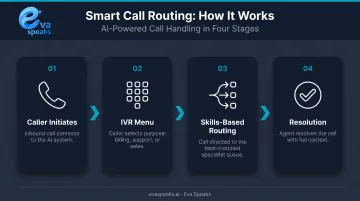
Not every agent can handle every call type equally well. Skills-based routing solves this by directing incoming calls to the agent or department best equipped to resolve that specific issue — rather than whoever is next in the queue.
The result: fewer transfers, shorter handle times, and faster resolution for callers.
IVR as the front door:
A well-designed IVR (Interactive Voice Response) menu is the backbone of smart routing. Before a live agent ever picks up, the IVR:
- Identifies the caller's purpose (billing, support, sales, etc.)
- Directs them to the right team or agent profile
- Sets realistic wait-time expectations
- Filters out calls that self-service can handle
A 2025 review published in Frontiers in Computer Science confirms that optimizing IVR flows is directly tied to better service quality, operational efficiency, and customer satisfaction in call centers.
Audit your routing logic regularly. Call volumes shift, new products launch, and customer inquiry patterns change. A routing tree built two years ago may be sending billing questions to the sales team. Review IVR paths and routing rules quarterly at minimum.
Strategy 2: Adopt a Multichannel Approach
Modern customers don't limit themselves to phone. They reach businesses through live chat, email, social media, and messaging apps — sometimes switching channels mid-issue. When your inbound call team operates in a silo, agents are flying blind on customer history.
When agents can see a customer's full interaction history across all channels before picking up, they resolve issues faster and more personally — no need to ask a caller to repeat what they've already shared twice.
Aberdeen's research (acknowledging it predates 2020) found that Best-in-Class omnichannel contact centers achieved 13.1% year-over-year CSAT improvement, while firms without an integrated approach saw a 1.1% decline. The direction of that relationship still holds.
What multichannel visibility gives agents:
- Prior complaint or inquiry context before the call starts
- Purchase or account history without digging through multiple systems
- Notes from previous email or chat interactions
- Faster resolution with less repetition for the caller
This doesn't require rebuilding your entire tech stack overnight. Even basic CRM integration that surfaces recent customer touchpoints before a call connects makes a measurable difference.
Strategy 3: Leverage AI-Powered Tools for Efficiency
The productivity data on AI in call centers is convincing. NBER's study of 5,179 customer support agents found that generative AI assistance increased issues resolved per hour by 14% on average, with 34% productivity gains for novice and low-skilled agents specifically.
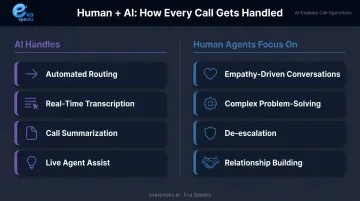
Where AI adds the most value in inbound call handling:
- Automated routing — directs calls based on caller intent without human intervention
- Real-time transcription — creates a live text record of the conversation as it happens
- Call summarization — generates post-call notes automatically, reducing after-call work
- Live agent assist — surfaces relevant information or response suggestions during a call
EvaSpeaks is one example of a platform built around this combination — using LLM integration and customizable call-flow scripts to handle routine inbound calls and transcribe every interaction, without requiring the IT infrastructure typical of enterprise-grade contact center deployments.
The human-AI balance matters. AI handles repetitive, high-volume, and data-retrieval tasks. Human agents focus on empathy-driven conversations, complex problem-solving, and de-escalation. The result is faster resolution on routine calls and better outcomes on the complex ones.
Platforms like Eva Speaks are built around this balance. Eva Speaks uses real-time conversational AI, LLM integration, and customizable call-flow scripts to help businesses manage inbound calls more efficiently — handling routine call types automatically while keeping the human touch accessible when it matters.
See how businesses across industries handle inbound volume with AI. See Industry Use Cases
Here is how the three core inbound call handling approaches compare across key business dimensions:
| AI-Powered (EvaSpeaks) | Traditional IVR | Human Agents Only | |
|---|---|---|---|
| Features | Natural language, 24/7, dynamic routing, CRM sync | DTMF menus, fixed routing, voicemail | Full interaction, judgment, adaptive |
| Best-fit Business Size | SMB to mid-market | Large enterprise | Any size |
| Key Strengths | Zero missed calls, consistent, instant CRM update | Predictable, widely deployed | Human empathy, complex situations |
| Implementation Complexity | Low - hours | High | None (hire) |
| Integration Capability | CRM, scheduling, EHR native | Custom dev required | Manual or CRM |
Strategy 4: Use Customized Call Scripts
Scripts get a bad reputation because people picture rigid, robotic dialogue. Done right, a call script is something different: a structured conversation guide that maps common call types to ideal agent responses, ensuring consistency without stripping out personality. For businesses using AI-powered call handling tools like EvaSpeaks, customizable call-flow scripts fulfill exactly this role — providing structure and routing logic that reflects how the business actually operates, while the underlying LLM handles natural caller language.
Map scripts to the call type:
| Call Type | Script Focus |
|---|---|
| New inquiry | Discovery questions, benefit summary, clear next step |
| Billing question | Calm tone, account verification, clear explanation |
| Complaint | Empathy first, ownership, resolution pathway |
| Escalation | De-escalation language, warm transfer protocol |
Each of these calls requires a different tone and a different pathway to resolution. A one-size-fits-all script fails at all of them.
Good scripts reduce agent hesitation — especially for newer team members — and prevent inconsistent messaging across your team. They also create a baseline for coaching: if the script exists and the call went sideways, you can identify exactly where it broke down.
Strategy 5: Make Decisions Using Call Data and Analytics
Gut instinct isn't a call center strategy. The data your inbound calls generate — if you actually use it — reveals patterns that are impossible to spot call by call.
Core data sources to monitor: call recordings and transcripts, IVR drop-off rates by menu option, call volume by time of day, hold time and transfer rate data, and CRM interaction histories.
Here's a practical example: if your analytics show 60% of calls ask the same question, that topic should be elevated in your IVR menu or addressed through self-service content. SQM Group's research supports this data-driven approach — for every 1% improvement in FCR, there's a corresponding 1% improvement in CSAT and a 1% reduction in operating costs. Small optimizations compound.
Call volume heat maps are particularly underused. Knowing that Mondays between 9–11am are your peak volume window lets you staff appropriately instead of scrambling reactively.
Strategy 6: Invest in Continuous Agent Training
One-time onboarding is not a training program. Products change, policies update, and customer expectations shift — agents need continuous development to keep pace.
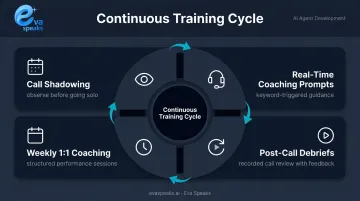
Effective training mechanisms:
- Call shadowing — new agents observe experienced ones handling real call types before going solo
- Real-time coaching prompts — keyword-triggered cheat sheets surface during live calls to guide responses
- Post-call debriefs — recorded interactions become training material, reviewed with specific feedback
- 1:1 weekly coaching sessions — SQM Group identifies this practice in top-performing FCR centers like Mr. Cooper, one of their first-quartile FCR performers
Training isn't just product knowledge. Soft skills — active listening, empathy, tone adaptation — are at least as important and harder to teach from a manual. Build both into your ongoing training cadence, not just the initial onboarding week.
Essential Skills for Inbound Call Agents
The gap between an average agent and a high performer isn't usually product knowledge. It's the ability to stay composed under pressure, adapt to a caller's emotional state, and take genuine ownership of the outcome.
Core hard skills:
- CRM navigation and note-taking simultaneously
- IVR and routing system familiarity
- Clear verbal communication under time pressure
- Accurate call documentation
Core soft skills:
- Active listening (not just waiting to speak)
- Empathy and emotional regulation
- Problem-solving when the script doesn't cover the situation
- De-escalation when a caller arrives frustrated
SQM Group's research on emotional intelligence in call centers found that agents with high emotional intelligence score measurably higher on CSAT than their peers. It's one of the stronger predictors of call outcome quality — not a minor edge.
High performers face difficult calls just as often as anyone else. What sets them apart is that they don't let those calls rattle them — they adapt tone, acknowledge frustration without absorbing it, and keep the conversation moving toward resolution.
Key Metrics to Measure Inbound Call Performance
You can't improve what you don't measure. These five KPIs give you a complete picture of inbound call performance.
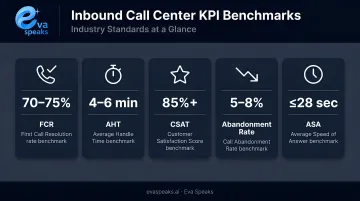
| Metric | What It Measures |
|---|---|
| First Call Resolution (FCR) | % of issues resolved without a callback or transfer |
| Average Handle Time (AHT) | Total time per call including hold and wrap-up |
| Customer Satisfaction Score (CSAT) | Post-call customer satisfaction rating |
| Abandonment Rate | % of callers who hang up before reaching an agent |
| Average Speed of Answer (ASA) | Time between call arrival and agent pick-up |
According to SQM Group's 2025 research, the industry FCR average sits around 70%. Their framing: 70–79% is "good", anything below 70% needs active improvement, and world-class performance sits above that range.
These metrics don't operate in isolation — that's where many teams go wrong. Cutting AHT to hit a handle-time target without fixing underlying issues just means callers call back, which tanks both FCR and CSAT. Reducing hold times improves abandonment rate, but it doesn't help if callers still aren't getting resolutions.
Review your benchmarks on a regular cadence — monthly at minimum for volume metrics, quarterly for trend analysis. ICMI's 2025 data shows abandonment rate (85%), AHT (84%), and ASA (76%) are among the most widely tracked metrics in contact centers, so peer comparison data is readily available to calibrate where your team actually stands.
Want an inbound call strategy designed for your team? Get a Customized Workflow Recommendation
Conclusion
Effective inbound call handling comes down to several working parts: smart routing, well-trained agents, AI-assisted efficiency, and consistent use of data to refine the process over time.
The businesses winning on customer experience treat every inbound call as a revenue and retention opportunity — not just a support task to close. More than half of customers will leave after a single bad experience, which means a weak process doesn't just cost you a call — it costs you the customer.
If you're looking to modernize your inbound call handling, platforms like Eva Speaks offer a practical starting point, including:
- Real-time AI call handling and routing
- Customizable call-flow scripts tailored to your business
- LLM integration for natural, context-aware conversations
- Transcription services to support quality review and compliance
The result is a call operation that moves quickly without stripping out the responsiveness customers actually notice.
Frequently Asked Questions
What is inbound call handling?
Inbound call handling is the complete system a business uses to receive, route, and resolve customer-initiated calls: covering the technology (IVR, routing, CRM), processes (scripts, escalation paths), and people (trained agents) that work together to manage incoming calls from first ring to resolution.
What are the best practices for inbound call handling?
The strongest practices include implementing smart call routing, using customized call scripts mapped to different call types, investing in continuous agent training, integrating AI tools to improve efficiency, and using call data analytics to refine processes over time.
What skills are needed for inbound calls?
Effective inbound agents need active listening, empathy, clear verbal communication, CRM proficiency, and the ability to multitask under pressure. Emotional intelligence and de-escalation ability, in particular, consistently drive higher customer satisfaction scores.
What software and tools are used for inbound call handling?
Common tools include IVR systems, CRM platforms, cloud contact center software, AI transcription and agent-assist tools, call analytics dashboards, and call recording solutions. Many businesses integrate these into a unified platform for a complete view of each customer interaction.
How is AI used in inbound call handling?
AI handles automated call routing, real-time transcription, post-call summarization, live agent coaching prompts, and AI-powered self-service for common inquiries. The goal is to augment human agents: offload repetitive tasks so agents can focus on complex, high-stakes conversations that require genuine human judgment.
What are the 7 P's of call handling?
The 7 P's — Prompt, Polite, Prepared, Patient, Professional, Proactive, and Problem-solving — are a foundational framework for quality call handling. They serve as a consistent behavioral standard that applies across call types, agent experience levels, and industries.