
Missed calls, slow follow-ups, and unstructured screening are among the most common reasons qualified leads choose a competing firm. A 2024 Clio secret-shopper study found that only **40% of law firms answered incoming phone calls**, and 48% were completely unreachable by phone — never answering and never calling back. Meanwhile, FindLaw's 2023 Consumer Legal Needs Survey reports that more than 7 in 10 legal consumers contact attorneys by phone first, and 50% expect a same-day response.
This guide is written for solo attorneys, small firm owners, and legal administrators who want to understand what legal intake and appointment setting actually involve, how the process works step by step, what makes or breaks it, and the mistakes that quietly cost firms clients every week.
Key Takeaways
- Legal intake is the full sequence from first contact to signed fee agreement.
- Appointment setting is the middle layer that screens and schedules qualified leads before they disengage
- Speed is the most controllable intake variable — slow follow-up directly costs firms clients
- A structured process prevents leads from falling through the cracks, protects the firm legally, and builds early client trust
- AI-powered call handling tools allow firms to respond 24/7 without adding staff
See how AI automates legal intake and appointment setting. Explore AI Call Automation
What Is Legal Intake and Appointment Setting?
Legal intake is the end-to-end process a law firm uses to evaluate, capture, and onboard potential clients — from the first inquiry through to a signed fee agreement. Every step in between either moves a prospect closer to becoming a client or gives them a reason to call someone else.
Appointment setting is a distinct but integrated function within intake. It covers the proactive outreach, lead qualification, and consultation scheduling that ensures the right prospects reach the right attorney at the right time. Done well, it filters out poor-fit leads while keeping qualified prospects from going cold before a consultation is booked.
Understanding where each function ends — and the other begins — is where most firms run into trouble.
Where Intake Ends and Onboarding Begins
These two functions are frequently confused, and the confusion creates process gaps.
Intake is about qualifying and converting — it ends when the fee agreement is signed and the matter is opened. Client onboarding begins after that point, when the firm sets up the file, introduces the client to their team, and outlines next steps.
Firms that conflate the two often skip critical intake steps (like conflict checks or fee transparency) because they assume those details will be handled "during onboarding." By that point, the firm may already be facing a conflict of interest, or the client may have entered with expectations the firm never addressed.
Why Law Firms Need a Structured Intake Process
Legal intake carries requirements that few other industries face:
- Conflict-of-interest screening before detailed case facts are disclosed (governed by ABA Model Rule 1.18)
- Jurisdictional and case-type eligibility checks to avoid wasting attorney time
- Fee transparency — clients need to understand the cost structure before committing
- Sensitivity to clients in crisis — many callers are dealing with divorce, criminal charges, accidents, or family emergencies
ABA Model Rule 1.18 protects prospective-client information even when no attorney-client relationship forms. The moment a prospect discloses case details, your firm carries professional obligations — whether or not you take the case. Running a conflict check before collecting substantive facts is a compliance requirement, not just good practice.
Those compliance stakes make the operational side equally important. When intake is informal or reactive, the consequences stack up fast.
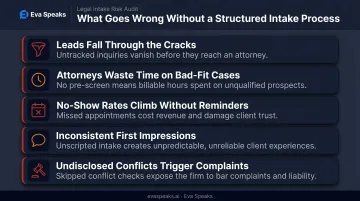
What Goes Wrong Without Structure
- Leads fall through the cracks because no one owns the follow-up
- Attorneys waste consultation time on cases the firm can't or shouldn't take
- No-show rates climb when reminders aren't automated
- Staff improvise scripts, creating inconsistent first impressions
- Undisclosed conflicts surface after engagement, triggering disciplinary complaints or disqualification
Most firms only catch these gaps when revenue plateaus — or when a referral source mentions that a prospect "said no one called back."
How the Legal Intake and Appointment Setting Process Works
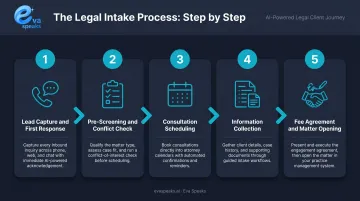
At a high level, intake runs from first contact through lead capture, pre-screening, conflict check, consultation scheduling, information collection, and fee agreement. Each stage must hand off cleanly to the next.
Step 1: Lead Capture and First Response
The firm receives an inquiry by phone, web form, email, or referral, and the speed of the first response determines whether the lead advances or disengages.
This is where most firms lose clients they never know they had. A prospect who hits voicemail at 7 p.m. on a Tuesday will often call the next firm on their list.
AI-powered call handling tools like Eva Speaks address this directly. The platform answers every inbound call in real time, 24/7, including after hours and weekends. When a call comes in outside business hours, Eva greets the caller, begins practice-area-specific intake, and qualifies the case against the firm's acceptance criteria, without routing anything to voicemail. Emergency criminal defense calls can be escalated to an on-call attorney immediately.
Every call is transcribed, and intake data flows automatically into connected case management systems like Clio, MyCase, or PracticePanther.
Watch how AI handles a real legal intake call. Watch AI Call Flow Demo
Step 2: Pre-Screening and Conflict Check
Once a lead is captured, a brief structured questionnaire (10 to 15 questions) assesses:
- Case type and practice area
- Jurisdiction and applicable court
- Opposing party name (for conflict screening)
- Fee tolerance and payment structure preferences
- Key dates (incident date, statute of limitations concerns)
This step does two things simultaneously: it filters out cases the firm cannot or will not take, and it generates the data needed to run a conflict-of-interest check before any attorney discusses case substance. Per ABA GPSolo guidance, firms should avoid receiving sensitive case information until a conflict check is cleared.
Eva Speaks can be configured to ask structured pre-screening questions during inbound calls, with captured data pushed directly into the firm's case management system including opposing party details needed for conflict screening. For solo attorneys and small firms where intake is currently handled ad hoc — whoever picks up the phone asks whatever comes to mind — this structured approach also improves the quality and consistency of data captured at the first contact, which has downstream effects on how reliably the firm can follow up and convert qualified leads.
Step 3: Appointment Setting and Consultation Scheduling
Once a lead clears pre-screening, the appointment setter (whether in-house staff, a virtual receptionist, or an AI system) coordinates a consultation time and triggers the confirmation workflow.
A complete scheduling workflow includes:
- Real-time calendar availability check
- Automated confirmation via SMS or email
- Reminder sequence (typically 24 hours before and day-of) to reduce no-shows
- Option for rescheduling without requiring staff intervention
Eva Speaks integrates with Calendly, Google Calendar, Acuity, and legal-specific platforms including Clio, MyCase, and PracticePanther. The system handles cancellations, reschedules, and reminder sequences automatically. 24/7 scheduling availability is increasingly a baseline client expectation, not a premium feature.
Step 4: Information Collection and Documentation
Before or during the consultation, the firm collects detailed client and case information using standardized intake forms. This typically includes:
- Full contact information
- Case narrative and timeline
- Prior legal representation
- Employment and income details (relevant for fee determination)
- Supporting documents (accident reports, contracts, medical records)
This data should flow directly into the firm's CRM or case management system. Manual re-entry between systems is where errors occur and attorney time disappears.
Step 5: Fee Agreement and Matter Opening
The consultation ends with a fee discussion. If both parties agree to proceed:
- Draft the fee agreement (e-signature tools accelerate this significantly)
- Collect any required retainer or advance payment
- Open the matter in the case management system
- Assign key deadlines, tasks, and responsible attorneys
This step closes the intake loop. Until the fee agreement is signed, the prospect has not converted — and even a strong earlier process can unravel if the fee discussion is unclear or delayed.
Want an intake workflow built for your practice area? Get a Customized Workflow Recommendation
Key Factors That Affect Legal Intake Effectiveness
Several variables determine whether your intake process converts prospects or loses them:
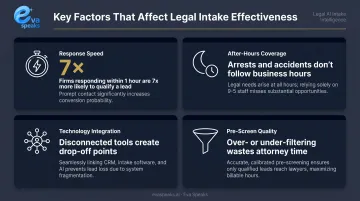
Five factors shape whether your intake process closes cases or loses them:
- Response speed: Harvard Business Review's analysis of 2,241 companies found firms responding within one hour were nearly 7 times more likely to qualify a lead than those waiting longer. Clio's legal consumer data reinforces this — 79% of legal clients expect a response within 24 hours, and FindLaw found 50% expect same-day contact.
- After-hours coverage: Car accidents, arrests, and custody disputes don't happen between 9 and 5. Firms without evening and weekend coverage miss a disproportionate share of inquiries — and those callers are often the most motivated to hire quickly.
- Technology integration: Disconnected tools create manual handoffs at every stage. A phone system that doesn't sync with your calendar, or a spreadsheet tracking leads separately from your CRM, is where prospects fall through the cracks.
- Pre-screen quality: Poorly designed questionnaires cut both ways — letting bad-fit leads through (wasting attorney time on unbillable consultations) or over-filtering and discarding viable cases.
Client sensitivity is another factor most firms underestimate. Callers dealing with criminal charges, family breakdown, or serious injury are often frightened or overwhelmed. Intake staff — and any automated systems — need to balance efficiency with genuine empathy.
Bilingual capacity is also a measurable gap. Census data show 61% of non-English-speaking adults in the U.S. speak Spanish, and firms without Spanish-language intake handle a fraction of the cases available to them.
Comparing Legal Intake and Appointment Setting Approaches
Not every firm handles intake the same way. Here is how the three most common approaches compare across the factors that matter most to growing practices:
| AI Intake (EvaSpeaks) | Human Intake Staff | Online Intake Software | |
|---|---|---|---|
| Features | 24/7 voice intake, conflict pre-screening, scheduling, Clio sync | Full interaction, matter details, conflict check | Web forms, e-sign, basic scheduling |
| Best-fit Business Size | Solo to mid-size firms | Larger practices | Tech-savvy clients, small firms |
| Key Strengths | Never misses a new lead, instant CRM push, consistent | Full case knowledge, attorney relationship | Self-service, low overhead |
| Implementation Complexity | Low - Clio/MyCase connectors | None (hire) | Low |
| Integration Capability | Clio, MyCase, PracticePanther native | Manual entry | Limited CRM sync |
Common Mistakes Law Firms Make with Intake
Most intake failures don't come from bad marketing — they come from operational blind spots that go unaddressed for years. Three patterns show up repeatedly across struggling firms:
- Treating intake as administrative, not revenue-generating. If you're not tracking response rate, consultation show rate, and lead-to-client conversion, you can't identify where the process is leaking. Firms that aren't growing predictably usually aren't under-marketing — they're under-measuring.
- Building a single-point-of-failure system. One coordinator, one phone line, no after-hours coverage. When that person is sick or overloaded, the entire intake process stalls. This bottleneck gets worse as the firm grows, not better.
- Booking volume instead of qualified consultations. Skipping pre-screening to fill the calendar wastes attorney time on poor-fit cases, invites billing disputes, and erodes the referral reputation that drives long-term growth.
Each of these mistakes is fixable — but only once you can see them clearly in your own numbers.
Have questions about AI intake for your firm? Talk to an AI Communication Expert
Conclusion
Effective legal intake does three things:
- Converts more qualified leads into paying clients
- Reduces time attorneys spend on non-billable intake activity
- Creates a first impression that sets the tone for the entire client relationship
The firms that grow predictably are the ones that answer the phone, run a structured process, and treat intake as the revenue function it is — not just an administrative formality.
Mapping each stage before the caseload demands it is what separates firms with predictable pipelines from those quietly hemorrhaging leads at the first point of contact.
Frequently Asked Questions
What is the legal intake process?
Legal intake is the structured sequence a law firm uses to evaluate and onboard new clients — covering first contact, pre-screening, conflict checks, consultation scheduling, information gathering, and fee agreement signing. The process ends when the matter is formally opened and the client relationship is active.
What is appointment setting in a law firm?
Appointment setting is the step within legal intake where qualified leads are contacted, assessed for fit, and scheduled for a consultation. It's handled by an in-house intake specialist, virtual receptionist, or an AI-enabled system like Eva Speaks, which can manage scheduling around the clock without staff involvement.
What information should a legal intake form collect?
At minimum: contact details, case type, opposing party name, key dates, jurisdiction, prior legal representation, and employment or income status. Specific fields vary by practice area — personal injury intake looks different from immigration or family law.
How long should the legal intake process take?
The contact-to-consultation booking phase should be completed within 24 hours of the first inquiry. The full cycle — first contact to signed fee agreement — typically spans a few days to a week, depending on case complexity and document turnaround.
What is the difference between a virtual receptionist and an AI call handling service?
A virtual receptionist is a human agent working remotely who answers calls and handles intake on behalf of the firm. An AI call handling service like Eva Speaks uses automated voice technology to answer, qualify, and route callers in real time — typically at lower cost with true 24/7 availability. Some clients prefer a human voice for sensitive legal matters; others prioritize speed and coverage.
How do you measure whether your legal intake process is working?
Track these four metrics monthly:
- Lead response rate — how quickly your team follows up on new inquiries
- Consultation show rate — percentage of booked consults that actually happen
- Lead-to-client conversion rate — how many inquiries become paying clients
- Cost per acquired client — total intake spend divided by new clients won
Use your CRM or case management dashboard to find which stage has the highest drop-off. Fix that stage first.