The problem? Most businesses are still routing those calls through rigid IVR menus that haven't meaningfully changed since the 1990s. Callers press "1 for billing," get transferred twice, repeat their account number, and hang up frustrated.
AI-powered voice automation and intelligent routing exist specifically to break that pattern. The platform you choose determines how much of that operational improvement you actually capture — whether calls get resolved on first contact or bounce around your queue.
This guide covers the best AI call center platforms built for voice automation and routing, what features to prioritize, and how to match a platform to your business size and call complexity.
Key Takeaways
- AI call center platforms use LLMs, NLP, and predictive analytics to route calls and automate voice interactions — far beyond static IVR menus.
- The strongest platforms combine accurate intent detection, low-latency voice agents, CRM integration, and flexible call-flow logic.
- SMBs need fast setup and flexible routing; enterprises require predictive routing, omnichannel support, and deep analytics.
- Top platforms covered: Eva Speaks, Retell AI, Genesys Cloud CX, Talkdesk, and Dialpad.
- When evaluating vendors, real-world call quality and integration depth matter more than demo performance.
What Is AI Voice Automation and Routing in Call Centers?
AI voice automation refers to software that uses speech recognition, NLP, and large language models to handle inbound calls, answer questions, qualify leads, and complete tasks — without routing every call to a human agent. Unlike traditional IVR, which forces callers through a fixed menu of numbered options, AI voice agents understand natural speech and respond based on what callers actually say.
AI call routing is a distinct but complementary capability. Instead of sending callers down a static decision tree, it analyzes caller intent, sentiment, interaction history, and agent skill profiles in real time — then connects each call to the best available resource, whether that's an AI agent or a human.
ContactBabel's 2024 US Contact Center Decision-Makers' Guide found that 47% of contact center leaders named AI a top-five IT expenditure area for 2024/2025 — with 16% already deploying AI or machine learning and another 21% planning to within 12 months.
The driver is straightforward: customers with complex issues still reach for the phone, and they expect faster, more accurate resolution when they do. That expectation is pushing voice AI adoption faster than most contact center technology before it.
The platforms reviewed below each address these two capabilities — automation and routing — in different ways, with different tradeoffs worth understanding before you commit.
Best AI Call Center Platforms for Voice Automation and Routing
Platforms were evaluated on voice call quality, routing intelligence, LLM/NLP capability, CRM integration, pricing transparency, and fit across business sizes from SMB to enterprise.
Eva Speaks
Eva Speaks is an AI-powered communication platform built for US businesses that need customizable call-flow scripts, real-time AI responses, and LLM-integrated voice handling. Built specifically for inbound call management, it offers a practical alternative to full Contact Center as a Service (CCaaS) platforms — without the infrastructure overhead.
Its core differentiators center on flexibility: deep LLM integration for context-aware responses, configurable routing rules and call-flow scripting, AI-enabled transcription, and consistent, low-friction call handling. For SMBs that need AI-native call automation without committing to a complex enterprise deployment, Eva Speaks is a strong starting point.
| Feature | Details |
|---|---|
| Key Features | AI call handling with LLM integration, customizable call-flow scripts, real-time AI voice responses, call transcription |
| Best For | US businesses seeking flexible, AI-native call automation with configurable routing logic |
| Pricing | Contact Eva Speaks directly for pricing details |
See Eva Speaks handle a real call. Request Live Demo
Retell AI
Retell AI is a voice-first platform built for production call center environments. It handles inbound and outbound calls with low-latency AI voice agents, and its technical infrastructure — SIP trunking, warm call transfers, configurable caller ID, and batch outbound calling — is engineered for real call volume, not proof-of-concept deployments.
What separates Retell from lighter-weight tools is its reliability under pressure. G2 users consistently highlight low-latency interactions and realistic voice behavior, with the platform earning a 4.8/5 from 2,239 reviews. Post-call analysis automatically extracts summaries, action items, sentiment, and success status. The usage-based pricing model ($0.07–$0.31/minute) suits teams that want to scale without fixed per-seat commitments.
One caveat: at high volumes, per-minute costs can escalate, and enterprise-level reporting is still maturing.
| Feature | Details |
|---|---|
| Key Features | AI voice agents, IVR replacement, warm call transfers, post-call analysis, batch outbound calling |
| Best For | Mid-to-large call centers needing production-grade voice automation with developer-accessible customization |
| Pricing | Usage-based; $0.07–$0.31/minute (as of May 2026) |
Genesys Cloud CX
Genesys Cloud CX is the enterprise benchmark in this category. Its predictive AI routing matches customers to the best available agent or virtual agent based on intent, sentiment, and historical interaction data. One published case study shows Probe Group reduced average handle time by 14% and call transfers by 5% after implementing Genesys Predictive Routing.
Genesys has been named a Leader in the Gartner Magic Quadrant for Contact Center as a Service for 11 consecutive years — the most consistent analyst recognition of any platform in this list. Workforce management, quality management, and real-time analytics are included at higher tiers, making it a genuine all-in-one CCaaS platform for large operations.
The tradeoff: starting at $75/user/month (billed annually), it's priced for enterprise budgets.
| Feature | Details |
|---|---|
| Key Features | Predictive AI routing, omnichannel engagement, AI voice bots, workforce management, real-time analytics |
| Best For | Large enterprises running high-volume, multi-channel contact centers needing advanced routing and WEM in one platform |
| Pricing | From $75/user/month, billed annually |
Talkdesk
Talkdesk targets enterprise contact centers that need complex routing logic, broad integration support, and AI-assisted agent workflows. Its Talkdesk Navigator provides generative AI-powered routing using natural language, while Talkdesk Studio offers a visual drag-and-drop flow builder for IVR and self-service design. Talkdesk Autopilot handles LLM-powered voice and digital bots for self-service automation.
The platform holds a 4.4/5 rating from 2,503 G2 reviews and was named a 2025 Gartner Magic Quadrant Leader for CCaaS. It's well-suited to enterprise sales and support teams. The AppConnect marketplace gives teams access to a broad ecosystem of third-party apps and services.
Pricing starts at $85/user/month (Digital Essentials) or $105/user/month (Voice Essentials) — cost-prohibitive for most SMBs.
| Feature | Details |
|---|---|
| Key Features | AI call routing, custom IVR flows, self-service automation, real-time AI coaching, generative AI analytics |
| Best For | Enterprise contact centers needing flexible routing rules, broad integration support, and AI-assisted agent workflows |
| Pricing | From $85/user/month (Digital Essentials); $105/user/month (Voice Essentials) |
Dialpad
Growing mid-market teams often hit a wall with enterprise CCaaS platforms — too complex, too slow to deploy. Dialpad addresses this directly: a cloud-native platform combining real-time AI transcription, sentiment analysis, and live AI coaching in an interface designed for fast rollout without heavy IT involvement.
Officially confirmed capabilities include real-time call transcription, sentiment analysis during conversations, and live AI-powered coaching guidance. G2 reviewers rate Dialpad Support at 4.4/5 from 693 reviews, though some note limitations around blended contact center statistics (like separating inbound and outbound average handle time). Dialpad's official contact center starting price wasn't publicly extractable at time of writing — contact them directly for current figures.
| Feature | Details |
|---|---|
| Key Features | Real-time AI transcription, auto attendant, sentiment analysis, AI coaching, contact center AI |
| Best For | Mid-market businesses wanting AI-native call handling with minimal setup complexity |
| Pricing | Contact Dialpad directly for current AI Contact Center pricing |
How the Top Platforms Compare
Here is how the leading AI call center voice routing platforms compare on the dimensions that matter most:
| Eva Speaks | Genesys Cloud CX | Talkdesk | |
|---|---|---|---|
| Best-fit Business Size | SMB to mid-market | Enterprise | Enterprise |
| Key Strengths | LLM-native, fast deploy, no overage risk | Deep CCaaS features, global scale | Strong analytics, AI assist |
| Implementation Complexity | Low - no-code, hours | High - weeks to months | Medium - weeks |
| Integration Capability | CRM, scheduling, EHR out-of-box | Extensive, custom dev | Salesforce, major CRMs |
Key Features to Look for in AI Voice Automation Platforms
Voice Quality and Latency
Callers notice delays immediately. Research from Telnyx shows contact centers see customers hang up 40% more frequently when voice agents take longer than one second to respond. The ITU-T G.114 standard recommends one-way network delay not exceed 400ms — and for AI voice agents, keeping end-to-end response latency in the 300–500ms range is the practical target for natural-feeling conversations.
Testing matters here. Demo conditions don't reflect live call volume. Demand a trial under real traffic.
Intent Detection and Routing Accuracy
A platform that misidentifies caller intent sends customers to the wrong queue — creating transfers, frustration, and longer handle times. Research published in Frontiers in Computer Science found machine learning dialog routing can achieve approximately 89% routing accuracy, with supervised ML correctly classifying difficult calls with 90% accuracy after five caller inputs.
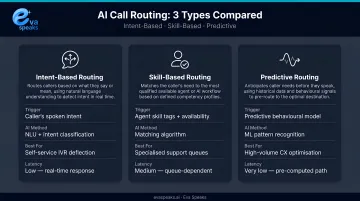
Look for three distinct routing modes:
- Intent-based routing — matches caller purpose to the right queue
- Skill-based routing — connects to agents with specific expertise
- Predictive routing — uses historical data to maximize outcomes like FCR or CSAT
Customizable Call-Flow Scripting
Not every business has the same call structure. The ability to define conditional routing logic, branching flows, and escalation triggers — without developer involvement — is a real differentiator, especially for SMBs. Eva Speaks addresses this with configurable call-flow scripts and LLM-integrated routing that businesses can tailor to their operations. This is one area where purpose-built platforms like Eva Speaks have a practical edge over larger enterprise suites — the configuration layer is designed to be managed by operations teams rather than requiring ongoing engineering support.
Want a workflow designed for your specific call types? Get a Customized Workflow Recommendation
CRM Integration Depth
AI routing is only as smart as the data it can access. There's a meaningful difference between "integration available" and "native, bidirectional integration."
Platforms that read and write to your CRM in real time let agents pick up calls with full customer context already loaded — no manual lookups, no repeated questions. Confirm the integration direction before committing to any platform.
Scalability and Compliance
Ask vendors directly:
- How does the platform handle peak call volume spikes?
- What is the uptime SLA?
- Which compliance certifications are in place — SOC 2, HIPAA, GDPR?
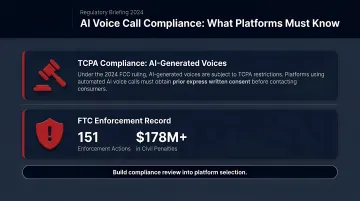
For US businesses running outbound calling, TCPA compliance is non-negotiable. The FCC ruled in 2024 that TCPA restrictions on artificial or prerecorded voice calls explicitly include AI-generated voices.
The FTC has brought 151 enforcement actions tied to robocall and Do Not Call violations, resulting in more than $178M in civil penalties. Build compliance review into your platform selection process, not as an afterthought.
See how AI keeps calls covered after hours too. See How AI Handles After-Hours Calls
How We Chose the Best AI Call Center Platforms
Each platform on this list was assessed against the criteria that actually determine fit — not just feature counts. Evaluation covered real-world voice call performance (not demo quality), routing intelligence across intent-based, predictive, and skill-based modes, CRM integration depth, pricing transparency, and suitability across business sizes.
Common buyer mistakes to avoid:
- Shortlisting on price alone without testing live call behavior
- Getting won over by polished demos that don't reflect off-script conversations or concurrent call loads
- Conflating "integration available" with deep, bidirectional data sync
- Treating analyst recognition as a proxy for fit (a Gartner Leader can still be the wrong choice for an SMB)
G2 ratings, publicly documented starting prices, and verified customer reviews were referenced throughout.
On G2's methodology: Every review must come from a verified user at a verified company with confirmed software experience. G2 also applies daily decay to older reviews, which means its scores reflect current user sentiment rather than accumulated legacy ratings — a more reliable third-party signal than vendor self-reporting.
Conclusion
The right AI call center platform isn't the one with the most features — it's the one whose routing intelligence, voice quality, integration depth, and pricing model fit your actual operations and growth path.
Before committing to any platform:
- Map your routing complexity and call volume patterns
- Identify compliance requirements specific to your industry
- Demand live demos under real traffic, not scripted walkthroughs
- Confirm CRM integration is bidirectional, not read-only
For US businesses looking for an AI-powered communication solution with customizable call-flow scripts, real-time AI responses, and LLM-integrated routing, Eva Speaks offers a purpose-built option worth exploring — purpose-built for businesses that need capable AI call handling without the complexity or cost of legacy cloud contact center platforms. Contact Eva Speaks directly to see how its routing and automation capabilities map to your specific call operations.
Watch the full AI call flow from start to finish. Watch AI Call Flow Demo
Frequently Asked Questions
What is AI call routing?
AI call routing uses real-time intent detection, NLP, and predictive analytics to automatically direct each incoming call to the most appropriate agent, team, or AI voice agent. It replaces static IVR menus with dynamic, outcome-driven routing decisions based on what the caller actually needs.
Can you use AI to answer phone calls?
Yes. AI voice agents powered by LLMs and speech recognition can handle inbound calls end-to-end for tasks like FAQs, appointment booking, lead qualification, and status updates. They escalate to human agents when the caller asks to speak with someone or when the AI can't resolve the query.
How can AI be used in call centers?
The main use cases are voice automation for routine inbound and outbound calls, intelligent routing, real-time agent coaching, post-call analytics, and automated quality assurance. Most modern platforms run several of these simultaneously.
What AI call center platforms have the highest automation rates?
Platforms like Retell AI, Genesys Cloud CX, and Talkdesk are commonly cited for high automation rates in production environments. Actual automation rates depend heavily on call type complexity, routing logic quality, and how thoroughly the AI has been trained on that business's specific use cases.
What is the best conversational AI platform for customer support?
It depends on scale. Genesys and Talkdesk lead for enterprise operations; Dialpad suits mid-market teams that need AI-native features with minimal setup. Eva Speaks is designed for businesses that need configurable LLM-integrated call flows without enterprise-level complexity.
Which platforms offer CRM integration for AI call centers?
Talkdesk, Genesys, and Dialpad all offer CRM connectivity. The depth of that integration — read-only versus real-time bidirectional data sync — varies significantly by platform and pricing tier.