
That's where virtual office services come in. But not all providers are built the same. Pricing structures, mail handling quality, location networks, and contract terms vary enough that the wrong choice costs real money — and sometimes credibility with banks or state filing offices.
This post compares the top four virtual office services in 2026 — Alliance Virtual Offices, Regus, Davinci Virtual Office Solutions, and Opus Virtual Offices — evaluated on the factors that actually matter for day-to-day business operations.
Key Takeaways
- Virtual office services provide a commercial street address, mail handling, and optional phone/receptionist services — no lease required.
- Each of the four leading providers in 2026 targets a different need: Alliance for network scale, Regus for workspace access, Davinci for call intake, and Opus for flat-rate value.
- The metrics that matter: address credibility, CMRA compliance, mail handling reliability, pricing transparency, and contract flexibility.
- Businesses wanting to go beyond a standard receptionist can layer AI-powered call handling — like Eva Speaks — on top of any virtual office plan.
What Is a Virtual Office?
A virtual office is a service that gives your business a real commercial street address, mail handling, and optional phone and workspace services — without requiring you to sign a physical office lease.
Core Services Typically Included
Depending on the plan and provider, virtual office services cover:
- Business address for LLC registration, correspondence, and marketing
- Mail receipt and forwarding (daily, weekly, or on-demand)
- Dedicated business phone number and live or AI-powered call answering
- On-demand meeting room access at partner locations
Who Benefits Most
Virtual offices work particularly well for:
- LLCs and corporations needing a registered street address in a specific state or city
- Remote-first teams and solo founders who don't need daily office access
- Consultants and e-commerce operators wanting a professional presence without overhead
- Out-of-state businesses expanding into new US markets
The right provider depends on which combination of these services your business actually needs. The four options below differ significantly in pricing, mail handling speed, and call coverage — so the breakdown ahead focuses on those specifics.
Discover how AI handles calls for businesses like yours. Explore AI Call Automation
Top 4 Virtual Office Services in 2026
Each provider below was evaluated on address credibility, service completeness, pricing transparency, contract flexibility, US location network size, and customer trust. The breakdown is consistent across all four for easy comparison.
Alliance Virtual Offices
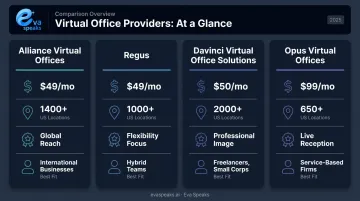
Alliance operates one of the largest US-based virtual office networks, with 1,400+ locations in recognized commercial business districts. All locations are CMRA-registered, meaning they satisfy USPS standards — and the address holds up for LLC registration, bank account verification, and professional licensing.
What sets Alliance apart is operational completeness. Pricing is published without a quote process, the service suite (address, mail handling, live receptionist, meeting rooms) is managed from a single dashboard, and multi-location support is built in for businesses expanding into new markets.
One thing to note: Alliance's terms state an initial six-month commitment, after which plans renew month-to-month. They also note they cannot guarantee address acceptance by all third parties, including banks.
| Feature | Details |
|---|---|
| Key Services | Business address, mail receipt, mail forwarding, live receptionist (add-on), on-demand meeting rooms |
| Starting Price | From $48/month (address); live receptionist from $125/month |
| Contract Terms | 6-month initial term, then month-to-month |
| Best For | Solopreneurs, attorneys, consultants needing a large US location network with scalable services |
Regus
Regus is the largest flexible workspace provider globally, with 1,872 US locations and 4,000+ locations worldwide under parent company IWG. Virtual office plans include address services and phone handling, but the real value proposition is access to their physical workspace network — coworking spaces, private offices, and meeting rooms across hundreds of cities.
For businesses that only need a mailing address, that infrastructure comes at a cost. Pricing runs on a per-day model (from $2/day for address services in LA and Chicago), and discounted rates apply for commitments of six months or longer. Where Regus earns its price is when physical workspace is a regular need — not an occasional one.
| Feature | Details |
|---|---|
| Key Services | Business address, mail handling/forwarding, call answering (add-on), global workspace/meeting room access |
| Starting Price | From $2/day for address in major US metros; call answering from $4/day |
| Contract Terms | Month-to-month or longer; discounts for 6+ month commitments |
| Best For | Businesses that regularly need physical desk or office access across multiple cities or countries |
Davinci Virtual Office Solutions
Davinci specializes in live receptionist and call answering services, with particular depth for legal, consulting, and finance clients. The platform partners with office locations nationwide and lets customers build customized service packages.
The differentiator here is phone intake quality. Davinci's live receptionist infrastructure includes call answering, call screening, call forwarding, and appointment scheduling on higher tiers. Base virtual address plans start at $49/month, while live receptionist plans begin at $129/month for 50 answered minutes.
The a-la-carte model is both strength and limitation — you only pay for what you use, but total monthly cost scales quickly once you add mail forwarding, receptionist minutes, and phone services together.
| Feature | Details |
|---|---|
| Key Services | Business address, mail receipt/sorting/storage, mail forwarding, live receptionist (add-on), meeting room access |
| Starting Price | Address from $49/month; Business 50 receptionist plan at $129/month |
| Contract Terms | No long-term commitment stated for receptionist plans |
| Best For | Law firms, consultants, and financial advisors that prioritize live phone intake and client-facing meetings |
Watch how AI receptionist calls flow in real time. Watch AI Call Flow Demo
Opus Virtual Offices
Opus takes a different approach: one flat monthly rate that bundles the core services most small businesses actually need. For $99/month, the all-inclusive plan covers a business address, dedicated local phone and fax number, unlimited live receptionist answering, call transfers, and voicemail-to-email — with no long-term contract required.
The appeal is a predictable bill with no per-minute charges or surprise add-ons. The location network is smaller — 650+ locations nationwide — and premium add-on services are limited compared to Alliance or Regus. For small businesses and startups that want everything covered at a fixed monthly rate, that's a trade-off most will take willingly.
| Feature | Details |
|---|---|
| Key Services | Business address, mail receipt, dedicated phone/fax number, unlimited live answering, call transfers, voicemail/fax-to-email |
| Starting Price | $99/month all-inclusive |
| Contract Terms | No long-term contracts, no hidden fees |
| Best For | Small businesses and startups wanting all-in-one virtual office coverage at a flat, transparent rate |
How We Chose the Best Virtual Office Services
The evaluation criteria focused on what actually creates problems for businesses — not just which provider has the best marketing copy.
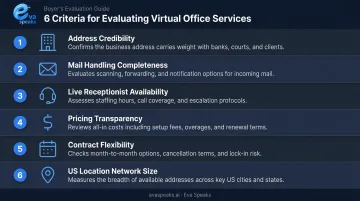
The Six Criteria That Mattered
- Address credibility — Is the address in a staffed commercial building or a retail mailbox store? CMRA-registered addresses (compliant with USPS Form 1583 requirements) are the standard to meet.
- Mail handling completeness — Does the plan cover receipt, scanning, and forwarding, or just receipt notification?
- Live receptionist availability — Is answering included, a paid add-on, or billed per minute?
- Pricing transparency — Are setup fees, forwarding charges, and overage costs disclosed upfront?
- Contract flexibility — Can you cancel month-to-month, or are you locked into a multi-month commitment?
- US location network size — Does the provider have coverage in the specific cities you need?
Common Mistakes to Avoid
Many businesses run into trouble by comparing only headline prices without accounting for add-on fees. A $49/month address plan can easily become $200+/month once mail forwarding, a phone number, and receptionist minutes are added.
Two other frequent oversights:
- Skipping CMRA verification — Not all virtual addresses are at CMRA-registered locations. According to the USPS, customers receiving mail through an agent must complete PS Form 1583 and provide two forms of ID, including one photo ID. If your provider isn't CMRA-compliant, your mail handling may not hold up for LLC registration or banking.
- Signing annual contracts without confirming meeting room availability — Some providers advertise meeting room access that's limited or unavailable in specific cities.
How AI, Hybrid, and Traditional Phone Answering Compare
Here is how AI-powered, hybrid, and fully human virtual office phone answering services compare:
| AI-Powered (EvaSpeaks) | Hybrid (Live + AI) | Traditional Live Answering | |
|---|---|---|---|
| Features | Fully automated conversations, scheduling, 24/7 | Human agents with AI assist | Human agents only |
| Best-fit Business Size | Remote-first SMBs | Growing businesses | Professional services firms |
| Key Strengths | No overage risk, instant setup, scales infinitely | Human for complex calls | Strongest human touch |
| Implementation Complexity | Low - no-code | Low | Low |
| Integration Capability | CRM, scheduling systems | Varies | Manual or limited API |
Where AI Call Handling Fits In
Call handling is the one area these criteria don't fully capture — and it's where per-minute receptionist plans tend to break down. For businesses with high call volumes or specific routing needs, the inconsistency becomes a real operational problem.
One option worth knowing about: AI-powered call handling can be layered on top of any virtual office setup as a standalone service. Eva Speaks handles call answering with real-time conversational AI, configurable routing rules, customizable call-flow scripts, and routing rules, and LLM integration. It works independently of whichever virtual office provider you choose. Because it doesn't require you to change your phone number or virtual office provider, it's a practical upgrade for businesses that want AI-quality call coverage without restructuring their existing setup.
See it in action with your actual call scenarios. Request Live Demo
Conclusion
The best virtual office provider isn't the one with the lowest price or the biggest brand — it's the one whose location network, service depth, pricing structure, and contract terms match how your business actually operates.
Before deciding, assess three things:
- Does the address satisfy your LLC registration and banking requirements? (CMRA-registered locations are the safer choice.)
- Will mail and call handling work reliably without manual intervention?
- Can the plan scale — more locations, more services — without forcing you to switch providers in 12 months?
Call handling is often where virtual office plans fall short. If a basic receptionist plan isn't cutting it, Eva Speaks offers AI-powered call answering, routing, and transcription that connects directly with your existing workflows — without the response gaps or inconsistencies that come with human-only coverage.
Not sure which option fits your team? Talk to an AI Communication Expert
Frequently Asked Questions
Does the IRS accept a virtual office address?
Form SS-4 for EIN registration requires both a mailing address and a physical location — real street addresses, not P.O. boxes. Virtual office addresses at staffed office buildings typically satisfy this requirement, but confirm your specific filing details before applying.
Can I use a virtual office address to register my LLC?
Most states accept a commercial street address for LLC registration, and virtual office addresses at staffed office buildings generally qualify. Requirements are state-specific — Florida and California require a street address for the principal office, not a P.O. box.
What is typically included in a virtual office plan?
Standard inclusions are a commercial business address and mail receipt with forwarding notification. Depending on the plan, you may also get a business phone number, live call answering, and on-demand meeting room access — though these are often add-ons rather than base inclusions.
How much does a virtual office cost per month?
Entry-level address-only plans typically start around $49–$99/month. Plans that bundle live receptionist services run higher — often $125–$200+/month depending on the minutes tier. Always check for setup fees and per-piece mail forwarding charges beyond the base rate.
Is a virtual office address the same as a registered agent?
No — these are two distinct services. A virtual office provides a mailing and business address for general correspondence, while a registered agent is a legal requirement for receiving official state and legal documents at a staffed physical address during business hours. Some providers offer both, but they are never interchangeable.
Can I use a virtual office address for a business bank account?
Most banks require a street address under FinCEN's Customer Identification Program rules. CMRA-registered virtual office addresses at staffed office centers are generally more accepted than retail mailbox store addresses — but bank policies vary. Confirm with your specific bank before submitting an application.