Introduction
Speed is the variable most sales teams underestimate. According to a Harvard Business Review audit of 2,241 U.S. companies, only 37% responded to leads within one hour, and companies that did were nearly 7x more likely to qualify those leads than those who waited longer. The average response time was 42 hours — by which point most prospects have moved on.
Traditional reception compounds the problem. Human reps miss after-hours calls, skip qualifying questions during busy periods, and take incomplete notes that never reach the CRM. The result: inconsistent lead data, lost deals to faster competitors, and sales reps following up blind.
An AI virtual receptionist closes each of these gaps. It handles inbound calls at any hour, runs a structured qualification conversation, scores intent in real time, and syncs the complete record to your CRM before the call ends.
This guide covers the core features to look for, how they function together during a live call, and the configuration decisions that determine whether your AI receptionist qualifies leads or just answers the phone. Businesses ready to see AI lead qualification in action can Explore AI Call Automation before reading the feature breakdown.
Key Takeaways
- An AI virtual receptionist qualifies leads through intelligent conversation — scoring intent, routing based on criteria, and syncing data to your CRM automatically
- Features that matter: dynamic questioning, real-time lead scoring, CRM integration with transcription, 24/7 availability, and human escalation protocols
- Configuration determines results — the AI only qualifies leads against the criteria you define upfront
- Research from Wu et al. (2023) found companies using structured lead scoring can see up to a 70% increase in lead-generation ROI
What Is an AI Virtual Receptionist for Lead Qualification?
An AI virtual receptionist is a system that handles inbound calls, engages callers in natural conversation, extracts qualification data through structured dialogue, and routes the lead to the right rep — all without human involvement.
Unlike a basic call-screening tool, it functions as a complete qualification layer — capturing intent signals, making routing decisions, and delivering a scored, documented lead to the sales team before any rep picks up the phone.
The Difference From Legacy IVR
Traditional IVR systems operate on decision trees. The caller hears "press 1 for sales, press 2 for support" and navigates menus until they reach a destination. The system doesn't understand what they're saying — it just registers keypad inputs.
Modern AI receptionists work differently:
- Interpret spoken intent rather than waiting for menu selections
- Ask follow-up questions based on what the caller just said
- Adjust conversation paths dynamically rather than following a fixed script
- Understand context across multiple turns in the same call
In practice, an IVR routes a caller to a sales queue. An AI receptionist determines whether that caller is worth routing to sales at all — and gathers the data your rep needs before the transfer happens.
The Role of LLMs
Large language models power the shift from rule-based IVR to genuine conversational AI. As IBM defines them, LLMs are AI systems that understand and generate human language by processing large language datasets using transformer-based architectures.
In a live qualification call, LLM integration enables three things a decision tree cannot:
- Context retention — the AI remembers what was said two minutes ago and references it when asking follow-up questions
- Intent interpretation — it understands that "we've been looking at this for a while" signals a different urgency level than "we need to implement this by Q3"
- Dynamic response generation — rather than retrieving a canned answer, the AI formulates a relevant follow-up in real time
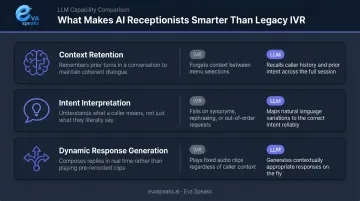
Eva Speaks combines LLM processing with speech-to-text (STT) and text-to-speech (TTS) so the system can interpret caller intent, respond naturally, and capture qualification data — all within a single live call.
Core Lead Qualification Features Every AI Receptionist Should Have
Intelligent Conversation Design and Dynamic Questioning
The foundation of any qualification system is the conversation itself. Dynamic questioning means the AI's next question depends on the caller's previous answer — not on a fixed sequence that plays the same way regardless of who's calling.
How call-flow branching works in practice:
- A caller mentions a tight budget → the AI branches to a path exploring timeline and decision criteria rather than upselling scope
- A caller identifies as the final decision-maker → the AI moves directly to budget and implementation timing
- A caller says they're still researching → the AI captures contact information and routes to a nurture workflow
Eva Speaks supports customizable call-flow scripts and routing rules, allowing businesses to map these branches to their specific sales process. The key is defining the branch conditions before deployment — the AI executes the logic you've configured.
LLM context retention in a qualification call:
A rigid script asks qualifying question 3 without remembering the answer to qualifying question 1. An LLM-backed system doesn't have that problem. If a caller mentions a bad experience with a previous vendor early in the call, the AI can reference that pain point when probing for urgency later — rather than treating each question as an isolated exchange.
Callers give more honest, detailed answers when the conversation feels like a dialogue rather than a survey — and that honesty is what makes qualification data reliable.
Real-Time Lead Scoring and Intelligent Routing
Post-call lead scoring is useful. Real-time scoring during the call is what determines where that caller goes before they hang up.
Intent signals an AI receptionist can score in real time:
- Budget language ("we have budget allocated" vs. "we're just exploring costs")
- Timeline cues ("we need this running by next month" vs. "maybe next year")
- Role indicators (decision-maker vs. researcher vs. influencer)
- Urgency markers (describing an active problem vs. general curiosity)
- Company size or context signals that indicate deal potential
These signals map closely to the BANT framework — Budget, Authority, Need, Timeline — the standard framework for prioritizing leads worth pursuing.
Routing logic based on score:
| Lead Score | Routing Action |
|---|---|
| High intent (hot lead) | Immediate live transfer to sales rep |
| Moderate intent (warm lead) | Appointment booking or automated follow-up sequence |
| Low intent / unqualified | Informational response or nurture enrollment |
| Complex scenario | Human escalation trigger regardless of score |
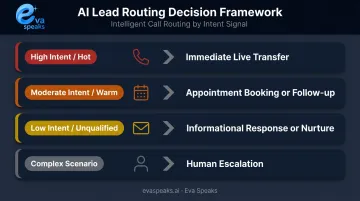
Hot leads that sit in a queue for 24 hours aren't hot anymore — routing logic is where qualification either pays off or falls apart. You can Watch AI Call Flow Demo to see how real-time intent scoring drives the routing decision during a live call.
Here is how AI virtual receptionist lead qualification compares to traditional IVR and human receptionist approaches:
| EvaSpeaks AI Receptionist | Traditional IVR | Human Receptionist | |
|---|---|---|---|
| Features | Real-time scoring, dynamic questions, instant CRM push | Fixed script, DTMF input | Flexible, judgment-based |
| Best-fit Business Size | SMB to mid-market | Large enterprise | Very small businesses |
| Key Strengths | 24/7, consistent scoring, instant routing | Familiar, widely deployed | Human judgment, relationship |
| Implementation Complexity | Low - no-code setup | High - IT-dependent | None (hire) |
| Integration Capability | Native CRM, scheduling sync | Custom dev required | Manual CRM entry |
CRM Integration, Call Transcription, and Data Sync
A qualification call that doesn't produce a usable CRM record is essentially a phone call with no paper trail. The data captured during the conversation needs to be structured, synced, and accessible to the rep who follows up.
Bidirectional sync vs. one-way logging:
Most basic integrations push call data into the CRM after the call ends. Bidirectional sync goes further — the AI also pulls existing customer context from the CRM before or during the call, so a returning prospect isn't treated as a cold caller. That context can shape the conversation without the rep being present.
Full call transcripts do more than create an audit trail. They give the sales rep the complete picture before the follow-up conversation — what the caller said, what they asked, and where they hesitated.
EvaSpeaks combines AI call handling with transcription to build this qualification record automatically. When a rep opens the CRM and sees the full transcript alongside budget mentions and a lead score, they skip the re-introduction and go straight to the relevant solution. EvaSpeaks handles this bidirectionally — pulling existing CRM context into the call before it starts and writing the structured output back when it ends, which means lead qualification data stays synchronized without any manual entry step.
This directly addresses a documented productivity problem: Salesforce research from 2022 found sales reps spent only 28% of their week actually selling, with the rest consumed by administrative work including manual data entry. Automated transcription and CRM sync removes one of the most common contributors to that burden.
How These Features Work Together in a Real Qualification Conversation
Consider a concrete scenario: a prospective customer calls at 9 p.m. on a Thursday. No human receptionist is available. Without an AI receptionist, that call either goes to voicemail (which fewer than 3% of missed callers leave) or goes unanswered entirely.
With Eva Speaks handling the call, the qualification process begins immediately.
From First Contact to Qualified Lead
The sequence in a well-configured system:
- Greeting and intent detection — the AI greets the caller professionally, identifies call purpose through natural language, and routes to the appropriate call-flow path
- Dynamic questioning — the AI selects the right branch and gathers qualification data: role, need, timeline, budget range
- Context retention — earlier answers inform follow-up questions, keeping the dialogue coherent
- Real-time scoring — the AI weights and scores intent signals in the background throughout the conversation
- Routing decision — the score and signal combination triggers the appropriate action: live transfer, appointment booking, or nurture enrollment
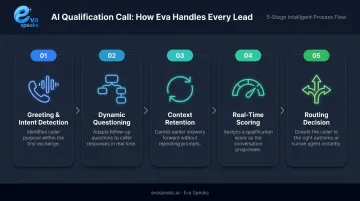
Why response latency matters here:
Each stage of this sequence depends on the AI responding quickly enough that the conversation feels natural. Research on conversational AI indicates that delays beyond 700ms affect perceived naturalness. For a qualification call, a perceptible pause after every question doesn't just feel awkward — it erodes caller confidence and increases the likelihood they disengage before the AI captures the data it needs.
Real-time response processing is a functional requirement for this kind of conversational qualification — not a performance nicety.
After the Call: What a Complete Qualification Record Looks Like
By the time the call ends, a well-configured AI receptionist should have produced:
- Contact information captured from the conversation
- Full call transcript with the complete dialogue preserved
- Assigned lead score based on the signals detected during the call
- Key intent signals identified — budget range mentioned, timeline stated, role confirmed
- Defined next step — appointment booked, rep alerted, or nurture sequence triggered
When that record is waiting in the CRM Friday morning, the sales rep isn't starting cold. They already know the caller's stated problem, their budget range, and whether they're a decision-maker — context that removes the "can you remind me why you called?" dynamic before the pitch even begins. Sales teams that want a qualification workflow built around their specific criteria can Get a Customized Workflow Recommendation.
How to Set Up Your AI Receptionist for Smarter Lead Qualification
How well your AI receptionist qualifies leads depends entirely on how well it's configured. Without clear qualification parameters, the system has nothing to work from — and you'll get inconsistent results regardless of the technology behind it.
Defining Your Qualification Script
Start with your actual sales qualification criteria, not a generic template. The most widely used framework is BANT: Budget, Authority, Need, Timeline. For enterprise deals, MEDDIC (Metrics, Economic Buyer, Decision Criteria, Decision Process, Identify Pain, Champion) provides more depth.
Sequencing logic for call-flow scripts:
- Lead with the question most likely to disqualify poor-fit leads early — this saves time on both sides
- Reserve deeper discovery questions for callers who pass the initial filter
- Map each answer to a branch: what happens if they say yes, what happens if they say no
Example branching structure:
- Caller identifies as decision-maker → branch to budget and timeline questions
- Caller identifies as researcher → capture contact info, route to nurture workflow
- Caller mentions enterprise-scale need → trigger high-priority routing path
Eva Speaks' customizable routing rules allow businesses to map these branches to their specific sales process, so the right signals reliably reach the right outcome.
Configuring Routing Rules and Escalation Triggers
Once the script is defined, routing rules determine what happens with each outcome. Setting score thresholds requires judgment — and then testing against real call data to refine them.
Routing threshold guidance:
- Set initial thresholds conservatively (lower score = human review) until you have call data to calibrate against
- Review the first 50–100 calls to identify where the AI is routing correctly versus where edge cases are falling into the wrong bucket
- Adjust thresholds based on conversion outcomes, not just routing counts
Hard-coded escalation triggers (never leave these out):
Certain scenarios should always transfer to a live rep regardless of lead score:
- Expressed urgency or distress (caller describes an active crisis or emergency)
- Complex objections that require consultative handling
- High-ticket signals that indicate enterprise deal potential
- Repeat callers with unresolved open issues
- Any indication the caller is confused or frustrated with the automated process
Hard-coding these triggers into your escalation logic protects both the lead and the brand. A high-value prospect who hits a dead-end because the scoring model didn't account for their situation is a missed deal that proper configuration would have caught.
Common Lead Qualification Pitfalls and How AI Addresses Them
Pitfall 1: Your reps don't ask the same questions
Human receptionists skip questions when call volume spikes, ask them in different orders, and use different language to describe what they heard. The result is lead data that can't be compared across calls and qualification outcomes that depend more on who answered the phone than on what the caller said.
AI enforces a consistent structured conversation every time, regardless of call volume or time of day:
- Same questions, same sequence
- Same scoring criteria applied to every caller
- No variation based on rep mood, workload, or experience level
Pitfall 2: After-hours calls go nowhere
ServiceTitan's analysis of over 3,000 trade businesses found that call booking rates drop from a 61% peak to 21% after 6 p.m. for larger businesses. The problem isn't just that fewer calls come in after hours — it's that the ones that do come in have nearly zero chance of being qualified and converted without an AI system in place.
CallRail's 2025 survey of 1,000 U.S. consumers found 52% believe companies using AI assistants after hours provide superior service — and 82% said they would call a competitor if a business doesn't answer. The after-hours call isn't a low-priority edge case. It's a competitor referral waiting to happen.
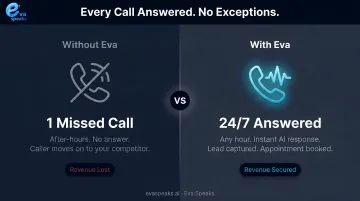
The businesses losing most leads from the after-hours gap can See How AI Handles After-Hours Calls to see exactly what capture looks like when no human is on duty.
Pitfall 3: Notes don't make it into the CRM
Manual note-taking is unreliable. Reps forget details, abbreviate context, and sometimes don't log anything at all. Gartner research from 2020 found that poor data quality costs organizations at least $12.9M per year on average — and incomplete post-call notes are one of the most consistent contributors.
AI-driven transcription and automatic CRM sync close this gap. The full conversation record lands in the system the moment the call ends — no rep action required, no context lost.
Frequently Asked Questions
How does an AI virtual receptionist assist in lead qualification?
It engages callers in structured conversation, extracts qualifying information through dynamic questioning, and scores intent in real time based on signals like budget, timeline, and role. Based on that score, it routes the lead: transferring hot leads immediately, booking appointments, or enrolling callers in follow-up sequences, all without human involvement.
What skills does an AI virtual receptionist need?
The core capabilities required are natural language understanding, context retention across a multi-turn conversation, configurable question logic, CRM integration, and the ability to make real-time routing decisions based on lead scoring rules. Without all five, the system handles calls but doesn't genuinely qualify them.
What are the most important lead qualification features to look for?
Dynamic questioning, real-time lead scoring, bidirectional CRM sync, call transcription, 24/7 availability, and human escalation protocols are the non-negotiable features. A system missing any of these is answering calls — not qualifying them.
How does an AI virtual receptionist integrate with a CRM?
Basic integrations push call data into the CRM after the call ends. Bidirectional sync goes further: it automatically creates or updates a lead record with the transcript, lead score, and intent signals the moment the call concludes, while pulling existing context into live conversations for returning callers.
Can an AI virtual receptionist handle complex or nuanced qualification conversations?
LLM-powered AI receptionists handle multi-turn, contextual conversations well for most standard qualification scenarios. Highly consultative situations — complex objections, sensitive accounts, or deals requiring judgment calls — are better served by a well-configured escalation trigger that hands off seamlessly to a live rep rather than asking the AI to handle what it wasn't built for.