AI receptionists solve this. They handle inbound calls, triage support requests, escalate emergencies, and create PSA tickets automatically — without a human picking up the phone. This guide covers what an MSP AI receptionist actually does, what it costs, how PSA integration works, and how to evaluate and deploy one without disrupting your operations.
Key Takeaways
- True 24/7 human coverage requires ~5.4 FTEs per seat, costing $285K–$562K annually
- AI receptionist solutions run $79–$295/month — a fraction of either staffing alternative
- Core capabilities: zero-missed-call handling, automatic ticket creation, emergency escalation, and concurrent call capacity
- PSA integration (ConnectWise, Autotask, HaloPSA) is well-supported via REST API
- Phased rollout (after-hours first, then overflow, then full primary reception) reduces deployment risk
What Is an AI Receptionist for MSPs?
An AI receptionist for MSPs is an LLM-powered virtual assistant that answers inbound calls, collects caller information, triages support requests, routes emergencies, and creates tickets in your PSA — all without human intervention. That last part is what separates it from an auto-attendant or IVR system. A traditional IVR presents a menu and waits for a keypress. An AI receptionist holds a real, multi-turn conversation.
How MSP Calls Differ from Other Industries
MSP callers don't call to ask about hours or place orders. They call to report broken things, often under stress, using technical language. The AI needs to:
- Understand IT terminology ("server down," "VPN won't connect," "email's not syncing")
- Triage based on urgency and client tier — not just forward to voicemail
- Log the interaction in ConnectWise, Autotask, or HaloPSA, not a generic CRM
That's a different use case entirely from a dental office AI handling appointment bookings.
The Technology Behind It
Modern MSP AI receptionists layer several technologies:
- Natural language processing (NLP) to interpret caller speech accurately
- LLM-based conversation handling to manage multi-turn exchanges with context retention
- Real-time integration layers that connect the AI to PSA and CRM systems
EvaSpeaks, for example, builds its call handling on LLM integration with real-time AI response generation and full call transcription. For MSPs, where every interaction needs to be logged and auditable, those aren't optional features. EvaSpeaks is also designed to be business-friendly in deployment: its configurable call-flow scripts and routing rules can be set up by operations staff without development resources, which matters for MSPs whose technical team's time is better spent on client infrastructure than internal tooling.
Why Traditional MSP Coverage Models Are Holding You Back
The Real Cost of 24/7 Human Staffing
Most MSPs underestimate what genuine 24/7 coverage actually requires. You can't cover 168 hours a week with three employees on rotating shifts — not once you account for days off, vacation, sick leave, and training.
A shift-relief factor model from the Oklahoma Department of Corrections calculates 5.37 FTEs to keep one seat staffed around the clock. Apply that to BLS wage data and account for the fact that wages represent 70.1% of total employer compensation costs (with benefits making up the remaining 29.9%), and the math becomes uncomfortable:
| Coverage model | Base payroll (5.37 FTEs) | Approx. annual total cost |
|---|---|---|
| 24/7 receptionist desk | $37,230 × 5.37 | ~$285,000 |
| 24/7 user support desk | $60,340 × 5.37 | ~$462,000 |
| 24/7 network support desk | $73,340 × 5.37 | ~$562,000 |
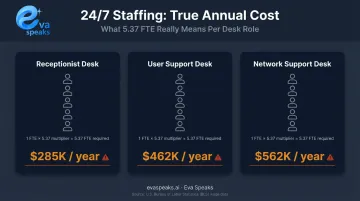
These figures exclude management overhead, recruitment, workspace, tooling, and turnover costs — all recurring line items that compound over time.
Outsourced NOC services reduce the direct employment burden, but they come with their own friction:
- Brand inconsistency when offshore teams handle client-facing calls
- Communication gaps that slow escalation and resolution
- Variable per-ticket fees that make costs unpredictable at scale
The Scalability Problem
Every new client adds call volume, but adding another receptionist is a fixed cost jump. You can't hire 0.3 of a person — so headcount-based coverage doesn't scale gracefully.
Kaseya's 2024 MSP Benchmark Survey, covering 984 respondents (65% MSPs), found that 60% cited automation as the most important RMM feature, and ticketing topped PSA feature priorities for 75% of executives. The data reflects where MSP leadership is putting its priorities: scalable, automated communication infrastructure over expanded headcount.
After-hours coverage compounds the problem. Evenings, nights, and weekends represent the majority of coverage hours but a smaller slice of total call volume. Staffing those hours with humans is the least efficient use of your labor budget.
See how AI receptionists handle calls for MSP clients. Explore AI Call Automation
Core Features of an MSP AI Receptionist
24/7 Inbound Call Handling with Intelligent Triage
The AI answers every call immediately. No hold time, no busy signal. It identifies the caller's issue, determines urgency based on configurable rules, and routes accordingly.
The difference between a server outage and a password reset determines whether you page an on-call engineer at 2 a.m. or queue a ticket for morning. A well-configured AI receptionist knows the difference and acts on it automatically.
Zero missed calls means zero SLA violations from unanswered contact.
Automatic Ticket Creation
During the call, the AI captures client identity, issue description, and priority level, then creates a fully populated ticket in the PSA within seconds of call completion. No one transcribes the call. No one opens ConnectWise and fills in fields.
According to vendor benchmarks from TeamDynamix, AI-assisted ticket handling can save 4–7 minutes per ticket and deflect 30–60% of incoming tickets entirely. For an MSP processing dozens of tickets daily, that adds up to hours of technician time recovered each day.
Emergency Escalation Protocols
When a caller says "server is down" or "we have a complete outage," the AI doesn't log it and move on. It:
- Recognizes the urgency signal in the caller's speech
- Asks qualifying follow-up questions to confirm severity
- Pages the on-call technician via SMS or phone with full call context attached
The technician gets the situation summary before they call back — cutting out the back-and-forth "what's the issue?" exchange that wastes critical minutes during actual emergencies.
Concurrent Call Handling
A human receptionist manages one call at a time. An AI receptionist handles unlimited simultaneous calls. During high-volume periods (patch cycles, network outages, new client onboarding) every caller gets an immediate response instead of voicemail.
Call Transcription and Documentation
Every interaction is recorded, transcribed, and logged automatically. Eva Speaks provides AI-enabled call transcription as a core capability, storing transcripts in U.S. data centers with industry-standard security measures. This creates an auditable record for SLA reporting, quality review, and client dispute resolution with no manual note-taking required.
Hear how AI handles real support calls. Listen to Sample AI Call
Cost Savings and ROI for MSPs
Put the three staffing options next to each other and the numbers make the decision clear.
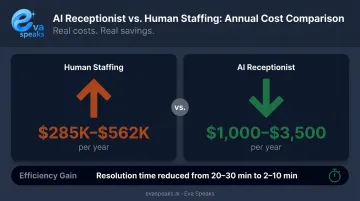
In-house 24/7 NOC staffing — as the staffing model above shows — runs $285K to $562K annually in total employment costs, before management overhead and turnover.
Outsourced NOC services reduce direct employment costs but introduce their own expenses. Pricing models vary (per-device, per-user, per-ticket), and reputable industry sources describe the structures without publishing concrete dollar ranges. The tradeoffs include:
- Quality control issues with third-party call handling
- Communication gaps between outsourced staff and clients
- Limited customization of call-routing behavior
AI receptionist pricing is publicly documented and far lower:
| Vendor | Plan | Monthly cost |
|---|---|---|
| Goodcall | Starter | $79/month |
| Goodcall | Growth | $129/month |
| AgentZap | Starter | $109/month |
| AgentZap | Professional | $295/month |
| Thread (MSP-specific) | AI Essentials | $19/managed customer/month |
For a mid-sized MSP managing 200 endpoints, the annual AI receptionist cost sits in the range of $1,000–$3,500 — compared to the six-figure floor of any human-staffing model.
Most MSPs achieve positive ROI within the first month, particularly when replacing any part-time reception cost. The longer-term gains come from improved SLA compliance, stronger client retention from faster response times, and the ability to redirect labor budget toward revenue-generating technical roles.
PSA Integration and Workflow Automation
PSA integration is what separates an AI receptionist from a glorified answering service. When the connection is native (not a Zapier workaround), tickets appear in your queue within seconds of call completion, fully categorized and attributed to the correct client account.
Verified integration support across major PSA platforms:
- Datto Autotask: Official REST API documentation explicitly supports ticket creation via POST requests, with full Tickets entity documentation available
- HaloPSA: Official API guides cover ticket creation; Rewst documents programmatic HaloPSA ticket workflows that return
ticket_idon completion - ConnectWise PSA: Official Developer Network confirms API and SDK support for connecting processes across ConnectWise PSA — specific endpoint verification is partial but API capability is confirmed
Setup involves API key configuration and three core field mappings:
- Caller identity → client record
- Issue description → ticket summary field
- Priority → triage logic from the call flow
Downstream Automation Benefits
Once the ticket exists, the automation chain continues:
- Automatic priority assignment based on issue type and client SLA tier
- Technician routing based on availability and skill set
- Client notification triggers for status updates
The time savings are real. Pia's case study with Restech (managing 520+ companies) showed resolution time dropping from 20–30 minutes to 2–10 minutes after AI automation was introduced, with the output of four L1 engineers achieved at the cost of two L0 technicians.
That efficiency extends beyond ticketing. CRM integration means caller recognition lets the AI greet returning clients by name, surface account status, and log new prospect details automatically.
Choosing and Implementing an AI Receptionist for Your MSP
What to Look for in an MSP-Specific Solution
Not every AI receptionist is built for MSP workflows. When evaluating options, apply these criteria:
- Native PSA integrations — not just generic API connections that require custom development
- Configurable call-flow scripts that match your service tiers and escalation matrix
- LLM-powered conversation quality — multi-turn capability, not just DTMF prompts
- Transcription and logging for auditability and SLA reporting
- Transparent, scalable pricing that doesn't spike unpredictably with call volume
- Security posture — encrypted call handling, U.S.-based data storage, and documented compliance certifications
Eva Speaks is built around LLM integration, real-time AI responses, and U.S.-based data storage — concrete requirements for MSPs that can't afford ambiguity on performance or data handling.
On compliance: MSPs handle client environments with sensitive data, so vendor vetting matters. Before you sign, confirm the provider holds relevant certifications (SOC 2 is a reasonable baseline) and can hand over documentation on data handling practices — not just a link to a privacy page.
Here is how AI-native, hybrid, and traditional receptionist options compare for managed services providers:
| AI-Native (EvaSpeaks) | Hybrid Live + AI | Traditional Answering Service | |
|---|---|---|---|
| Features | Full AI conversation, CRM sync, ticketing integration, after-hours | Human agents + AI assist | Human agents, message-taking |
| Best-fit Business Size | SMB-to-mid MSPs | Growing MSPs | Any size |
| Key Strengths | Predictable cost, no overages, 24/7, scales with client count | Human judgment when needed | Familiar, low commitment | | Implementation Complexity | Low - PSA and CRM connectors | Low | Low | | Integration Capability | ConnectWise, HubSpot, Salesforce native | Varies by provider | Limited or manual |
A Phased Implementation Approach
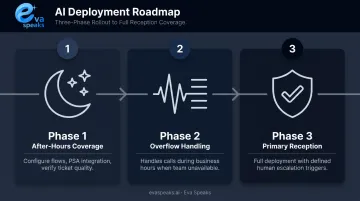
Phased rollout reduces risk and lets your team build confidence in the system before it's handling primary reception.
Phase 1 — After-hours coverage only Configure call flows, populate client names and common issues, complete PSA integration. This phase handles the lowest-risk calls (off-hours, lower urgency) while your team verifies ticket quality and escalation behavior.
Phase 2 — Overflow handling during business hours The AI handles calls when your team is unavailable or on other lines. This tests the system under real business-hours conditions without fully removing the human backup.
Phase 3 — AI as primary reception with human escalation paths Full deployment. The AI handles all inbound with defined escalation triggers for complex scenarios.
Even a well-configured rollout can underperform if these common pitfalls go unaddressed:
- Launching without clearly defined escalation triggers
- Failing to update the knowledge base as clients and services change
- Skipping real-call testing before go-live
- Not reviewing call recordings and SLA data post-launch to refine performance
Post-launch, schedule a monthly review of call recordings and SLA data for the first quarter. That's where most teams catch the gaps that initial configuration missed.
Ready to see it working for your clients? Request Live Demo
Frequently Asked Questions
Can an AI receptionist handle technical MSP support calls effectively?
Modern AI receptionists designed for MSPs are trained on IT terminology and support scenarios. They capture technical details accurately and escalate complex issues to on-call technicians with full context — rather than attempting resolution independently.
How does an AI receptionist integrate with PSA tools like ConnectWise and Autotask?
Native integrations use API connections and field mapping to create fully populated tickets during or immediately after the call. Client lookup, priority assignment, and issue categorization are handled automatically — no manual data entry required.
What happens when the AI can't understand a caller's issue?
Fallback protocols handle these gaps: transferring to a human backup, taking a detailed callback message, or offering alternative contact options. The specific mix depends on how the system is configured for your team's availability.
How do AI receptionists handle after-hours emergencies and critical outages?
The AI detects urgency signals in caller speech, asks qualifying questions to confirm severity, and pages on-call technicians via SMS or phone with full call context — typically within seconds of the call completing.
How much does an AI receptionist cost compared to traditional MSP staffing?
AI receptionist plans run roughly $79–$295/month, versus $285K–$562K annually for genuine 24/7 in-house staffing. Most MSPs see positive ROI within weeks, especially when offsetting part-time reception costs.
Can an AI receptionist handle multiple simultaneous calls during peak periods like Patch Tuesday?
AI receptionists have no limit on concurrent calls — every caller gets an immediate response regardless of spike volume. This eliminates the busy signals and hold times that human-staffed reception cannot avoid during high-demand events.