
Introduction
Monday morning. A product outage hits. Every phone line lights up at once. Agents are mentally juggling three conversations before finishing one, and callers are already 12 minutes into hold — right before they hang up.
High call volume isn't just an inconvenience. It's a structural failure waiting to happen. According to Nextiva's 2025 Customer Patience Benchmark, 54% of inbound callers hang up after 8 minutes on hold — and 28% will abandon your product or service entirely after a missed response window.
The mistake most teams make is treating this as a headcount problem. Hiring more agents doesn't fix the root causes — poor self-service, misrouted calls, no callback options. Those stay intact, and the same crisis repeats next quarter.
This guide covers 7 practical solutions that address volume at its source: reducing unnecessary calls, routing remaining ones intelligently, and scaling capacity with automation. Teams looking to see AI call handling in action can Request Live Demo before diving into the solutions below.
Key Takeaways
- High call volume is typically defined as 10%+ above expected baseline — and it degrades customer experience fast
- Most volume problems stem from structural gaps: absent self-service, clunky IVR, no callback options
- The 7 solutions span three layers: deflection, smarter routing, and AI-powered coverage
- Even 2-3 combined strategies can cut wait times, reduce abandonment, and ease agent burnout
- Start by auditing your call data — match solutions to your top 3 volume drivers
What Is High Call Volume (and Why It Breaks Teams)
Defining the Threshold
High call volume is generally understood as 10% or more above a business's expected inbound baseline — though the practical impact varies considerably by team size. A 10% spike at a 10-agent center is a crisis. At a 500-agent operation with proper forecasting, it's a Tuesday.
What drives those spikes? The usual culprits:
- Seasonal demand surges (tax season, holidays, enrollment periods)
- Product launches or service outages generating reactive inquiry calls
- Policy or pricing changes customers weren't notified about
- Promotions that brought in more customers than the support infrastructure can handle
- Poor or absent self-service — customers calling because there's nowhere else to turn
Understanding what triggers volume spikes makes the instinctive response — adding more agents — worth questioning.
Why Hiring More Agents Rarely Solves It
Adding headcount addresses capacity, not the underlying demand. ICMI's 2025 State of the Contact Center data found that only 14% of contact centers even measure deflection rates — meaning most centers are focused on handling calls rather than preventing unnecessary ones.
The result is a predictable domino effect: longer queues raise frustration, frustrated callers take longer to handle, and longer handle times deepen the backlog. Eventually, callers abandon before connecting. That abandonment typically converts into repeat calls or, in the worst cases, lost customers entirely.
7 Solutions for Managing High Call Volume
These solutions work across three layers: reducing unnecessary calls, routing remaining calls more intelligently, and scaling capacity with automation. You don't need all seven — but understanding the full set helps you match the right fix to your actual problem.
Solution 1: Build Comprehensive Self-Service Resources
The most effective way to reduce call volume is to make calling unnecessary for routine questions. A well-structured knowledge base, FAQ page, and in-product help content can deflect a meaningful share of inbound contacts before they ever reach the queue.
The opportunity here is real. Gartner's 2024 research found that 73% of customers attempt self-service — but only 14% fully resolve their issue there. The most common reason for failure? In 43% of cases, customers simply couldn't find content relevant to their issue.
The fix is content coverage, not a platform upgrade.
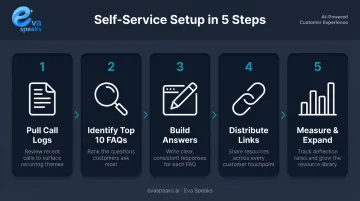
How to start:
- Pull your last 90 days of call logs and tag each call by inquiry type
- Identify the top 10 most frequently asked questions
- Build clear, findable answers for those 10 questions first
- Link to that content from your IVR greeting, website header, and email signatures
- Measure containment rate monthly and expand coverage as call patterns shift
The goal isn't to build a comprehensive encyclopedia on day one — it's to eliminate the calls that should never have happened. For teams ready to layer AI handling on top of a solid self-service foundation, you can Explore AI Call Automation to see what a full automation stack looks like.
Solution 2: Set Up Smart Call Routing and IVR
When calls do come in, where they land matters as much as how quickly they're answered. Skills-based routing — directing callers to agents based on issue type, language, account tier, or technical specialty — reduces transfers and cuts average handle time.
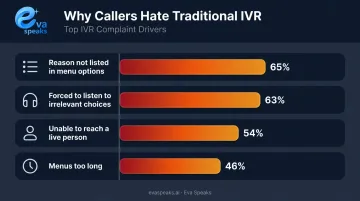
The contrast with static IVR menus is stark. Traditional phone trees force callers through irrelevant options and create friction precisely when customers are already frustrated. A Vonage survey of 2,010 U.S. adults found 61% believe reaching an IVR makes for a poor customer experience, with the top complaints being:
- Reason not listed in menu options: 65%
- Forced to listen to irrelevant choices: 63%
- Unable to reach a live person: 54%
- Menus too long: 46%
Modern routing logic — the kind that triages based on caller input, account type, or issue urgency rather than static button presses — avoids most of these failure modes. The key difference: the system adapts to the caller, rather than forcing the caller to adapt to the system.
A misconfigured IVR during a volume spike doesn't just frustrate callers — it actively drives abandonment and increases the volume of repeat contacts.
Solution 3: Offer Callback Options Instead of Hold Music
Virtual callback queuing is one of the highest-ROI interventions available. Callers are told their estimated wait time and offered the option to hang up and receive a call back when an agent is free. They get their lives back. You keep the contact.
Nextiva's 2025 survey found 75% of customers prefer scheduled callbacks over waiting in a traditional hold queue. Given that 31% won't wait more than 5 minutes, offering callbacks before the frustration threshold is hit matters.
Practical implementation notes:
- Trigger callback prompts when estimated wait exceeds 3 minutes
- Confirm the callback window clearly — "We'll call you back within 45 minutes" sets better expectations than "as soon as possible"
- For missed or after-hours calls, auto-reply SMS can serve as a lightweight alternative — acknowledging receipt and setting a response timeline prevents repeat call attempts
Solution 4: Expand Support Across Multiple Channels
Phone-only support doesn't just create long queues — it creates them artificially. Customers who would happily resolve a billing question via chat or send a quick SMS are forced to call because there's no other option.
Offering live chat, SMS, and email distributes load across channels and gives customers the flexibility to choose what works for them. That said, the deflection benefit only holds if those channels are actually staffed.
When response windows are missed, 56% of customers immediately switch to a different support channel — and that channel is usually the phone. An unanswered chat or email doesn't deflect a call; it delays one.
The key question isn't just "do we have these channels?" but "are they staffed to meet response expectations?" Two rules of thumb:
- Web chat requires near-real-time responses — slow replies push customers to the phone
- Email can tolerate more latency, but still needs a defined SLA
Matching staffing to channel norms is what makes multichannel support a volume solution rather than a volume redistribution exercise.
Solution 5: Deploy AI-Powered Call Handling for Routine Inquiries
For predictable, high-frequency call types — appointment scheduling, order status checks, account balance inquiries, FAQ responses — AI voice agents can handle the full interaction without human involvement.
The scalability advantage over human staffing is direct: AI capacity doesn't require a hiring cycle, onboarding period, or shift scheduling. During sudden volume spikes, an AI system absorbs additional calls without the queue growing. Unlike human agents, AI capacity doesn't degrade under load — there's no hold time creep when call volume doubles at 9 a.m. on a Monday.
On containment, a Forrester Consulting study commissioned by IBM found a financial services firm achieved 40% containment for up to 1 million monthly conversations using AI assistant technology — with savings of $5.50 per contained conversation.
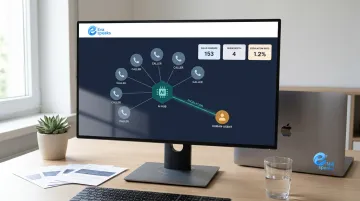
Platforms like EvaSpeaks offer AI-enabled call handling that combines real-time LLM responses with customizable call-flow scripts and routing rules — businesses can configure how their AI agent handles incoming calls, what it says, when it escalates, and how it routes based on predefined logic. EvaSpeaks is designed to deploy alongside existing telephony setups rather than requiring a full platform replacement, which is one reason businesses dealing with sudden call volume spikes can adopt it quickly without disrupting current operations. You can Watch AI Call Flow Demo to see how AI containment works during a real inbound call volume surge.
Here is how AI-powered, cloud CCaaS, and legacy call management solutions compare for high-volume environments:
| AI-Native (EvaSpeaks) | Cloud CCaaS (Genesys, NICE) | Legacy On-Premise System | |
|---|---|---|---|
| Features | AI containment + smart routing, 24/7, unlimited concurrent calls | Full ACD, workforce management, omnichannel | Fixed queues, IVR, manual routing updates |
| Best-fit Business Size | SMB to mid-market | Mid-market to enterprise | Large enterprise |
| Key Strengths | No dropped calls, AI reduces human agent load | Proven enterprise scale, full feature set | Maximum control |
| Implementation Complexity | Low - hours | High - months | Very High |
| Integration Capability | CRM, scheduling, EHR native | Deep but complex | Custom dev required |
Solution 6: Use Predictive Scheduling to Staff for Peak Periods
The best volume management happens before the spike hits. Workforce management (WFM) forecasting uses historical call data, seasonal trends, and promotional calendars to anticipate when volume will increase and schedule agents accordingly.
ICMI benchmarks set best-in-class forecast variance at less than 5% for large agent groups — yet only 38% of contact centers currently measure WFM metrics like forecast accuracy and agent utilization.
Where to start:
- Build a weekly call volume heatmap from 12 months of data — most centers have recurring peak windows (Monday mornings, post-billing cycle, post-campaign send)
- Model volume for upcoming events: product launches, policy changes, promotional campaigns
- Adjust shift structures 2-3 weeks out, not the morning of
- Track forecast accuracy weekly and tighten the model over time
Proactive scheduling won't eliminate every spike, but it closes the gap between forecasted volume and actual capacity before agents feel it.
Solution 7: Proactively Communicate with Customers Before Volume Spikes
Reactive calls — "I got an email about a price change and I don't understand it" — are some of the most preventable contacts in any queue. Customers who already have clear information don't need to call.
Proactive communication via email, SMS, and in-app banners before planned changes (outages, policy updates, billing cycles) reduces inquiry volume at the source. A ServiceNow case study with Rogers Communications showed that shifting from reactive to proactive customer communication drove a 19% reduction in inbound calls and a 43% reduction in status-chasing contacts.
During known high-volume events, update your IVR greeting to acknowledge the situation and set wait time expectations upfront. "We're currently experiencing higher than normal wait times due to [X]. Your estimated wait is Y minutes." That one message reduces abandonment and negative sentiment from callers caught off guard.
How to Choose the Right Solutions
Not every team needs all seven solutions. The right starting point is a targeted call audit — diagnosing exactly where volume is breaking down before committing to a solution.
Start with a call audit:
- Categorize inbound calls by inquiry type for the last 60-90 days
- Identify the top 3 drivers of call volume
- Ask: are these calls preventable (self-service gap)? Misrouted (routing problem)? Unavoidable but handleable by AI?
Then match solutions to root causes:
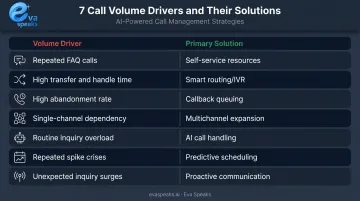
| Volume Driver | Primary Solution |
|---|---|
| Repeated FAQ-type calls | Self-service resources |
| High transfer and handle time | Smart routing / IVR |
| High abandonment rate | Callback queuing |
| Single-channel dependency | Multichannel expansion |
| Routine inquiry overload | AI call handling |
| Repeated spike crises | Predictive scheduling |
| Unexpected inquiry surges | Proactive communication |
Key metrics to track post-implementation:
- First Call Resolution (FCR): Industry average sits at 69%; top-performing centers hit 80% or higher
- Call abandonment rate: Benchmark average sits around 6%
- Average Handle Time (AHT): Baseline voice AHT benchmarks around 7.5 minutes
- Self-service containment rate: Only 14% of centers currently track this — it should be on your dashboard
Conclusion
High call volume is a system design problem, not a staffing problem. Adding agents without addressing the underlying causes — missing self-service, poor routing, no callback options, zero proactive communication — just delays the next crisis.
The combination of self-service infrastructure, smart routing, multichannel access, and AI automation can convert a reactive phone queue into something manageable. Start with your highest-volume call drivers, address those first, and layer in additional fixes as you measure results.
Businesses that want to reduce inbound volume through AI call handling and customizable routing can see how Eva Speaks manages routine calls end-to-end — without adding headcount or straining your existing team. You can also Talk to an AI Communication Expert to discuss which of the seven solutions in this guide apply most directly to your operation.
Frequently Asked Questions
What strategies do you use to manage high call volumes effectively?
The most effective approach combines multiple layers: self-service content to deflect preventable calls, smart call routing to reduce transfers, callback queuing to cut abandonment, and AI-powered handling for routine inquiry types. No single solution covers everything. The right combination depends on your specific volume drivers.
How do you handle inbound calls effectively?
Skills-based routing ensures callers reach the right resource on the first attempt. Pairing that with a well-configured IVR triage and equipping agents with real-time knowledge tools reduces both transfer rates and handle time, improving first call resolution across your team.
How many calls are considered high call volume?
Most teams define high call volume as 10% or more above a business's expected baseline. The practical impact varies by team size — a 10% spike at a small support team hits differently than at a large contact center with WFM infrastructure.
How to reduce incoming call volume?
Three proven deflection tactics: proactive customer communication before changes occur, a self-service knowledge base that answers common questions, and AI voice agents that resolve routine inquiries before they reach a human agent.
What is the golden rule when dealing with a phone call?
Resolve the issue on first contact wherever possible. Every repeat call represents a preventable failure, making first call resolution the single highest-impact tactic for reducing volume. Active listening, keeping the caller informed, and not closing prematurely are what make it happen.