Introduction
SaaS teams scale headcount fast. Customer volume climbs. And somewhere in that growth, call oversight starts slipping.
Most supervisors review a fraction of calls after the fact — long after a renewal conversation went sideways or an onboarding call left a new customer confused. For Managed Service Providers, the problem is sharper: they're managing voice interactions across multiple client accounts at once, each with its own scripting requirements and SLA commitments. By the time post-call review surfaces an issue, the damage is already done.
Real-time call monitoring addresses that gap directly. This guide covers what it actually is (and what it isn't), why SaaS companies and MSPs face challenges that generic tools don't address, the features worth prioritizing, and how to evaluate solutions before you commit.
Key Takeaways
- Real-time call monitoring lets supervisors — or AI systems — observe, coach, and intervene in live calls rather than reviewing recordings after the fact.
- SaaS companies use it to protect high-stakes retention, onboarding, and trial-conversion calls.
- MSPs need it to maintain consistent quality and SLA compliance across multiple client accounts from one place.
- AI-augmented monitoring goes beyond listen/whisper/barge by delivering contextual guidance to agents automatically, with no supervisor required.
- Key features to prioritize: live dashboards, sentiment detection, customizable routing, multi-tenant support, and CRM integration.
What Is Real-Time Call Monitoring?
Real-time call monitoring means actively observing, analyzing, and acting on phone conversations as they happen. Call recording and call logging are after-the-fact tools — they capture what occurred so someone can review it later. Monitoring is different: it creates the option to intervene before a conversation ends badly.
The Three Classic Supervisor Modes
Most platforms support three core monitoring actions:
- Listen (silent monitoring) — The supervisor hears the call without either party knowing, useful for quality audits and training observation.
- Whisper — The supervisor speaks to the agent only, coaching mid-call without the customer hearing a word.
- Barge — The supervisor joins as a full participant, stepping in to handle escalating or complex interactions directly.
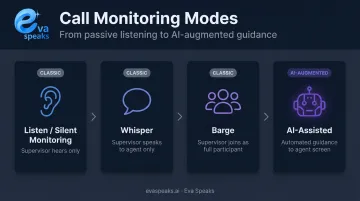
These modes give supervisors real options during a live conversation, not just notes to leave afterward.
The Fourth Mode: AI-Assisted Monitoring
AI-assisted monitoring systems continuously analyze active conversations — tracking keywords, tone, and sentiment — and push contextual guidance directly to the agent's screen, without waiting for a supervisor to step in. Platforms like EvaSpeaks enable this through LLM integration, delivering AI-generated responses and scripted prompts as conversations evolve. EvaSpeaks is relevant here as a real-world example: its customizable call-flow scripts and real-time AI responses can be configured per client account, which is the type of multi-tenant flexibility that MSPs managing diverse portfolios need to maintain quality across all their end-clients simultaneously.
The scale problem this solves is significant. According to Call Centre Helper, some organizations manually review as few as 8% of total inbound calls. The other 92% go unmonitored. AI-assisted monitoring covers that volume without requiring proportional growth in supervisory headcount.
Watch an AI-monitored call flow in action. Watch AI Call Flow Demo
Why SaaS Companies and MSPs Need Dedicated Call Monitoring
Generic call center tools weren't built for SaaS customer lifecycles or MSP multi-account environments. The gaps show quickly.
The SaaS Stakes
SaaS businesses live by retention metrics. Onboarding calls, customer success check-ins, renewal conversations, and churn-risk escalations aren't routine support interactions — they're high-revenue moments where a single mishandled exchange can accelerate a cancellation.
Bain & Company research shows that a 5% increase in customer retention can boost profits by up to 95%. That's the economic argument for catching a deteriorating conversation mid-call rather than discovering it in a recording two days later. A supervisor who whispers a retention offer before a frustrated customer disengages can change the outcome. The same supervisor reviewing a recording afterward cannot.
The MSP Challenge
MSPs handle voice calls on behalf of multiple end-clients simultaneously — each with different scripting requirements, escalation paths, and SLA commitments. That creates a monitoring problem that compounds with every client added.
Without real-time visibility across accounts, maintaining consistent quality becomes guesswork. MSP-ready monitoring must be multi-tenant by design, giving supervisors the ability to:
- Isolate performance data per client without cross-account noise
- Apply client-specific scripts and escalation rules independently
- Track SLA compliance across all accounts from a single dashboard
Distributed Teams and Remote Oversight
Remote and distributed agents are the norm for both SaaS teams and MSPs. Without a physical call floor, real-time monitoring is the only reliable way supervisors can intervene, coach, and maintain consistency at scale.
Cloud-based monitoring makes that practical. A supervisor in California can whisper to an agent in Texas handling an account managed out of New York — without any of those locations creating a barrier.
Compliance and SLA Accountability
SaaS companies in regulated verticals — fintech, healthtech — face contractual and regulatory requirements that demand documented evidence of service quality. MSPs carry SLA obligations to every client they serve. Real-time dashboards provide the live evidence base needed for audits and client reviews, not just after-the-fact call logs.
Have questions about AI monitoring compliance for your service? Talk to an AI Communication Expert
Key Features of Real-Time Call Monitoring for SaaS & Managed Services
Live Dashboards and Queue Visibility
A real-time dashboard displays — without manual refresh — active call count, agent availability, average handle time, queue depth, and current wait times.
For MSPs, filtering by client account is non-negotiable. Supervisors need to isolate performance per client instantly, without digging through aggregated data that mixes one client's call volume with another's.
AI-Powered Agent Assist and In-Call Guidance
Rather than requiring a supervisor to manually barge or whisper, AI systems can detect when a call is trending negative and push guidance directly to the agent's screen — automatically.
This works through continuous analysis of conversation signals: keywords, tone shifts, phrasing patterns. When thresholds are crossed, the system surfaces relevant prompts, suggested responses, or scripted guidance without any human supervisor involvement. Eva Speaks' architecture integrates with large language models to deliver context-aware, real-time assistance rather than static keyword-triggered responses.
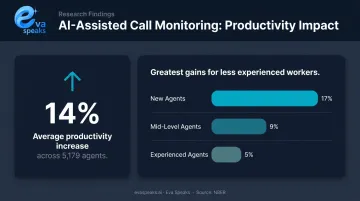
That capability matters more than it might seem. NBER research across 5,179 customer support agents found that AI assistance increased productivity by 14% on average — with the largest gains going to less experienced workers. That's precisely the population that benefits most from in-call guidance.
Sentiment Analysis and Automated Escalation
AI sentiment analysis scores customer emotion continuously during a live call. When scores fall below defined thresholds — frustration detected, tone shifting negative — automated triggers can alert a supervisor or re-route the call to a senior retention specialist without requiring manual intervention.
This removes the dependency on a supervisor happening to notice a problem. The system detects, escalates, and responds — regardless of whether anyone is actively monitoring that call.
Customizable Call-Flow Scripts and Routing Rules
Each client segment, product tier, or customer journey stage may require a different script, different escalation path, or different SLA priority.
A monitoring solution with configurable call flows ensures agents are guided consistently — without requiring a separate platform instance for each client. For MSPs, that flexibility is what makes one platform workable across a varied portfolio.
CRM and Helpdesk Integration
Real-time monitoring delivers its full value when supervisors and agents can see live customer context alongside the call itself. That means account health score, subscription tier, open tickets, and interaction history — visible at a glance, not buried in a separate tab.
A Forrester study commissioned by Microsoft found that CRM-integrated customer service environments achieved:
- 20% improvement in first-call resolution
- 40% reduction in average handling time
Live customer context transforms monitoring from passive observation into active decision support.
See how it performs for your SaaS or MSP setup. Request Live Demo
Real-World Use Cases Across the SaaS Customer Lifecycle
Real-time monitoring isn't a single-use tool — its value shifts depending on where a customer sits in the lifecycle. Here's where it makes the biggest difference.
Onboarding Calls
New customers form lasting impressions during onboarding. Real-time monitoring ensures they hear consistent product messaging, that activation milestones are communicated clearly, and that agents handle common objections with a prepared response rather than improvisation. Supervisors can whisper correction cues without the customer hearing anything unusual.
Retention and Churn-Risk Conversations
A customer on the fence about renewing — or actively expressing frustration — is a high-stakes situation with a short window. Real-time sentiment detection can flag that call the moment tone shifts, alerting a customer success manager to barge in or whisper a tailored retention offer before the customer disengages entirely. Reviewing a recording two days later doesn't help — the churn has already happened.
MSP Helpdesk Escalation
A Tier 1 agent handling a technical issue that has exceeded their scope faces a binary choice: keep struggling or tell the customer to call back. Neither option is good.
Real-time monitoring enables a Tier 2 engineer to join via barge before the customer is forced to hang up — resolving the issue in the same call, avoiding an SLA breach, and keeping the client account intact.
See how MSPs and SaaS teams are deploying real-time AI monitoring. See Industry Use Cases
How to Choose the Right Real-Time Call Monitoring Solution
Three questions cut through most vendor evaluations quickly:
1. Does it support multi-tenant environments natively? The platform should offer separate scripting, routing rules, SLA dashboards, and reporting views per client account — not just a single unified environment with limited filtering. Ask vendors whether multi-tenant configuration is a native feature or a workaround.
2. How deep is the AI capability? Systems that flag issues after a call ends are useful — but they can't help an agent who's mid-conversation with a frustrated client. Look for platforms that deliver real-time prompts and LLM-generated guidance during the call itself. EvaSpeaks is built around this model: its real-time AI response architecture and customizable call-flow design support active in-call assistance, not just post-call review. EvaSpeaks also captures every interaction as a structured transcript, which means call monitoring data accumulates automatically rather than requiring someone to manually log notes — an important capability for MSPs that need to demonstrate SLA compliance across many client accounts.
3. Is CRM integration bidirectional and real-time? Middleware connections that sync data post-call introduce lag at exactly the wrong moment. Verify whether the solution pulls live context from your CRM during an active monitored call — not just after it ends.
Comparing Real-Time Call Monitoring Approaches for SaaS and MSPs
Not all monitoring solutions are built for the same environment. Here is how AI-native, cloud monitoring-only, and legacy reporting approaches compare for SaaS and MSP use cases:
| AI + Real-Time Monitoring (EvaSpeaks) | Cloud Monitoring Platform | Legacy Reporting | |
|---|---|---|---|
| Features | AI call handling + live transcription, intent tagging, real-time CRM sync | Real-time dashboards, alert systems, analytics | Scheduled reports, post-call logs |
| Best-fit Business Size | SMB to mid-market SaaS/MSP | Any size | Large enterprise |
| Key Strengths | Unified call + monitoring data, zero manual work | Deep real-time visibility | Familiar, minimal change |
| Implementation Complexity | Low | Medium | Low |
| Integration Capability | PSA, ticketing, CRM native | API-based | Limited |
Frequently Asked Questions
What is real-time call monitoring?
Real-time call monitoring is the active observation and analysis of phone calls as they happen. It allows supervisors or AI systems to listen, coach, or intervene during a live conversation — rather than reviewing a recording hours or days later.
What is SaaS-based monitoring?
SaaS-based monitoring is a cloud-delivered solution accessed via subscription, requiring no on-premises hardware. Teams can oversee call quality from anywhere, making it well-suited for distributed SaaS and MSP environments where agents and supervisors aren't in the same location.
How does real-time call monitoring improve agent performance?
It enables immediate coaching through whisper and barge, AI-generated in-call prompts, and automated sentiment alerts — reducing the gap between identifying a skill issue and correcting it from days to seconds.
What is the difference between call monitoring and call recording?
Call recording captures conversations for later review. Real-time monitoring enables live observation and intervention during the call itself. Where recording looks backward, monitoring acts in the moment.
Can real-time call monitoring work for remote or distributed teams?
Yes. Cloud-based monitoring is designed for distributed environments. Supervisors can oversee agents across locations, time zones, and client accounts from a single dashboard — no shared physical space required.
What features should a SaaS or MSP look for in a call monitoring solution?
Key features to evaluate include:
- Live dashboards with real-time agent status
- Listen, whisper, and barge controls
- AI-powered sentiment detection and in-call alerts
- Customizable call-flow scripts
- Multi-tenant support (critical for MSPs)
- Bidirectional CRM integration that syncs during active calls