The problem isn't that teams don't know follow-up matters. It's that manual callbacks are slow, inconsistent, and impossible to scale during peak hours or after hours. Automated missed call follow-up solves that — but only if it's configured correctly.
The variables that separate high-performing automation from wasted effort are specific: trigger configuration, response timing, message quality, channel selection, and CRM handoff. Get any one of these wrong, and the system fires at the wrong time, on the wrong contact, with a message that gets ignored.
This guide covers the exact setup steps, what you need in place beforehand, the variables that control outcomes, and the mistakes that quietly kill conversion rates.
See how AI prevents missed calls from becoming missed revenue. Explore AI Call Automation
Key Takeaways
- Missed call automation detects an unanswered inbound call and instantly fires a pre-configured outbound response — usually an SMS — to re-engage the caller before they move on.
- Speed is the single biggest factor: a 2007 MIT/InsideSales.com study found a 5-minute response produces 100x higher contact odds than waiting 30 minutes.
- Three components are required: a platform that exposes missed call events, a workflow engine, and a CRM to log and route re-engaged leads.
- One auto-reply isn't enough — effective automation uses a multi-touch sequence: SMS → email → agent callback.
- Common failure points: misconfigured triggers (voicemail vs. true missed call), generic messages, and no defined handoff when a lead responds.
How to Automate Missed Call Follow-Ups in Your Contact Center
Step 1: Define What a "Missed Call" Means in Your System
Before building any automation, nail down the exact event you're targeting. Three distinct scenarios exist in most contact center platforms, and each requires a different trigger:
| Event Type | What Happened | Automation Trigger Needed |
|---|---|---|
| True missed call | Call received, never answered | "Call not answered" event |
| Voicemail reached | Caller connected to voicemail and left a message | "Voicemail received" event (separate) |
| Abandoned in queue | Caller hung up while on hold | "Abandoned call" event |
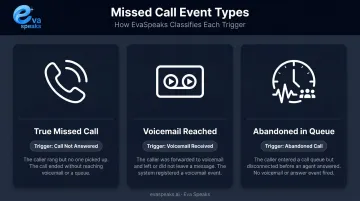
Using the wrong trigger causes automation to fire on calls where the caller already received some form of acknowledgment — creating redundant or confusing outreach. Most platforms treat these as separate events. Confirm which one you're targeting before touching any workflow settings.
Step 2: Configure Your Automation Trigger
Once you've defined the event, locate the workflow or automation module in your contact center platform. This is typically found under call event rules, IVR settings, or a dedicated automation center.
Set the following conditions:
- Trigger condition: Call received but not answered within X rings (define your threshold — 4–6 rings is standard)
- Call direction: Inbound only
- Caller type: Mobile numbers only (landlines cannot receive SMS — sending to one wastes a touch and skews your metrics)
- Hours: Decide between 24/7 triggering or business-hours-only (24/7 generally outperforms, but see compliance note below)
Compliance check before you enable: TCPA regulations require prior express consent for automated marketing texts to wireless numbers. The FCC's permitted calling/texting window for telemarketing is 8:00 a.m. to 9:00 p.m. local time. Informational (non-marketing) texts are treated differently, but opt-out requests must still be honored within 10 business days.
Florida, Texas, and California impose additional state-level requirements on top of federal rules. Confirm your consent records and message classification before going live.
Step 3: Write and Configure the Immediate Outbound Response
Speed matters here — the first automated message should fire within seconds of the missed call. Every minute of delay increases the chance the caller reaches a competitor first.
A strong immediate response includes:
- Personalized acknowledgment — caller's name if available, or at minimum a reference to the department or number they called
- Clear next step — "Reply to this message," "Click here to book a time," or "We'll call you back within the hour"
- Business name — always include it; the caller may not recognize the number
What to avoid: generic "Sorry we missed your call" messages with no context and no next step. They read as automated noise and get ignored.
Platforms with AI-powered call handling — such as Eva Speaks, which captures caller ID, call duration, transcriptions, and routing outcomes — can automatically pull that data into outbound messages, pre-filling the caller's name, department, or call reason into the SMS template without agents lifting a finger. Because Eva Speaks generates structured call records for every inbound interaction, the data needed to personalize follow-up messages is already captured at the moment of the missed call — no additional tracking layer or manual enrichment step required.
Step 4: Build a Multi-Touch Follow-Up Sequence
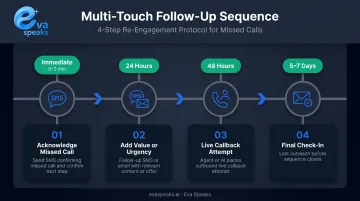
A single text rarely converts. Structure your sequence with escalating channels:
- Immediate (0–2 minutes): SMS acknowledging the missed call with a clear next step
- 24 hours: Follow-up SMS or email — add value or urgency, don't just repeat the first message
- 48 hours: Agent callback attempt — personal outreach from a real person
- 5–7 days: Final check-in message via email or SMS before closing the sequence
InsideSales/XANT's 2021 research across 5.7 million marketing leads found that 7+ follow-up attempts produced 15% more connections, while 81% of sellers stopped at 5 or fewer attempts. A Skaled/Ziff Davis B2B survey of 100 senior sales and marketing professionals found 42% identified 7–10 touchpoints as most successful.
The commonly cited claim that "80% of sales require five follow-ups" has no verified primary source — the "National Sales Executive Association" that's often cited doesn't appear to exist as a traceable organization. Use the persistence data above instead.
Channel rotation matters: SMS reaches people fastest. Email handles complex information and attachments better. Agent callbacks carry the most weight but cost the most time. Vary the channel across your sequence rather than repeating the same medium three times.
Watch how an AI follow-up call flow works in practice. Watch AI Call Flow Demo
Step 5: Route Responded Leads Back to a Live Agent
Once a prospect responds, the automation has done its job. What happens in the next five minutes determines whether that re-engagement converts — or stalls.
Configure the following handoff logic:
- CRM flag: Response triggers an automatic lead status update (e.g., "Re-engaged — needs callback")
- Agent queue assignment: Lead routes to the appropriate team or agent based on the original call's department or priority tier
- Sequence exit: Contact is removed from the automated follow-up sequence immediately upon response — they should never receive another automated touch after a human conversation begins
The handoff is where most automation setups leak revenue. If a responded lead stays in an automated loop past the point of re-engagement, agents never get the chance to close — and the prospect experiences the kind of impersonal follow-through that kills trust.
When Should You Automate vs. Handle Follow-Ups Manually?
Automation isn't the right answer for every missed call. The decision comes down to call volume, industry, and caller context.
Automate when:
- Call volume makes same-minute manual callbacks impossible
- Calls come in after hours or during overflow periods
- The caller is new or unidentified in your CRM
- Recurring callers haven't converted after prior contact
Handle manually when:
- The caller is a known high-value account
- Prior interactions flagged frustration or a sensitive issue
- The industry involves sensitive handling requirements (healthcare, legal, financial services) — these sectors face additional TCPA exemption conditions, HIPAA constraints, and professional ethics rules that limit what automated outreach can say and to whom
High-volume contact centers with consistent inbound patterns get the most from automation. Very low-volume operations may find the setup overhead outweighs the benefit, particularly if agents can return every missed call within the five-minute window without automation support.
See how AI handles after-hours calls so none are ever truly missed. See How AI Handles After-Hours Calls
Here is how AI-powered, IVR callback, and manual follow-up approaches compare for handling missed calls:
| AI Automated Follow-Up (EvaSpeaks) | IVR Callback System | Manual Human Follow-Up | |
|---|---|---|---|
| Features | Instant AI outbound call, personalized, CRM sync, multi-channel | Scheduled callback queue, DTMF re-engagement | Agent manually calls back from missed call list |
| Best-fit Business Size | SMB to mid-market | Mid-market to enterprise | Any size |
| Key Strengths | Instant response, zero slip-through, consistent message | Structured queue, compliant | Personal touch, human judgment |
| Implementation Complexity | Low - CRM connectors | Medium | None |
| Integration Capability | CRM, scheduling, email/SMS native | Limited | Manual CRM entry |
What You Need Before Setting Up Missed Call Automation
System and Platform Requirements
Three components are non-negotiable:
- A contact center phone system that exposes missed call events — either via API, webhook, or a native automation module
- An automation or workflow tool connected to that system and capable of sending outbound SMS and email
- A CRM that can receive triggered contact records, log each automated touch, and surface flagged leads to agents
If your phone system can't expose missed call events programmatically, none of the automation downstream will function. Verify this capability before configuring anything else.
Data and Compliance Readiness
Caller data audit: Personalization fails if caller ID isn't captured. SMS fails entirely if no mobile number is on file. Before launch, audit your CRM for:
- Percentage of inbound callers with captured mobile numbers
- Match rate between caller ID and existing contact records
- Any records with landline-only numbers that would receive SMS (these need to be filtered out)
Clean data also sets the foundation for compliance. Compliance readiness: Confirm opt-in records exist for every contact who will receive automated marketing texts. Build STOP/opt-out handling into the sequence before it goes live.
The FCC requires opt-out requests to be honored within 10 business days. Violations carry private damages of $500 per message, up to treble damages for willful violations.
Key Variables That Affect Follow-Up Performance
Two contact centers can run identical automation setups and see very different results. These three variables explain most of the gap.
Response Timing
Lead intent peaks at the moment of the missed call. The 2007 InsideSales.com/MIT study found that 5-minute response produced 100x higher contact odds than 30-minute response. The 2011 Harvard Business Review audit of 2,241 US companies found firms responding within one hour were nearly 7x more likely to have a meaningful conversation than those waiting longer.
Set your automation to fire instantly. Any deliberate delay, even five minutes, meaningfully reduces response probability. Configure 24/7 triggering unless compliance or operational constraints require otherwise.
Message Personalization
Generic messages perform poorly. A message that references the caller's name, the department they called, or their account status signals relevance and earns more responses than a one-size-fits-all template.
Twilio's 2023 State of Personalization research (surveying 3,001 consumers) found 56% of consumers were more likely to become repeat buyers after a personalized experience. While this covers broad consumer personalization rather than missed-call SMS specifically, the directional signal is consistent: context-aware messages outperform generic ones.
AI-powered call handling platforms capture real-time metadata: caller ID, routing path, and prior call history. That data feeds directly into outbound messages without requiring agents to manually enrich each record.
Channel Selection and Sequence Cadence
SMS opens first, email handles detail, and agent callbacks close the loop. Bandwidth's 2024 State of Messaging report (1,600+ consumers and businesses) found text open rates above 98%, compared to email open rates averaging 35.63% per Mailchimp's 2023 benchmarks.
Sequence spacing:
- Immediate: SMS
- 24 hours: SMS or email (varied content, not a repeat)
- 48 hours: Agent callback
- 5–7 days: Final outreach before sequence close
Too many touches in quick succession risks spam complaints and opt-outs. Too few leaves recoverable leads on the table. The 3–5 touch range with the spacing above is a solid starting point. Test from there and adjust based on opt-out rates and response data.
Common Mistakes When Automating Missed Call Follow-Ups
Most missed call automation failures trace back to the same handful of setup errors. Catching these early prevents wasted follow-ups, compliance exposure, and leads that go cold.
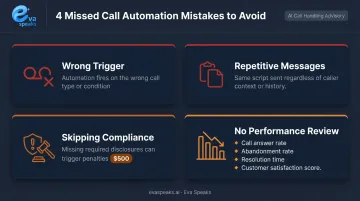
Voicemail triggers firing instead of true missed call triggers. When automation fires on a voicemail event, the caller already received some acknowledgment — a follow-up text lands out of context. Configure separate triggers for each event type.
Sending the same message at every touch. The same template repeated three times reads as a broken loop. Each follow-up should add something new — a different offer, additional context, or a direct callback option.
Skipping compliance setup. Automated texts sent without opt-in records, or outside the 8 a.m.–9 p.m. local time window, expose your operation to $500-per-message TCPA liability. State-specific rules in Florida, Texas, and California add further risk. Build consent verification and opt-out handling before going live.
No ongoing performance review. Set-and-forget automation degrades over time. Track these KPIs monthly:
- Response rate (what percentage of contacts reply)
- Re-engagement rate (how many re-engaged leads move to conversation)
- Conversion rate from automated follow-up
- Opt-out rate (rising opt-outs signal message fatigue or poor targeting)
Want expert guidance on your missed call automation setup? Talk to an AI Communication Expert
Frequently Asked Questions
How do I follow up on a missed call?
The fastest method is an immediate automated SMS acknowledging the missed call, followed by a multi-touch sequence of texts, emails, and an agent callback. The first response should fire within seconds rather than minutes of the missed call event.
How do I set an auto-reply for missed calls?
Auto-replies are configured through your contact center platform or automation tool by creating a workflow triggered by the "call not answered" event. Most platforms include a template or automation module where you define the message and send conditions.
How do I automatically send texts when a call is missed?
This requires a phone system that exposes missed call events via webhook or native automation, connected to an SMS-capable automation tool. When the missed call trigger fires, the system sends a pre-configured text to the caller's mobile number automatically.
How do I set missed call reminders for agents?
The same trigger that fires the customer-facing SMS can also send an internal push notification or create a CRM task alert assigned to the responsible agent or queue. Most automation platforms support both outbound customer messages and internal notifications from the same trigger.
What are the best practices for follow-up in contact centers?
Key practices include:
- Respond within five minutes of the missed call
- Use a multi-touch sequence across SMS and email before escalating to a live call
- Document every touch in the CRM
- Give agents full context (call history, prior touches, prospect responses) before the callback
Is it true that 80% of sales require five follow-ups?
This statistic is widely repeated but has no verified primary source. The "National Sales Executive Association" commonly cited doesn't appear to be a traceable organization. What verified data does show: InsideSales/XANT found 7+ follow-up attempts produced 15% more connections, with most sellers stopping too early. The principle holds, but the specific "80% / five follow-ups" figure should not be treated as fact.