Introduction
US hospitals lose a measurable share of daily appointments to no-shows — and the traditional response creates its own problems. Overbooking frustrates patients who show up on time. Manual reminder calls burn through front desk hours. And when a patient can't make it, the slot often disappears without recovery.
Most hospitals already have some form of reminder system. The missing piece is what happens after the reminder lands. When a patient realizes they can't make it, they need an immediate, frictionless way to reschedule — otherwise the slot is lost regardless of how many reminders went out.
Research from a US academic outpatient practice found automated voice reminders reduced no-show rates from 23.1% to 17.3%. But the bigger opportunity is what happens when those reminders can also handle rescheduling in real time, without any staff involvement.
This guide covers how AI call bots for hospital appointment reminders and rescheduling actually work. That includes triggering logic, conversation flow, rescheduling mechanics, EHR integration, and the compliance requirements that govern every deployment in US healthcare.
Key Takeaways
- AI call bots place outbound reminder calls, confirm attendance, and complete rescheduling within a single conversation — no front desk involvement needed
- End-to-end automation pulls appointments from the EHR, contacts patients on schedule, and writes results back — no manual follow-up required
- Unlike basic robocalls, AI call bots check live availability and book a new slot during the same conversation
- A two-touch reminder sequence (3 days + 1 day before) is the most evidence-supported timing approach for no-show reduction
- Any vendor handling patient appointment data must sign a Business Associate Agreement (BAA) under HIPAA
Watch how AI handles a real patient appointment call. Watch AI Call Flow Demo
What Is an AI Call Bot for Hospital Appointment Reminders and Rescheduling?
An AI call bot for hospital reminders is an outbound voice automation system that conducts spoken conversations with patients to confirm, remind, and facilitate rescheduling — without a human agent on the line.
It exists because the gap between booking an appointment and the patient actually showing up is operationally costly. Manual reminder calls don't scale at volume. SMS reminders get ignored. Front desk staff can't proactively manage rescheduling across hundreds of upcoming appointments.
How It Differs from a Robocall or IVR
This distinction matters practically:
| System Type | What It Can Do |
|---|---|
| Robocall / Press-1 IVR | Plays a prerecorded message; records a single keypress |
| AI Call Bot | Understands natural spoken responses, handles unexpected replies, completes multi-step rescheduling in one call |
A true AI call bot uses natural language processing — and in more advanced platforms, large language models (LLMs) — to interpret free-form patient speech. When a patient says "I actually can't make Tuesday, can we move it to later in the week?", the bot understands that request and acts on it. A press-1 system cannot do any of that.
Here is how an AI call bot compares to legacy IVR and human staff for hospital appointment management:
| AI Call Bot (EvaSpeaks) | Legacy Healthcare IVR | Human Scheduling Staff | |
|---|---|---|---|
| Features | Natural language booking, rescheduling, reminders, EHR sync | DTMF menus, appointment reminders | Full interaction, judgment, complex scheduling |
| Best-fit Business Size | Clinics to large health systems | Large hospital networks | Small to medium practices |
| Key Strengths | 24/7, no hold time, consistent, HIPAA-compliant | Widely deployed, hospital-tested | Human empathy, edge-case handling |
| Implementation Complexity | Low - EHR API connectors | High - months + IT | None (hire) |
| Integration Capability | Epic, Cerner, Athena native | Custom dev required | Manual EHR entry |
Eva Speaks builds this LLM layer directly into the conversation engine, so the bot handles unexpected phrasings, asks clarifying questions, and maintains context across a multi-turn conversation — rather than failing whenever a patient goes off-script.
One more distinction worth making: an AI call bot is not a chatbot. A chatbot operates over text channels (web, SMS, messaging apps). An AI call bot handles live voice conversations, which reach a broader patient population — including those who don't use patient portals.
How Does an AI Call Bot for Hospital Reminders Work?
The bot operates through a defined sequence of stages. The quality of each stage determines whether a call ends in a confirmed appointment or a recovered rescheduled slot.
Call Initiation: Triggers and Patient Identification
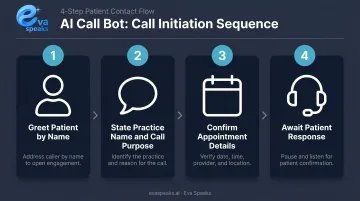
The bot pulls upcoming appointment records from the hospital's scheduling system or EHR on a configured schedule — typically 48 to 72 hours before the appointment. It generates an outbound call list automatically and begins placing calls without any manual queue.
At the start of each call, the bot:
- Greets the patient by name
- States the practice name and purpose of the call immediately
- Confirms the appointment details — date, time, provider, and location
- Then asks for the patient's response
This sequencing is deliberate. Leading with who is calling and what the appointment is reduces hang-ups and builds enough trust in the first few seconds for patients to stay on the line.
Core Call Execution: The AI Conversation in Action
The bot conducts a structured but natural-sounding conversation using a configurable call-flow script. It listens to the patient's response, interprets their intent, and routes the call accordingly.
Common call paths:
- Patient confirms → Bot logs confirmation and optionally delivers pre-visit instructions (fasting requirements, what to bring, parking details)
- Patient is uncertain or unavailable → Bot transitions to the rescheduling flow
- Call goes unanswered → Bot leaves a structured voicemail and can trigger an SMS fallback
The LLM layer handles the variability. Patients don't say "I confirm" — they say "yeah, I'll be there" or "wait, what time was that again?" Eva Speaks' conversational AI combines LLM-based reasoning with accurate speech-to-text processing. The bot maintains context across these exchanges rather than breaking on anything outside a narrow expected response.
Rescheduling Logic: Handling Patient Responses in Real Time
When a patient indicates they can't attend, the rescheduling flow activates:
- Bot queries the hospital's live scheduling system for available slots matching the same provider and appointment type
- Presents two or three specific options to the patient
- Patient selects a time verbally
- Bot books the new slot and confirms it within the same call
No front desk involvement. No callback required. The patient who would have been a no-show is converted into a confirmed future appointment, and the vacated original slot is simultaneously flagged as available for the waitlist.
That recovery scales. A 2010 telephone reminder study found that 7.4% of reminded patients canceled during the call, and 28% of those canceled slots were reallocated. An AI call bot that can handle rescheduling in the same call captures that recovery rate at scale, automatically.
Output: What Gets Updated After the Call
At the end of each call, the system produces:
- Status written back to the scheduling system: confirmed / rescheduled / cancelled / no answer
- Call transcript: generated, timestamped, and stored with speaker labels and key extracted data
- Downstream triggers: SMS confirmation of the new appointment time, front desk alert for late cancellations
Platforms like Eva Speaks flow transcripts and structured data directly into the patient record within connected EHR systems. When every call result is logged automatically, the morning huddle starts with an accurate picture of confirmed appointments, unconfirmed slots, and open cancellations that can still be filled. No one on the front desk team is scrambling to verify the schedule before the first patient walks in.
Ready to see it live with your scheduling system? Request Live Demo
The Reminder Call Sequence: Timing and No-Show Reduction
Effective AI reminder programs don't rely on a single call. A 2018 trial across 25 primary care clinics found that two automated reminders — at 3 days and 1 day before the visit — reduced missed appointments to 4.4%, compared with 5.8% for a 3-day reminder alone and 5.3% for a 1-day reminder alone.
What Each Touchpoint Is Designed to Accomplish
| Timing | Primary Goal |
|---|---|
| T-72 / T-48 (First call) | Catch patients who already know they can't attend; open a rescheduling window |
| T-24 (Second call) | Reach non-responders; deliver procedural prep information |
| T-2 (Final call) | Identify same-day cancellations early enough to fill from waitlist |
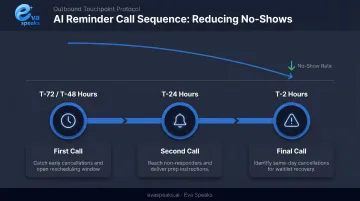
The first call handles the bulk of rescheduling activity, catching patients who already know they can't make the appointment. The second call reaches those who missed the first. The final call is about operational intelligence: a cancellation at T-2 is still actionable if the hospital runs an active waitlist.
Timing and Configuration Considerations
- Call window: Calls placed during lunch hours or early evenings reach more patients than early morning attempts
- Time-zone compliance: The system must respect patient time zones and applicable FCC call-hour rules
- Voice-to-SMS fallback: Patients who don't answer voice calls should receive an SMS with the same reminder content and a callback number
- Retry logic: A single unanswered attempt is not a final result; configurable retry schedules improve contact rates
Specialty-Specific Adjustments
Script requirements vary by department:
- Psychiatric appointments: Voicemails should use generic language that doesn't reveal the department or reason for visit
- Pediatric calls: Scripts should address parents, not patients, with age-appropriate framing
- Diagnostic / pre-procedure calls: Preparation instructions (fasting, bowel prep, medication holds) make these reminders high-value beyond basic confirmation
Eva Speaks handles these variations through per-department script configuration, with routing rules and customization managed directly in the dashboard.
EHR and Scheduling System Integration
The AI call bot's effectiveness depends entirely on real-time integration with the hospital's scheduling system. Without live read and write access, the bot can't offer accurate rescheduling slots or update the calendar after the call.
What the Integration Layer Must Do
- Read: Patient name, contact number, appointment date/time, provider, appointment type
- Query: Available slots for the same provider and appointment type in real time
- Write: Confirmation status, new appointment booking, cancellation flag
- Trigger: Downstream notifications — SMS confirmations, front desk alerts, and waitlist updates
Modern integrations use API connections to EHR scheduling modules. Eva Speaks has validated integrations with Epic, athenahealth, eClinicalWorks, NextGen, and Dentrix, among others. ONC data shows approximately 9 in 10 US hospitals enabled patient access through APIs in 2024, so API-based integration is feasible for most large healthcare organizations.
When Direct API Integration Isn't Available
For legacy systems without scheduling API support, file-based workflows can serve as an interim solution:
- Daily CSV exports ingested by the calling platform
- Status written back to a separate file for manual import
- Limitation: This approach introduces a lag that prevents real-time rescheduling; the bot can confirm or cancel, but cannot book new slots dynamically
Whether using direct API or file-based integration, validate all connections in a sandbox environment before deployment. Errors in the read/write cycle — double-booking, failed status updates — need to surface in testing, not during actual patient calls.
Want a workflow configured for your EHR and call volume? Get a Customized Workflow Recommendation
HIPAA Compliance for Healthcare Call Bots
Required HIPAA Vendor Obligations
Any vendor handling protected health information (PHI) in the context of appointment reminder calls must meet these requirements under 45 CFR 164.502(e) and 164.504(e):
- Signed Business Associate Agreement (BAA) before any PHI is transmitted
- Encryption of PHI in transit and at rest
- Access controls on call transcripts containing patient information
- Configurable retention policies for stored transcripts
- Security Rule compliance under 45 CFR 164.308, including risk analysis and activity review
HHS explicitly states that appointment reminders are part of treatment and can be made without patient authorization — but this does not eliminate the BAA requirement for the vendor.
The HIPAA permission to call without authorization is a Privacy Rule provision. The BAA requirement is a separate contracting obligation — and it applies regardless of that permission.
What a Compliant Call Looks Like in Practice
- Disclosure of call recording at the start of the call
- No clinical advice or diagnosis attempted by the bot
- Clear escalation path to a human for any patient expressing distress or describing an emergency
- Consent for contact collected at booking, not during the reminder call
Eva Speaks handles the escalation requirement directly: urgent calls route to on-call clinicians via SMS, voice, or paging system integration, covering live call scenarios without manual intervention. For hospital systems evaluating AI call bots, one practical advantage of Eva Speaks' approach is that call-flow scripts and routing rules can be configured per department — meaning a psychiatric clinic's reminder script behaves differently from an oncology department's, without requiring a separate system for each specialty.
Service Communication vs. Promotional Call
Appointment reminders to existing patients with a booked appointment are service communications — they're generally not subject to Do-Not-Call restrictions and may qualify for FCC healthcare call exemptions when the call is non-promotional, identifies the provider, and includes an opt-out mechanism.
Adding promotional content to a reminder call (upselling a health package, for example) changes its legal classification and triggers additional TCPA requirements. Before launching any outbound call program, hospitals should have legal counsel review call scripts specifically for promotional language — even a single upsell mention can shift the call's TCPA classification.
Have compliance or workflow questions? Talk to an AI Communication Expert
Frequently Asked Questions
How can AI help with appointment scheduling?
AI automates the outbound reminder and confirmation process, handles rescheduling requests within a single call, and integrates with live scheduling systems to book new slots immediately. This frees front desk staff from high-volume routine calls and reduces the no-show rate without adding headcount.
What's the best AI virtual receptionist for appointment scheduling?
The best fit depends on your EHR, call volume, and compliance requirements. Key criteria: LLM-powered conversation handling for natural responses, customizable call-flow scripts per department, real-time scheduling integration with your specific EHR, a signed BAA, and measurable no-show reduction outcomes in comparable healthcare settings.
Is an AI call bot for hospital appointment reminders HIPAA compliant?
AI call bots can be HIPAA compliant when the vendor signs a BAA, encrypts PHI in transit and at rest, and implements appropriate access controls. Before deploying, verify BAA availability and request SOC 2 attestation or equivalent security documentation.
How does an AI call bot handle rescheduling requests during a live call?
When a patient indicates they can't attend, the bot queries available slots in the live scheduling system, presents specific alternatives, confirms the new time within the same call, and writes the updated booking back to the calendar with no front desk involvement required.
Will patients respond to appointment reminders from an AI voice caller?
Patient acceptance is solid when the call immediately identifies the practice name and delivers clear value: appointment details, prep instructions, or a rescheduling option. A 2024 study found 58.6% of patients preferred phone reminders over SMS. Track opt-out and hang-up rates during any pilot to gauge acceptance in your specific patient population.
How does an AI call bot integrate with a hospital's existing EHR?
The bot connects via API to the EHR's scheduling module to read appointment lists, check live slot availability, and write confirmation or rescheduling outcomes back to the calendar. Eva Speaks supports integrations with Epic, athenahealth, eClinicalWorks, NextGen, and others, with file-based workflows available for legacy systems.