When a patient calls and no one answers, that revenue doesn't wait. According to Dental Economics, 87% of new patients who reach voicemail or are placed on hold without a proper greeting will hang up and not call back. Meanwhile, the ADA notes that the first phone contact with a prospective patient is a critical opportunity — one that directly affects whether they book or move on to the next practice on their list.
Dental AI receptionists address this gap in concrete, operational terms. This article covers what they actually do, which practice metrics they move, and where they deliver the clearest return.
Key Takeaways
- Nearly one-third of dental practice calls go unanswered — AI receptionists capture those calls 24/7 and book appointments in real time
- Measurable gains across three areas: after-hours revenue recovery, front desk efficiency, and automated hygiene recall
- AI handles volume and consistency; human staff focus on complexity and relationship-building
- Practices in competitive markets see compounding gains across appointment volume, hygiene revenue, and patient retention
- ROI shows up in calls answered, slots filled, and staff hours recovered — not in projections
What Is a Dental AI Receptionist?
A dental AI receptionist is software that handles inbound and outbound patient calls, books appointments, answers routine questions, and routes complex situations to human staff — without requiring anyone to pick up the phone.
In practice, it covers the full range of front-desk communication:
- Inbound calls — scheduling, FAQs, insurance questions, new patient intake
- After-hours coverage — evenings, weekends, and holidays with no call going unanswered
- Outbound outreach — hygiene recall, appointment reminders, reactivation campaigns
- Intelligent routing — call triage and handoff to staff with full context already captured
Eva Speaks, for example, connects directly with dental practice management systems like Dentrix to book appointments in real time. The system qualifies new patient inquiries, captures insurance information and reason for visit, triages clinical versus administrative calls, and routes urgent after-hours situations to on-call clinicians.
The practical result: every patient inquiry gets a response, and scheduling opportunities that would otherwise land in voicemail get captured instead.
Here is how an AI dental receptionist compares to a human receptionist and a traditional answering service:
| AI Dental Receptionist (EvaSpeaks) | Human Receptionist | Traditional Answering Service | |
|---|---|---|---|
| Features | Scheduling, reminders, after-hours, PMS sync | Full interaction, treatment coordination | Message-taking, basic call routing |
| Best-fit Business Size | Solo practices to multi-location groups | Any size | Practices without front desk gaps |
| Key Strengths | 24/7 availability, zero missed calls, no sick days | Human empathy, established relationships | Low cost, no management overhead |
| Implementation Complexity | Low - PMS integration | None (hire) | Low |
| Integration Capability | Dentrix, Eaglesoft, Curve native | Manual entry | None or limited |
Key Advantages of Dental AI Receptionists
Each advantage below ties directly to metrics practice owners already track: revenue captured, staff time recovered, and schedule utilization.
24/7 Call Coverage and Missed-Revenue Recovery
A dental AI receptionist answers every call — regardless of time, day of week, or how busy the front desk is. Dental pain doesn't pause for lunch breaks or holidays, and patients calling on a Saturday evening aren't going to wait until Monday morning.
The mechanism matters here. When a patient calls, the AI accesses real-time schedule availability through the practice management system and books the appointment during that call — not after a callback loop. Patient intent converts to a confirmed visit in minutes, not days.
Why this translates directly to revenue:
- Dental Economics reports that 10 mishandled prospective-patient calls can represent over $15,000 in potential lost revenue using average dental patient expenditure assumptions
- Nearly one-third of calls to dental offices go unanswered — each one is a patient who made the effort to reach your practice
- 87% of callers sent to voicemail hang up without leaving a message and don't call back
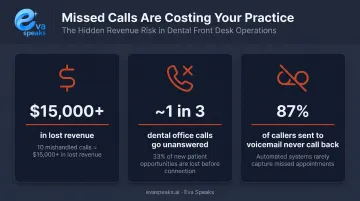
That last number is the crux of the problem. Voicemail isn't a safety net — it's where patient intent goes to disappear. A patient calling with a toothache at 8 PM has three other practices visible in their Google search results. The one that answers gets the appointment.
KPIs this moves:
- Call answer rate
- New patient conversion rate
- After-hours appointment volume
- Estimated annual revenue from previously missed calls
This matters most for: Practices in competitive markets where patients have multiple options nearby; single-location practices with one or two front desk staff who are regularly pulled into in-person interactions during peak hours; and practices currently relying on voicemail or a generic answering service after hours. You can See How AI Handles After-Hours Calls to understand what that coverage looks like for a dental practice.
Operational Efficiency and Front Desk Productivity
Front desk staff are expensive, increasingly hard to retain, and regularly asked to do too many things at once. When a patient walks in for checkout while two lines are ringing and someone needs to confirm tomorrow's appointments, something drops.
An AI receptionist absorbs the routine, high-volume work — scheduling, appointment reminders, basic FAQs about hours and insurance — so staff can stay focused on the interactions that genuinely require a human.
What the staffing data shows:
- DentalPost's 2025 survey found 29.7% of front-office associates changed employers in 2024, and 28% planned to apply for new positions in 2025
- Front-office compensation satisfaction sat at just 38% — meaning most front desk employees are either underpaid, overworked, or both
- Practice managers reported "a constant undercurrent of anxiety and stress" and said patients had become harder to interact with since 2020
Turnover is expensive. Burnout precedes turnover. Reducing the repetitive call burden is one of the more direct levers practices have to improve both.
How intelligent routing works in practice: Eva Speaks' smart call routing gathers caller intent, name, reason for visit, and appointment preferences before transferring to staff. When a call does reach a human, that staff member already has context — no starting from scratch, no putting the caller on hold to pull up their record. The AI handles the intake; the human handles the judgment.
KPIs this moves:
- Staff hours recovered per week
- Front desk overtime
- Employee retention rate
- In-office patient satisfaction scores
This advantage is most pronounced in practices with lean admin teams, where one dropped task creates a cascade — and in growing practices where call volume is outpacing headcount without yet justifying a new hire. You can Watch AI Call Flow Demo to see how the AI handles a dental intake call from start to finish.
Hygiene Recall Automation and Schedule Gap Reduction
The hygiene department drives a disproportionate share of practice revenue — and not just from cleanings. Dental Economics notes that oral health care appointments generate 70–80% of all dental treatment, meaning an empty hygiene slot costs more than just the cleaning revenue. It costs the downstream restorative opportunity too.
Most practices know this. The problem is execution: recall outreach is tedious, inconsistent, and gets deprioritized when staff are already stretched.
Dental Economics describes many practices as having no written patient retention system and no team member specifically accountable for recall. That's a structural gap, not a staff motivation problem.
The AI approach to recall:
- Queries the PMS to identify patients overdue for hygiene visits
- Initiates personalized outbound calls or messages on a configurable schedule
- Books appointments directly into the schedule without staff involvement
- Runs with retry logic and voicemail detection so outreach doesn't stop after one failed attempt
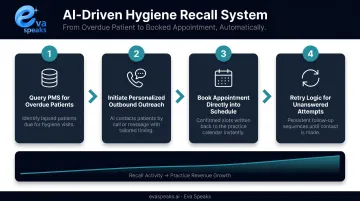
Eva Speaks' outbound calling includes re-engagement campaigns that operate on CRM-driven contact lists — the same mechanic applies to hygiene recall when connected to the practice's scheduling data. The outreach uses conversational AI built on large language models, so patients hear a fluid, natural conversation rather than a scripted phone menu. For dental practices that have historically depended on staff to manually work through recall lists, this kind of automated outreach addresses the structural gap — the problem was never lack of intent but lack of consistent execution, and automated outreach removes the dependency on who has bandwidth that week.
Where this diverges from manual recall is consistency. AI-driven recall runs the same way every day, regardless of how busy the office is or whether the one person who usually handles it is out sick.
KPIs this moves:
- Hygiene schedule utilization rate
- Recall appointment volume per month
- Hygiene revenue as a percentage of total practice revenue
- Downstream restorative treatment conversion
This matters most for: Practices where hygiene utilization regularly falls below 85–90%; practices with one hygienist where every unfilled slot has direct dollar impact; DSOs and multi-location practices where manual recall at scale is operationally impractical. Practices curious about how this works in a dental context can Talk to an AI Communication Expert to walk through a specific recall workflow scenario.
What Happens When AI Call Handling Is Overlooked
Practices that continue using voicemail, manual callback queues, or generic answering services face consequences that accumulate quietly:
- Unanswered calls drain revenue quietly — nearly one-third of inbound calls go unanswered, and while no single missed call looks critical, the aggregate loss is substantial
- Voicemail after hours signals unavailability, not responsiveness — patients form their impression of your practice in that moment and often don't call back
- Front desk staff pulled in multiple directions make errors, drop follow-ups, and burn out faster — the cycle the DentalPost data documents plays out daily without AI handling routine scheduling calls
- Adding providers increases call volume, but headcount rarely keeps pace — without automated call handling, growth creates operational pressure rather than capacity
These consequences don't surface as a single crisis. They erode performance gradually — in lower conversion rates, rising staff turnover, and hygiene schedules that never quite reach full utilization.
How to Get the Most Value from a Dental AI Receptionist
Deployment quality determines outcomes. Practices that configure their AI receptionist thoughtfully from the start see measurably better results than those that run it on default settings.
Three principles that separate high-performing deployments:
Map call types and configure actual workflows — define routing rules for distinct scenarios (emergencies, new patient inquiries, existing patient scheduling, billing questions), and give the AI accurate, practice-specific information. Eva Speaks lets dental practices build separate call-flow scripts per call type through the dashboard, with custom routing rules for office hours and after hours.
Track performance data monthly — call volume handled, after-hours bookings captured, recall outreach results, and appointment conversion rates should be reviewed monthly. Patterns in the data reveal where the AI is performing well and where call flows need refinement.
Keep the handoff protocol clear — the AI handles volume and routine consistency so staff can focus on complexity and relationship-building. Blurring this line — routing sensitive conversations through AI, or manually handling tasks the AI is built for — reduces the value of both.
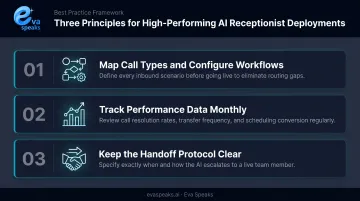
The most common mistake is treating AI receptionist deployment as a one-time setup rather than an ongoing operational practice. The practices seeing the strongest results treat it as a live system they actively manage, revisiting call flows and performance data as the practice evolves. To see how it would work for your practice, you can Request Live Demo.
Conclusion
The value of a dental AI receptionist isn't theoretical. It shows up in calls answered instead of voicemailed, appointments booked at 9 PM on a Sunday, hygiene slots filled through automated recall, and front desk staff who can focus on the patients in front of them instead of juggling four phone lines.
These gains build on each other. A practice that consistently captures after-hours calls and runs recall outreach without depending on whoever has bandwidth that week develops a clear competitive edge over competitors still losing patients to voicemail. Smart call routing only sharpens that gap further.
The practices getting the most out of AI call handling treat it as a core operational system, not a set-it-and-forget-it tool. They review call data regularly and adjust workflows as the practice grows — which is exactly what turns a technology investment into a lasting efficiency gain.
Frequently Asked Questions
Frequently Asked Questions
What are the main benefits of a dental AI receptionist?
The core benefits are fewer missed calls, automated scheduling, hygiene recall outreach, and a more efficient front desk. Call handling is where most practices see the fastest measurable return — typically within the first few months.
Will a dental AI receptionist replace my front desk staff?
No. AI receptionists are built to absorb high-volume routine tasks — scheduling, reminders, FAQs — so staff can focus on complex interactions, relationship-building, and in-office patient care. The role of front desk staff shifts toward higher-value work, not elimination.
How does a dental AI receptionist handle after-hours calls?
The system stays active 24/7, triages urgency, answers routine questions, and books available appointments directly into the practice management system. Genuine emergencies are escalated to the on-call protocol you define — practices set those routing rules during onboarding.
How long does it take to implement a dental AI receptionist?
Most implementations take a few weeks — configuring call flows, integrating with the practice management system, and testing. Dental-specific platforms like Eva Speaks, which connects directly with Dentrix and other major PMS tools, typically go live faster than generic solutions.
What is the ROI of a dental AI receptionist?
ROI comes from two primary sources: revenue recovered from previously missed calls and increased hygiene appointment volume from automated recall. Dental Economics notes that AI receptionist platforms typically run $300–$500+ per month — most practices see those costs offset within the first few months when factoring in recovered call revenue.
Can a dental AI receptionist integrate with my practice management software?
Leading solutions integrate directly with major dental PMS platforms for real-time schedule access and automatic appointment booking. Eva Speaks integrates with Dentrix and other practice management systems. Confirm specific PMS compatibility with your chosen provider before committing.