Introduction
Every unanswered call at a law firm is a potential case walking out the door. According to Clio's Legal Trends Report, 39% of law firm calls go to voicemail — and more than half of those firms never responded within 72 hours. 42% of potential clients never heard back at all.
Personal injury callers, people facing arrest, or families in crisis don't wait. Clio's research shows firms have roughly five minutes to respond before the chance of reaching a prospect drops sharply. 79% of consumers say immediate response is a top factor in choosing an attorney.
Legal answering services exist precisely because attorneys can't be available around the clock, after-hours emergencies are real, and every minute spent on administrative calls is a minute not billed. In 2026, both AI-powered platforms and live-receptionist services are available for firms of every size and budget — and choosing the wrong one costs more than the monthly fee.
This article covers the top answering services for law firms in 2026, what to look for when evaluating them, and how to match a service to your firm's size and practice area. If you want to see one of these platforms in action before you evaluate, you can Request Live Demo to start.
Key Takeaways
- Missed calls cost cases — firms have about five minutes to respond before prospects move on
- AI services (Eva Speaks) offer flat-rate, always-on coverage with no per-minute billing surprises
- Live services (Ruby, Answering Legal, LEX Reception) provide human judgment for sensitive client intake
- Hybrid options (Smith.ai) combine AI screening with live agent escalation on one account
- Must-have features: 24/7 coverage, structured legal intake, HIPAA-compliant data handling, and CRM integration with Clio or MyCase
Why Law Firms Need a Dedicated Answering Service
The Intake Conversion Problem
Legal intake is time-sensitive in a way most industries aren't. Personal injury victims, criminal defense prospects, and family law callers are often in crisis — and they're typically calling multiple firms simultaneously. The firm that answers first, asks the right questions, and books the consultation wins the client.
Most firms are losing this race. Thomson Reuters' 2022 State of US Small Law Firms found that the average small-firm attorney spends only 56% of their time on actual legal work — down from 58% in 2020. 80% of respondents said excessive administrative tasks were at least a moderate challenge. Every receptionist duty an attorney handles personally is billable time converted to overhead.
The Cost of In-House Coverage
A full-time legal receptionist isn't cheap — and they don't provide 24/7 coverage. Consider the numbers:
- BLS median pay for a general receptionist: $37,230/year
- Robert Half's 2026 legal receptionist range: $38,500–$48,750/year
- Benefits, payroll taxes, and PTO: effective cost exceeds $50,000+/year
- Coverage gaps: nights, weekends, holidays, sick days — all unaddressed
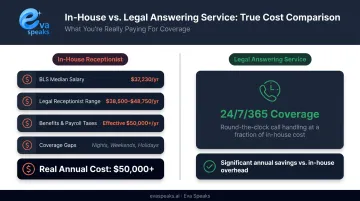
A legal answering service provides round-the-clock coverage for a fraction of that cost, with no overtime, no sick days, and no Monday-morning call backlog.
Beyond Message-Taking
That cost advantage only tells half the story. Modern legal answering services do far more than take messages — they actively move callers through your intake pipeline. Core functions include:
- Legal intake screening — qualifying callers by case type, injury timeline, or jurisdictional eligibility
- Conflict-of-interest filtering — collecting adverse party names before the call reaches an attorney
- Appointment scheduling — booking consultations directly into the firm's calendar
- CRM data entry — pushing caller details into Clio, MyCase, or PracticePanther in real time
A personal injury firm fielding post-accident calls at 2 a.m. has different needs entirely from an estate planning firm with weekday-only traffic. The services reviewed below are compared across both scenarios — high-volume urgent intake and lower-frequency scheduled consultation traffic. You can Watch AI Call Flow Demo to see how an AI platform handles a live law firm intake call.
Best Answering Services for Law Firms in 2026
These services were evaluated on response speed, intake depth, legal-specific training or configuration, CRM compatibility, security compliance, and pricing predictability.
Eva Speaks
Eva Speaks is an AI-powered communication platform built for inbound call routing, live transcription, and real-time responses using large language models (LLMs). For law firms, it delivers immediate caller engagement and structured intake data without requiring a human operator on each call.
What sets it apart is configurability. Key capabilities include:
- Call-flow scripts and routing rules customized per practice area (personal injury intake differs from criminal defense screening)
- LLM-backed responses that handle nuanced caller queries beyond simple menu trees
- Automated transcription producing searchable call records ready for attorney review
EvaSpeaks is also designed to be cost-predictable at scale: because it operates on a software-based model rather than per-minute live agent billing, a high-volume intake period from a marketing campaign does not produce proportionally higher costs the way traditional answering services would.
Because Eva Speaks operates on AI infrastructure rather than staffed receptionist teams, it answers instantly at any call volume with no hold times and no per-minute billing clock running.
| Feature | Detail |
|---|---|
| Service Model | AI-powered call handling with real-time LLM responses |
| Key Capabilities | Customizable call-flow scripts, automated transcription, 24/7 availability |
| Best Fit | Law firms prioritizing scalable, always-on AI intake without per-minute billing |
| Compliance & Integrations | Contact privacy@evaspeaks.ai for HIPAA compliance details and CRM integration specifics |
Smith.ai
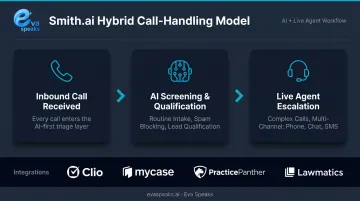
Smith.ai pairs AI call screening with North America-based live agents, giving law firms both automation speed and human judgment on the same account. Multi-channel coverage spans phone, web chat, and SMS, making it practical for firms running digital advertising alongside traditional referral intake.
Key differentiators:
- Custom lead qualification per practice area
- Outbound calling for follow-up and appointment confirmations
- Native integrations with Clio, MyCase, PracticePanther, and Lawmatics
- Spam and solicitation blocking at no extra charge
| Feature | Detail |
|---|---|
| Service Model | AI screening for routine intake; live agent escalation for complex calls |
| Pricing | AI Receptionist from $95/month; Live Receptionist from ~$300/month for 30 calls; per-call overage applies |
| Best Fit | Mid-size firms managing multi-channel lead capture who want AI efficiency with human backup |
Ruby
Founded in 2003, Ruby is a 100% US-based live virtual receptionist service with a strong following among solo attorneys and small firms where every caller interaction needs to feel personal.
Ruby's receptionists are trained to be indistinguishable from in-house staff. Firms manage call handling in real time via a mobile app, and the same receptionist team handles live website chat, avoiding the disjointed experience of separate phone and chat vendors.
| Feature | Detail |
|---|---|
| Service Model | Live US-based receptionists only; no AI call handling |
| Pricing | From $250/month for 50 minutes; per-minute billing at $3.45–$4.70/minute overage; bilingual outbound limited to weekday business hours |
| Best Fit | Solo attorneys and small firms where a premium human caller experience is non-negotiable |
Answering Legal
Answering Legal handles only law firm calls, with no cross-industry volume and no receptionists splitting attention across industries. That single-industry focus means receptionists speak the language of legal intake fluently, from case-type screening to conflict checks.
Standout features:
- Fully custom intake process built from your first setup call
- No add-on fees at any plan tier
- Month-to-month terms with no cancellation penalties
- Free AI intake chatbot for website visitors included alongside live answering
Integrations include Clio Grow, MyCase, PracticePanther, Lawmatics, Salesforce, Lead Docket, Smokeball, and Zapier.
| Feature | Detail |
|---|---|
| Service Model | Legal-only live answering; optional AI chatbot; 24/7/365 including holidays |
| Pricing | Custom quote required; flat-rate per-minute packages; no public tiers |
| Best Fit | Solo practitioners and small-to-mid-size firms needing a dedicated legal intake specialist team |
LEX Reception
LEX Reception operates as a legal-only virtual receptionist service, with receptionists trained exclusively on law firm protocols. Its Trustpilot score of 5 stars from 1,270 reviews is the strongest independent review signal in this category.
Key differentiators:
- Outbound follow-up for missed calls and appointment reminders
- English and Spanish bilingual coverage, 24/7
- Call analytics dashboard
- Native integrations with Clio, MyCase, PracticePanther, Lawmatics, and Zapier
| Feature | Detail |
|---|---|
| Service Model | Live legal-specialist receptionists; no AI handling; 24/7/365 |
| Pricing | Custom plans; minute-based billing; entry pricing unconfirmed; verify directly with LEX Reception |
| Best Fit | Small to mid-size firms on Clio or MyCase that want legal-specialist live answering |
How the Main Inbound Call Handling Options Compare
Here is how the main inbound call handling options compare for law firms:
| AI Legal Answering (EvaSpeaks) | Live Legal Answering (Smith.ai/Ruby) | In-House Legal Staff | |
|---|---|---|---|
| Features | 24/7 AI intake, matter routing, conflict pre-screening, Clio sync | Human agents trained in legal, 24/7, message delivery | Full interaction, deep firm knowledge, scheduling |
| Best-fit Business Size | Solo to mid-size firms | Growing practices | Larger firms |
| Key Strengths | Zero missed leads, instant CRM push, no overages | Human empathy, complex intake | Firm knowledge, attorney relationships | | Implementation Complexity | Low - Clio, MyCase connectors | Low | None (hire) | | Integration Capability | Clio, MyCase, PracticePanther native | Manual or limited API | Manual entry |
Key Features to Look for in a Legal Answering Service
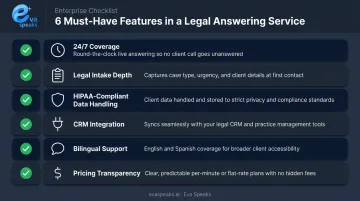
Generic answering services aren't equipped for legal calls. Mishandled intake, attorney-client privilege exposure, and lost leads are real risks when receptionists aren't trained on legal protocols. Here are the six features that matter most.
Six Features That Separate Legal Services from Generic Ones
- 24/7 coverage — not just business hours. Accident victims and arrested individuals don't call at convenient times
- Legal intake depth — qualifying callers by case type, screening for conflicts, collecting structured case details
- HIPAA-compliant data handling — encrypted call recordings, secure message transmission, controlled access; especially critical for personal injury and medical malpractice practices
- CRM integration — native sync with Clio, MyCase, PracticePanther, or Lawmatics eliminates double-entry and data gaps
- Bilingual support — Spanish-language coverage affects conversion rates in most US markets
- Pricing transparency — flat-rate and per-minute models behave very differently at scale; overage costs can double an effective monthly bill
AI vs. Live: Match the Model to Your Calls
| Dimension | AI Services | Live Receptionist Services |
|---|---|---|
| Response speed | Instant, any volume, no hold time | Varies; queue-dependent |
| Cost predictability | Flat-rate; no per-minute exposure | Per-minute billing; overage risk |
| Emotional sensitivity | Limited; scripted empathy | Human judgment; genuine rapport |
| Best call type | Standard intake, screening, scheduling | Distressed callers, crisis situations |
A firm handling primarily post-accident personal injury calls or criminal defense inquiries should weigh human judgment heavily. A firm with high-volume, structured intake — immigration, estate planning, business law — benefits more from an AI-first model.
Integration Reality Check
That AI vs. live decision only matters if the service actually connects to your workflow. A service that doesn't sync with your case management software creates duplicate data entry and gaps in the matter record. Here's how integration stacks up across the five services:
| Service | Clio | MyCase | PracticePanther | Lawmatics |
|---|---|---|---|---|
| Eva Speaks | Contact vendor | Contact vendor | Contact vendor | Contact vendor |
| Smith.ai | ✓ Native | ✓ Native | ✓ Native | ✓ Native |
| Ruby | ✓ | Unverified | Unverified | Unverified |
| Answering Legal | ✓ Native | ✓ Native | ✓ Native | ✓ Native |
| LEX Reception | ✓ Native | ✓ Native | ✓ Native | ✓ Native |
Eva Speaks uses a customizable API and integration model. Contact the vendor directly to confirm setup for your specific CRM. Firms that want a setup mapped to their exact practice area and case management system can Get a Customized Workflow Recommendation to start that conversation.
How We Chose the Best Answering Services for Law Firms
Each service was evaluated across six criteria:
- Legal-specific training or AI configuration capability
- Breadth of CRM integrations
- Pricing model predictability
- Security and compliance standards (HIPAA minimum)
- 24/7 availability
- Verified customer feedback from law firm users
The most common mistake firms make: choosing based on the lowest headline price without accounting for per-minute overage costs. A service priced at $250/month with $4.50/minute overage becomes a $600+ bill for a firm averaging 10-minute intake calls at reasonable monthly volume.
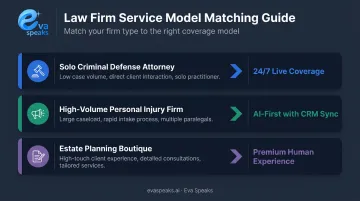
Firm size and practice area should drive the final decision:
- Solo criminal defense attorney: needs 24/7 live coverage, fast crisis-sensitive intake, and rarely need multi-channel chat
- 10-attorney personal injury firm running TV ads: needs high-volume scalability, structured intake scripts, CRM sync, and predictable pricing as call volume fluctuates
- Estate planning boutique: fewer calls, higher stakes — a premium human experience often matters more than 24/7 AI coverage
The metrics that actually matter: cost per acquired client, conversion rate from first call to booked consultation, and attorney hours recovered from non-billable administrative work.
Conclusion
The right answering service answers before your competitor does, captures the intake detail that moves a case forward, and integrates cleanly with how your firm already operates. Feature lists matter less than whether the service fits your call type, volume, and budget model.
Evaluate pricing models carefully before committing. Per-minute billing is unpredictable as call volume grows; flat-rate AI services offer cost certainty that scales without penalty. Request demos or free trials before signing anything — every service on this list should be willing to demonstrate before you commit.
If 24/7 coverage, predictable pricing, and automated intake are your priorities, Eva Speaks is built for that. Its AI-powered call flows handle real-time responses and configurable intake scripts without adding headcount — or per-minute billing surprises. Reach out at privacy@evaspeaks.ai to discuss your firm's specific needs, or See How AI Handles After-Hours Calls for a practical example of what after-hours coverage looks like.
Frequently Asked Questions
How can attorneys handle inbound calls effectively?
Use a legal answering service or AI-powered call handling for 24/7 coverage, set up practice-area-specific intake scripts to qualify callers immediately, and integrate call data directly with your case management software. This ensures every caller's details reach the right file without gaps or delays.
What inbound tools help manage law firm calls?
The main categories are dedicated legal answering services (live or AI), CRM-integrated call tracking platforms, and AI voice agents with automated intake. Tools that pair instant response with structured data capture — syncing directly into your case management system — remove manual re-entry entirely.
What are the three basic requirements for attorney-client privilege?
The communication must be between an attorney and a client (or prospective client), made in confidence without third-party presence, and for the purpose of seeking or providing legal advice. Answering service agents and AI systems should collect intake information only — providing substantive legal guidance falls outside privilege protection for non-attorneys.
Can AI answering services handle legal client intake?
Yes. AI services can capture caller details, screen for case eligibility based on firm-defined criteria, schedule consultations, and sync data to CRMs. For highly sensitive call types — criminal defense, domestic violence — many firms supplement AI intake with a live escalation option for distressed callers.
What's the difference between an answering service and a virtual receptionist for law firms?
An answering service typically handles message-taking and call routing. A virtual receptionist provides fuller front-desk functions — live intake, appointment scheduling, outbound follow-up, and direct CRM entry. Many services now market both terms interchangeably; the practical distinction is intake depth and real-time calendar access.
Are legal answering services HIPAA compliant?
Reputable services maintain HIPAA-compliant data handling: encrypted recordings, secure message transmission, and controlled data access. If your firm handles personal injury or medical malpractice matters, require a signed Business Associate Agreement (BAA) from any service processing protected health information before going live.