The gap between those two realities is costing businesses more than they realize. Legacy IVR doesn't just frustrate callers — it inflates handle times, increases agent workload, and quietly erodes trust every time a call gets misrouted or dropped into a dead-end menu.
This article covers what makes legacy IVR fall short, how conversational AI changes the equation, the real business case for modernizing, and a practical roadmap for getting started.
Key Takeaways
- Legacy IVR relies on fixed menus and touch-tone inputs that break down under real call complexity.
- Conversational AI IVR uses natural language understanding and LLM integration to handle spoken intent dynamically.
- Businesses that modernize report measurable gains in call containment, agent efficiency, and customer satisfaction.
- Starting with high-volume, repetitive call types delivers the fastest ROI from a phased modernization rollout.
- Strong platform choices offer LLM integration, customizable call-flow logic, CRM connectivity, and analytics depth.
Why Legacy IVR Is Costing Your Business More Than You Realize
The license fee is the smallest part of the problem. The real cost is operational drag — compounding, call by call.
Gartner research from 2024 found that only 14% of customer service issues are fully resolved in self-service — and even issues customers describe as "very simple" resolve without agent involvement only 36% of the time. That means most callers navigating an IVR menu end up reaching a live agent anyway, with the added frustration of having gone through the menu first.
The Static Menu Problem
Legacy IVR is hardcoded. When menus can't adapt to what a caller actually needs, people with non-standard requests spend time cycling through options that don't fit — inflating both handle time and frustration simultaneously.
The same Gartner data shows 45% of customers said the company didn't understand what they were trying to accomplish. A separate 43% of failed self-service attempts occurred simply because callers couldn't find content relevant to their issue.
Where Language Breaks Down
Legacy systems are built for short keywords or keypad input. Accented speech, conversational phrasing, and background noise can all cause the system to misfire, forcing callers to repeat themselves or abandon the call entirely.
ContactBabel's Inner Circle Guide to Self-Service found that 71% of voice self-service abandonments happen because the functionality doesn't meet customer needs. That's not a volume problem or a staffing problem — it's a capability problem baked into the technology itself.
The Downstream Cost of Routing Errors
Rigid routing logic sends callers to the wrong queue. Agents then spend the first part of every transfer reconstructing context from scratch, which drives up average handle time and repeat call rates.
Genesys reported that predictive routing alone reduced average handle time by 14% in one deployment — a direct measure of how much overhead poor routing generates. That overhead compounds across every misrouted call:
- Higher abandonment rates as callers give up mid-transfer
- More repeat calls from unresolved first interactions
- Eroded customer trust that accumulates quietly over time
Each of these effects is addressable. The question is whether your current system has the flexibility to fix them.
See how AI automation goes beyond what IVR ever could. Explore AI Call Automation
What Is Conversational AI IVR and How Does It Work?
Conversational AI IVR replaces fixed menu trees with natural language understanding and machine learning. Rather than forcing callers through preset choices, the system lets them speak naturally — "I need to reschedule my appointment" or "What's my account balance?" — and interprets the intent behind those words in real time.
The Core Technology Stack
Four layers work together during each call:
- Automatic speech recognition (ASR) captures the caller's words as they speak
- Natural language processing (NLP) parses intent and extracts relevant entities — account numbers, dates, request types
- Intent engine matches the recognized intent to a configured workflow
- Response generation either executes an action (pulling account data, confirming an appointment) or escalates intelligently to a live agent
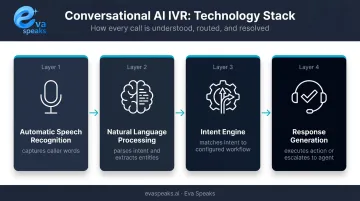
The entire exchange happens within a conversational flow, not a menu sequence.
The Role of LLM Integration
Modern platforms that integrate large language models handle multi-turn conversations — where context from earlier in the call informs later responses — and can generate answers that feel relevant and contextual. AWS's production architecture for voice contact centers targets caller response times of 2.5 seconds or less, keeping interactions natural and responsive.
Unlike static IVR, AI-driven systems improve over time by learning from real call data — refining intent models and reducing misclassifications as call volume accumulates.
Legacy IVR vs. Conversational AI — Key Differences
| Dimension | Legacy IVR | Conversational AI IVR |
|---|---|---|
| Input method | Touch-tone / short keywords | Natural spoken language |
| Interaction model | Menu-driven | Intent-driven |
| Flexibility | Fixed, hardcoded | Adaptive, configurable |
| Personalization | None | Context-aware |
| Call containment | Low | Significantly higher |
| Improvement over time | Static | Continuous learning |
Here is how legacy IVR, conversational AI, and hybrid IVR+AI compare across key business dimensions:
| Conversational AI IVR (EvaSpeaks) | Legacy DTMF IVR | Hybrid IVR + AI | |
|---|---|---|---|
| Features | Natural language, intent detection, dynamic routing, CRM sync | Fixed menus, DTMF input, hold queue | IVR front-end + AI escalation layer |
| Best-fit Business Size | SMB to large enterprises | Large enterprise with legacy systems | Mid-market transitioning away from IVR |
| Key Strengths | High containment, no caller frustration, fast updates | Proven, widely deployed | Gradual migration path |
| Implementation Complexity | Low - replaces IVR, no IT team needed | High - telephony engineers required | Medium |
| Integration Capability | CRM, EHR, scheduling native | Custom dev required | Varies |
The shift isn't just technological. Conversational AI IVR transforms the phone channel into a resolution engine — one that solves problems directly rather than simply routing callers toward humans.
Watch how AI handles a real call compared to IVR. Watch AI Call Flow Demo
The Business Benefits of Modernizing Your IVR
Higher Call Containment and First-Call Resolution
When the system correctly identifies intent and has access to backend data, more calls get resolved without agent involvement. A Forrester Consulting Total Economic Impact study for PolyAI modeled a composite organization that resolved 40% of customer calls by Year 3 using conversational AI — a containment rate that's not achievable with legacy menu logic.
A separate Microsoft/Nuance case example described a global telecommunications company automating over 70% of 4 million monthly calls with conversational IVR.
Lower Operational Costs at Scale
The same Forrester TEI study reported:
- Over $10.2M in agent labor savings over three years
- 191,100 live agent hours saved in Year 3
- 92 new agent hires avoided by Year 3
- More than $1M in avoided recruitment and training costs
Those numbers reflect a specific modeled organization, but the underlying dynamic scales broadly: automating high-volume, repetitive call types reduces live-agent minutes without requiring headcount additions during peak periods.
Measurable Customer Satisfaction Gains
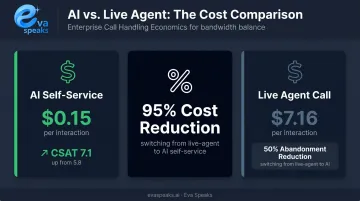
Fewer transfers, faster answers, and a conversational tone create a noticeably better experience. The Forrester TEI study cited one organization that saw customer satisfaction scores improve from 5.8 to 7.1 within a year of deployment. The same study reported a 50% reduction in call abandonment after implementation.
The cost picture reinforces this. ContactBabel's data puts self-service at roughly $0.15 per interaction, versus $7.16 per live-agent phone interaction. That 95% cost gap adds up fast at scale.
Richer Operational Intelligence
Legacy IVR produces call counts and hold times. Conversational AI generates transcripts, intent trend data, and sentiment signals from every interaction. Those signals give operations teams something legacy systems never could:
- Visibility into which issues are spiking before they become escalations
- Concrete data for agent coaching and script refinement
- Early signals on product or service gaps that callers mention repeatedly
The phone channel stops being a black box and becomes a continuous source of operational intelligence.
Ready to see this for your call setup? Request Live Demo
How to Build a Modernization Roadmap for Your IVR
Start With Call Data, Not Technology
Pull at least three to six months of inbound call logs and map call types by volume and resolution complexity. The goal is to identify the top repeatable intents — balance inquiries, appointment scheduling, order status, FAQ-style questions — that are strong candidates for AI containment before any platform decision is made.
This analysis usually surfaces 20–30% of call volume concentrated in a handful of intent types. That's where you start.
Take a Phased Approach
A full rip-and-replace is rarely the right first move. A phased approach looks like this:
- Select one or two high-volume, low-complexity call types for an initial pilot
- Set measurable KPIs — containment rate, average handle time, escalation rate
- Run the pilot on real call volume, not just test scenarios
- Iterate based on actual call data before expanding to additional intent types
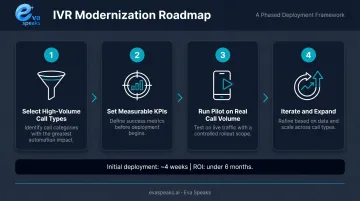
The Forrester TEI study noted that initial deployment for the modeled organization took approximately four weeks, with ROI realized in under six months. Timelines vary by platform and complexity, but a phased pilot on a single call type is achievable in days to weeks with cloud-native platforms.
Design Human Handoff as a Feature
The most effective AI IVR deployments treat escalation as a designed capability, not an afterthought. A well-built handoff includes:
- Full conversation context and transcript passed to the live agent
- Caller intent and sentiment flagged before the transfer completes
- Zero repeated questions — the agent picks up exactly where the AI left off
Done right, warm transfers cut handle time on escalated calls and measurably improve CSAT scores — because callers notice immediately when an agent already knows why they called.
What to Look for in a Conversational AI IVR Platform
Natural Language Understanding and LLM Integration
A platform that processes intent through an LLM — rather than keyword matching — handles conversational phrasing, multi-turn context, and nuanced requests more reliably. This is the core capability gap between modern conversational AI and older speech recognition layers.
Look specifically for:
- LLM-backed intent inference (not just keyword matching)
- Multi-turn context retention across a single call session
- Handling of accented or informal speech
- Sub-3-second response latency for natural conversation flow
Customization and Integration Flexibility
The ability to configure call-flow logic, define routing rules, and connect with existing CRMs or backend systems determines whether the AI can resolve calls — or just route them. Platforms that require heavy engineering effort for basic configuration slow down deployment and raise the total cost of ownership.
EvaSpeaks, for example, provides LLM-backed call handling with customizable call-flow scripts and routing rules, along with transcription services and real-time AI responses that integrate with existing CRMs and telephony infrastructure. Customers also have opt-out controls over how their call data is used for AI model training — a concrete compliance consideration for regulated industries. EvaSpeaks also represents a more accessible entry point into conversational AI IVR than enterprise platforms: businesses can configure it through a non-technical dashboard and connect it to their existing phone number without a dedicated implementation project.
Analytics, Compliance, and Scalability
Integration flexibility only gets you so far — how the platform handles data, reporting, and traffic spikes will determine long-term viability. Before committing, verify three things:
- Analytics depth — call transcripts, intent reporting, and sentiment data to support ongoing optimization
- Compliance fit — especially for regulated industries; confirm the platform's data handling aligns with your requirements (Eva Speaks complies with applicable U.S. federal and state privacy frameworks across multiple states)
- Scalability — the platform should handle peak call volumes without degradation and ideally without requiring manual capacity adjustments
Have questions about which platform fits your needs? Talk to an AI Communication Expert
Frequently Asked Questions
What is the difference between conversational AI and IVR?
Traditional IVR uses touch-tone inputs and fixed menu trees to route calls. Conversational AI IVR uses natural language processing and machine learning to understand spoken intent, hold multi-turn conversations, and resolve or route calls dynamically — giving it far greater accuracy and flexibility across a wider range of caller needs.
Is IVR outdated?
Traditional touch-tone IVR is increasingly inadequate for modern caller expectations and call complexity. Automated call handling itself isn't obsolete — the underlying technology is. Conversational AI replaces rigid menus with faster, more accurate, and more satisfying experiences.
What are the main limitations of legacy IVR systems?
The core pain points include:
- Static menus that can't adapt to unique caller needs
- Limited language understanding that breaks on accented or conversational speech
- Routing errors that generate expensive agent transfers
- Impersonal experiences that drive abandonment and repeat calls
How does conversational AI IVR improve call containment rates?
Higher containment comes from better intent recognition and backend integration. When the AI correctly understands what a caller needs and has access to relevant systems to act on it, a larger share of calls can be resolved without a live agent.
How long does it take to modernize a legacy IVR system?
A phased pilot on a single call type can go live in days to weeks with modern platforms. A full migration replacing a complex legacy system may take several months. Starting with high-volume, repetitive call types is the fastest path to measurable results.
What features should I prioritize when choosing a conversational AI IVR platform?
Focus on these five capabilities:
- LLM-powered natural language understanding for accurate intent recognition
- Customizable call-flow and routing configuration
- CRM and backend integration for real-time data access
- Low-latency response performance during live calls
- Call transcripts and intent analytics for ongoing optimization