Introduction
Conversational AI now touches nearly every stage of the patient journey — inbound appointment calls, post-visit follow-ups, prescription refill requests, symptom triage, and insurance verification. What was a niche experiment five years ago has become standard infrastructure for health systems and medical practices of every size.
The numbers reflect that shift. According to Grand View Research, the broader AI-in-healthcare market was valued at $36.67 billion in 2025 and is projected to reach $505.59 billion by 2033. A 2026 McKinsey survey found that 50% of US healthcare organizations had already implemented generative AI — with another 51% pursuing proofs of concept.
Adoption hasn't translated into understanding. Most providers deploying conversational AI don't know what actually happens between a patient saying "I need to reschedule" and a confirmed appointment appearing in the EHR. That gap leads to:
- Poor vendor selection based on surface-level demos
- Compliance blind spots around PHI handling and audit trails
- Systems that fail to perform once real patient volume hits
This guide covers the mechanics — how conversational AI processes patient input, generates responses, connects to clinical systems, and enforces the compliance guardrails healthcare can't afford to skip. Healthcare administrators who want to see how Eva Speaks handles a full patient conversation can Request Live Demo.
Key Takeaways
- Conversational AI uses NLP, machine learning, and LLMs to handle patient communication in real time
- It runs through a defined pipeline — from input capture and intent recognition to response generation and EHR integration
- Core use cases include scheduling, triage, prescription refills, post-visit follow-up, and administrative Q&A
- In 2026, systems have moved from rigid scripted bots to LLM-powered, voice-capable platforms with direct EHR integration
- HIPAA compliance is built into the architecture: BAAs, audit trails, and escalation logic are required, not optional
What Is Conversational AI in Healthcare?
Conversational AI in healthcare refers to AI-powered systems — chatbots, voice assistants, and automated messaging tools — that engage patients, providers, or staff in natural dialogue to complete clinical or administrative tasks. The distinguishing factor is the ability to understand varied, unpredictable language and respond coherently, not just match keywords to preset answers.
Healthcare communication has always been high-volume, repetitive, and bottlenecked by staff availability. Conversational AI was built for that communication layer — handling the exchange of information that precedes and follows clinical decisions, without touching the decisions themselves.
What It Is Not
Three categories get conflated with conversational AI — and the distinctions matter:
- IVR/phone trees follow rigid scripted paths; conversational AI understands natural language and adapts mid-conversation
- Consumer tools like ChatGPT are general-purpose products not built for PHI handling, clinical routing, or HIPAA compliance
- Diagnostic AI analyzes clinical data to suggest diagnoses; conversational AI operates at the communication layer, not the decision layer
Understanding what conversational AI is not makes it easier to evaluate the actual architectures in use today.
Types in Use in 2026
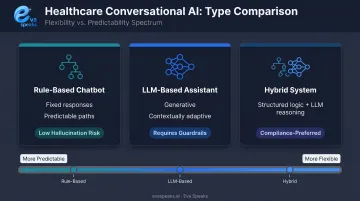
| Type | How It Works | Risk Profile |
|---|---|---|
| Rule-based chatbot | Scripted decision trees, fixed predictable responses | Low flexibility, low hallucination risk |
| LLM-based assistant | Generative, contextually adaptive responses | Higher flexibility, requires guardrails |
| Hybrid system | Structured logic combined with LLM reasoning | Preferred balance for compliance-sensitive environments |
A 2025 systematic review of 160 studies classifies healthcare chatbot architectures across exactly these three categories — rule-based, ML-based, and LLM-based — with each presenting different tradeoffs between adaptability and predictability.
How Does Conversational AI Work in Healthcare?
Healthcare conversational AI doesn't function as a single black box. It operates through a defined sequence of stages, each contributing to the system's ability to understand intent, retrieve relevant information, and respond accurately while maintaining compliance.
Initiation: How the Conversation Begins
A patient or staff member triggers the system through a supported channel — phone call, SMS, web chat, or patient portal message — and the system activates a session, capturing input type and channel context.
Initiation can be:
- Patient-driven — an inbound call to reschedule, ask about lab results, or request a refill
- System-driven — an outbound reminder for an upcoming appointment, a post-discharge check-in, or a medication follow-up
Eva Speaks, for example, handles both directions within the same platform — answering inbound patient calls 24/7 while also placing outbound confirmation and reminder calls on configurable schedules.
A frequently missed detail at this stage: routing logic matters from the first second. A well-configured initiation layer distinguishes urgent clinical contacts from routine administrative inquiries immediately — directing them to different handling paths before any conversation occurs.
Eva's smart call routing achieves this through configurable rules based on caller intent, time of day, department availability, and custom logic built in the dashboard. For smaller practices without dedicated IT staff, this matters because routing changes can be applied directly through the dashboard — updating after-hours behavior, adding a new department queue, or adjusting escalation thresholds doesn't require submitting a support ticket or involving a vendor.
Core Operation: Understanding and Responding
Once input is received, it passes through Natural Language Processing (NLP) and Natural Language Understanding (NLU) layers that:
- Parse the words — converting speech or text into processable input
- Identify intent — "schedule appointment" vs. "ask about lab results" vs. "request a refill"
- Extract entities — dates, medication names, provider names, insurance details
This is well-documented in practice. The JAMIA Watson Assistant deployment across 37 institutions explicitly relied on intent understanding, entity extraction, query expansion, and answer retrieval as its core technical components — delivering over 6.8 million messages for administrative questions.
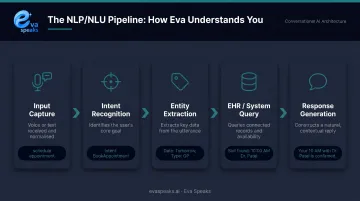
After intent and entity extraction, the system queries connected systems — EHR platforms, scheduling tools, patient records — and formulates a response. Eva integrates directly with Epic, athenahealth, Dentrix, eClinicalWorks, and NextGen, with write-back capabilities: it doesn't just read availability, it books the appointment and pushes the confirmation back to the record.
Accuracy depends on several factors, each of which is controllable:
- Quality and recency of training data
- Specificity of call-flow scripts and routing rules
- Depth of real-time EHR integration
- How well the knowledge base reflects the practice's actual workflows
Systems drawing on live patient data and integrated scheduling produce substantially more accurate responses than those working from static FAQ documents.
Regulation and Control: Maintaining Safety and Guardrails
Getting the response right is only part of the equation. Once the system can understand and reply, the next layer controls what happens when it shouldn't — or can't — handle a request safely.
Escalation logic recognizes when patient input exceeds the system's safe handling scope. Triggers typically include:
- Mentions of emergency symptoms
- Expressions of suicidal ideation
- Requests that require clinical judgment
- Ambiguous or high-acuity situations the system isn't configured to resolve
When triggered, the system routes immediately to a live agent, on-call clinician, or emergency service — no conversational dead ends.
Conversation state tracking prevents contradictory responses within a session. The system remembers prior turns, so a patient who mentioned a specific medication two exchanges ago doesn't get a generic response later in the same call.
Interaction logging captures every exchange for audit review. Under HIPAA Security Rule audit controls at 45 CFR 164.312(b), systems containing ePHI must implement mechanisms to record and examine activity — non-compliance here creates direct regulatory exposure.
Unlike e-commerce or customer service deployments, an incorrect or incomplete AI response in healthcare can have clinical consequences. Guardrails, fallback paths, and human escalation are structural requirements.
Output and System Integration
The conversation concludes with two outputs running in parallel:
- Patient-facing: a delivered response — voice, text, or confirmation message
- System-facing: a backend action logged, written, or flagged in connected platforms
In well-integrated deployments, the AI's actions write back to scheduling systems and EHRs automatically. The conversation doesn't live in a silo — it becomes part of the patient record and care workflow. Eva routes transcripts and structured interaction data directly into the patient record, so the clinical team works from a single source of truth rather than chasing call notes.
On outcomes: a 2023 randomized quality-improvement study using an EHR-based risk model combined with targeted outreach reduced composite no-show rates from 36.2% to 32.8% among high-risk appointments — and from 42.1% to 35.8% for Black patients.
That result reflects AI-integrated outreach, not autonomous chatbot performance alone — but it illustrates what happens when AI-driven patient contact is tied to real scheduling data.
How Conversational AI Compares to IVR and Human Staff
Before examining where conversational AI fits, it helps to see how it stacks up against the two alternatives most healthcare organizations are already using - traditional IVR phone systems and human clinical support staff.
| Conversational AI (EvaSpeaks) | Traditional Healthcare IVR | Human Clinical Support Staff | |
|---|---|---|---|
| Features | Natural language, scheduling, triage, EHR sync, 24/7 | DTMF menus, appointment reminders, hold queue | Full clinical interaction, judgment, adaptive |
| Best-fit Business Size | Clinics to large health systems | Enterprise health networks | Small to large practices |
| Key Strengths | 24/7, no hold time, HIPAA-compliant, consistent | Widely deployed, structured | Human empathy, complex care coordination |
| Implementation Complexity | Low - EHR connectors | High - months | None (hire) |
| Integration Capability | Epic, Cerner, Athena, scheduling native | Custom dev required | Manual entry |
EvaSpeaks is designed to be configured directly from a dashboard - no vendor tickets, no months-long implementation cycles. Practices of any size can connect existing EHR systems, adjust routing logic, and go live on their own timeline.
Where Conversational AI Fits in Healthcare Workflows
Conversational AI earns its place in healthcare by handling predictable, high-volume touchpoints that consistently exceed what staff can manage manually.
Strong fit:
- Inbound appointment scheduling and rescheduling
- Prescription refill requests
- Insurance verification questions
- Post-discharge check-ins and follow-up
- Routine symptom assessment and triage routing
- Appointment reminder outreach
These workflows share a common characteristic: a defined set of possible responses, clear escalation paths, and no requirement for clinical judgment.
These same use cases scale well across specific care settings:
- Multi-location practices with distributed call volume
- Hospital systems running high-traffic contact centers
- Telehealth platforms needing 24/7 responsiveness
- Any setting where after-hours coverage requires automation rather than on-call staff
That said, not every patient interaction is a fit. Some conversations require human presence — and a well-configured system knows which ones.
Where it should not be the primary interface:
- Complex clinical consultations
- End-of-life care conversations
- High-acuity triage decisions requiring immediate clinical assessment
- Legal or informed consent documentation
When any of these scenarios arise, the AI's job is clean handoff — getting the patient to the right human, fast. Organizations that want to understand where AI call automation fits within their clinical operations can Explore AI Call Automation to see the full picture.
Compliance, Privacy, and Safety in Healthcare Conversational AI
HIPAA compliance in conversational AI runs deeper than policy documents. Every architectural decision — from data storage to access controls — determines whether a deployment is truly compliant or just paperwork-covered.
The Business Associate Agreement Is Non-Negotiable
Any AI vendor that creates, receives, maintains, or transmits protected health information (PHI) on behalf of a covered entity is a business associate under HIPAA. HHS is explicit: covered entities must obtain written satisfactory assurances from business associates that PHI will be safeguarded. No BAA means the deployment is non-compliant, regardless of the vendor's other security claims.
What About ChatGPT?
A common question: is there a HIPAA-compliant version of ChatGPT? The consumer ChatGPT product — Free or Plus — does not offer BAAs and cannot be used with PHI. OpenAI's own guidance states that organizations need a BAA before using its API platform with PHI, and it maintains separate healthcare regulated workspace documentation for covered arrangements. Healthcare AI platforms built for clinical environments include these controls by design. General consumer tools do not.
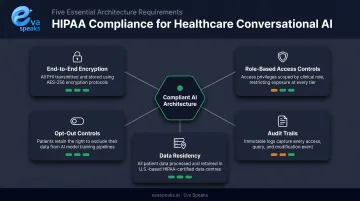
What Compliant Architecture Actually Requires
- End-to-end encryption — data in transit and at rest
- Role-based access controls — limiting who can retrieve interaction logs
- Audit trails — full logs of every interaction, what data was accessed, and when
- Data residency — processing and storage in compliant environments (Eva processes data in US data centers)
- Opt-out controls — patients and clients should be able to control how interaction data is used
The enforcement environment makes this consequential. HHS OCR's 2024 compliance report recorded 730 compliance reviews initiated and $8.76 million in corrective action settlements — including settlements specifically targeting business associates. When a vendor mishandles PHI, the covered entity shares liability. Vetting your AI vendor's BAA, audit logging, and data residency policies is as important as vetting the AI itself. To see how Eva Speaks handles a real healthcare patient call within its HIPAA-aligned architecture, you can Watch AI Call Flow Demo.
Frequently Asked Questions
What is conversational AI in healthcare?
Conversational AI in healthcare refers to AI-powered systems — chatbots, voice assistants, and automated messaging tools — that handle patient-provider communication using NLP and machine learning. They support real-time interactions for scheduling, triage, follow-ups, prescription refills, and administrative tasks.
Is there a HIPAA-compliant version of ChatGPT?
The consumer ChatGPT product is not HIPAA compliant and cannot be used with PHI. Enterprise-grade healthcare conversational AI platforms are purpose-built with BAAs, encryption, access controls, and audit trails that meet HIPAA requirements.
What types of conversational AI are used in healthcare?
Three main types: rule-based chatbots (scripted decision trees), LLM-based assistants (generative and contextually adaptive), and hybrid systems combining both. Hybrid models are increasingly preferred for balancing flexibility with compliance-safe deterministic logic.
How does conversational AI protect patient data?
Compliant systems use end-to-end encryption, role-based access controls, full interaction logs, and data handling policies aligned with HIPAA. Responsible vendors sign a Business Associate Agreement and process PHI only within governed, auditable environments.
Can conversational AI replace healthcare staff?
Conversational AI supplements staff by handling high-volume, repetitive communication tasks — freeing clinical and administrative teams for complex patient needs. Escalation to a human remains essential for anything requiring clinical judgment or emotional nuance.
What is the difference between a healthcare chatbot and conversational AI?
A basic chatbot follows rigid, pre-scripted decision trees with no flexibility. Conversational AI uses NLP, machine learning, and large language models to understand context, adapt to varied inputs, and generate dynamic responses — making it significantly more capable for the variability of real patient communication.
Conclusion
Conversational AI in healthcare works when it's built around a clear pipeline. That pipeline includes:
- Structured initiation that captures patient intent from the first exchange
- NLP-driven recognition that maps spoken or typed input to actionable categories
- Real-time data access connected to EHR, scheduling, and practice management systems
- Guardrail-protected response generation that flags clinical risk and escalates appropriately
- Output that integrates into existing workflows rather than running parallel to them
Providers and administrators who understand that pipeline are better positioned to evaluate vendors honestly, set realistic expectations, configure appropriate escalation paths, and deploy systems that actually improve patient communication. The technology has matured, but deployment quality still comes down to the decisions made before go-live — not the claims made during the sales process. Healthcare organizations ready to take the next step can Talk to an AI Communication Expert to discuss deployment for their specific patient population and EHR environment.