Introduction
Call center performance management is under pressure from multiple directions at once. AI capabilities are maturing faster than most operations teams can adopt them, customer expectations keep rising, and the cost of agent attrition continues to climb — reaching a projected 31.2% in 2024, according to Metrigy.
At the same time, the contact center software market is accelerating. Grand View Research projects the market will grow from $47.71 billion in 2025 to $227.57 billion by 2033 — a 21.9% CAGR that reflects how aggressively organizations are investing in new capabilities.
Five trends are reshaping how performance gets managed, measured, and improved. This article breaks each one down — what it looks like in practice, why it's gaining traction, and what contact centers need to act on now.
Key Takeaways
- Real-time AI analytics has replaced reactive dashboards, delivering in-the-moment coaching that improves FCR and AHT
- Fragmented point solutions are giving way to unified platforms that connect QA, CRM, WFM, and coaching data in one view
- Predictive analytics is turning workforce planning from a reactive scramble into a proactive strategy
- LLM-powered QA now scores 100% of interactions automatically, up from less than 1% with manual review
- Gamification tied to real KPIs is emerging as a retention tool as attrition rates push toward historic highs
Trend 1: AI-Powered Real-Time Analytics and Agent Coaching
From End-of-Day Reports to In-the-Moment Visibility
Real-time AI coaching flips the traditional feedback loop. Instead of a supervisor reviewing last week's calls and scheduling a one-on-one, AI surfaces performance insights during live interactions — flagging tone issues, missed objection-handling moments, or escalation risk as the conversation happens.
Under the hood, AI monitors call audio and transcription in real time, cross-references the interaction against QA frameworks and historical performance patterns, and delivers targeted prompts to agents or supervisors without interrupting the call flow. Recommendations aren't generic ("be more empathetic") — they're grounded in the specific interaction.
The performance case for this approach is strong. An NBER study of 5,179 customer support agents found that generative AI assistance:
- Increased issues resolved per hour by 14%
- Reduced average handle time by 9% (roughly 3.8 minutes from baseline)
- Improved resolution rates by 1.3 percentage points
- Delivered a 34% productivity boost for newer and lower-skilled agents specifically
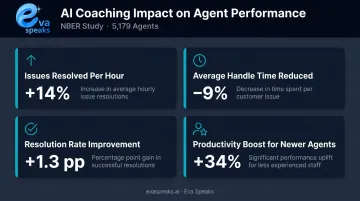
That 34% figure is where the real operational leverage lies. Real-time coaching compresses the learning curve for new hires — a meaningful advantage when attrition keeps cycling inexperienced agents through the floor.
Why This Is Accelerating
The volume problem is the core driver. Contact centers handling thousands of calls per day cannot rely on supervisors sampling 2–3% of interactions and scheduling monthly coaching sessions. The math doesn't work. AI closes the gap by monitoring every call and acting on what it finds — not once the damage is done, but while there's still time to adjust.
Zendesk's 2025 CX Trends survey found that 73% of agents believe an AI copilot would improve their job performance. That level of agent-side buy-in reduces pushback during rollout — when frontline staff see the tool as support rather than surveillance, deployment resistance drops considerably.
Watch how AI-driven routing and analytics work in a live call. Watch AI Call Flow Demo
Trend 2: Unified Cross-System Performance Data
The Fragmentation Problem
Ask a contact center supervisor how long it takes to get a complete picture of one agent's performance, and the answer usually involves logging into three or four different systems. QA scores live in one platform. Coaching logs in another. CRM interaction history somewhere else. Scheduling data in WFM. None of it talks to the rest.
The cost of this fragmentation isn't just inconvenience. Managers spend time reconciling reports instead of improving performance. Coaching sessions happen without QA context. Staffing decisions don't account for skill development data. The whole system underperforms because the information is there — it's just never connected.
Salesforce's Sixth Edition State of Service report puts numbers to this:
- 58% of agents at underperforming organizations toggle between multiple screens during calls
- 36% at high performers do the same — a 22-point gap that correlates directly with performance outcomes
- 82% of high-performing service organizations use a single unified CRM across service, sales, and marketing
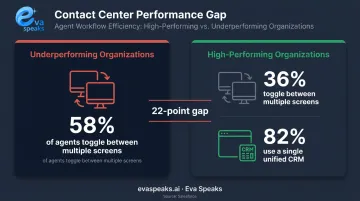
That gap doesn't close on its own — it closes when organizations stop treating data as a byproduct of operations and start treating it as infrastructure.
The Competitive Advantage in 2026
The organizations gaining ground are those that connect call metadata, QA outcomes, routing decisions, and agent development data into one coherent view. When a supervisor can see that an agent's QA scores dip on Friday afternoons, cross-reference that with call volume data, and tie it back to specific interaction types, coaching conversations become targeted rather than generic.
Platforms like EvaSpeaks, which capture routing outcomes, call transcripts, and interaction metadata as native outputs of AI call handling, provide the raw data layer that unified analytics environments need. Contact centers that build this connected infrastructure in 2026 will spend less time hunting for context and more time acting on it. EvaSpeaks is a practical entry point for this type of data infrastructure because it generates structured call records — transcripts, routing outcomes, caller metadata — as part of standard operations, without requiring a separate analytics layer to be built and maintained.
How AI-Native, Cloud Analytics, and Legacy Reporting Tools Compare
Not all platforms approach call routing analytics the same way. Here is how the three main solution types stack up for contact center team performance management:
| AI + Analytics (EvaSpeaks) | Cloud Analytics Platform (Mixpanel/Looker) | Legacy Call Reporting | |
|---|---|---|---|
| Features | Real-time AI call data, intent tagging, routing rules, CRM push | Custom analytics dashboards, BI tools | Scheduled reports, basic call logs |
| Best-fit Business Size | SMB to mid-market | Any size | Large enterprise |
| Key Strengths | Unified call + data, zero manual tagging, instant CRM | Deep custom analytics | Familiar, minimal change | | Implementation Complexity | Low | Medium | Low | | Integration Capability | CRM, BI tools, ticketing native | API-based | Limited |
Trend 3: Predictive Analytics and Intelligent Workforce Optimization
Forecasting Before the Problem Hits
Reactive workforce planning creates a familiar pattern: too many agents sitting idle Tuesday morning, not enough available Friday at 4pm, a campaign launch triggers an unplanned volume spike, and abandonment rates climb accordingly.
Predictive analytics changes this by analyzing historical call volume patterns, agent performance data, and external variables — seasonality and marketing campaign calendars — to forecast staffing requirements before gaps appear. The goal isn't perfect prediction; it's shifting from firefighting to preparation.
McKinsey's research on contact center AI applications confirms that AI agents can connect scheduling systems and update call routing strategies in real time based on live operational data — so staffing adjustments and routing decisions move together, not in sequence.
Skill-Based Routing as a Performance Variable
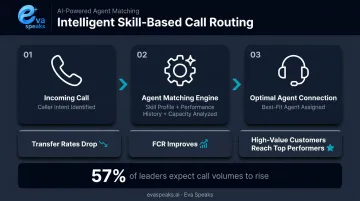
Forecasting tells you how many agents you need. Routing logic determines whether the right ones actually handle each call. Basic queue-based routing assigns whoever is next available. Intelligent skill-based routing matches each caller to the agent whose expertise, performance history, and current capacity align with that specific interaction type.
The operational implications are significant:
- Transfer rates drop when callers reach the right agent on first contact
- FCR improves when routing accounts for agent skill profiles, not just availability
- High-value or at-risk customers can be matched to top performers automatically
McKinsey found that 57% of customer care leaders expected call volumes to rise over the next one to two years. At that scale, smarter routing isn't just a quality improvement — it's how teams absorb higher demand without proportional headcount growth.
See how businesses in your industry are applying call analytics. See Industry Use Cases
Trend 4: Conversational AI and LLM Integration in Call Management
Beyond IVR Menu Trees
Traditional IVR handled calls by presenting options and routing based on key presses or basic voice recognition. It was functional for simple triage but brittle — callers would force through to a live agent the moment their need didn't fit a menu option.
LLM-powered conversational AI operates differently. These systems understand caller intent from natural language, respond contextually rather than from a fixed decision tree, and can handle multi-turn conversations that address routine inquiries without live agent involvement. The caller interaction feels closer to a conversation than a phone tree.
Gartner predicts that agentic AI will autonomously resolve 80% of common customer service issues without human intervention by 2029 — contributing to a projected 30% reduction in operational costs. Meanwhile, 85% of customer service leaders already planned to explore or pilot customer-facing conversational GenAI in 2025, per Gartner — so this shift is already underway.
The QA Coverage Shift
The secondary impact of AI call handling is what it does to quality management. When AI processes and transcribes every interaction, automated quality management can score up to 100% of voice and digital interactions — compared to the less than 1% that manual QA sampling typically covers, according to DMG Consulting.
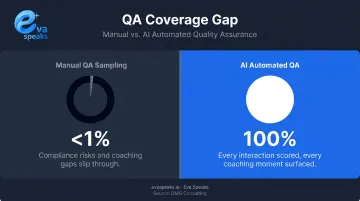
The practical consequences are significant. Compliance risks that would have slipped through a 1% sampling rate get flagged automatically. Coaching moments surface for every agent — not just those whose calls happened to land in a reviewer's queue.
Eva Speaks approaches this challenge through LLM integration and AI-enabled call handling — capturing transcripts and routing outcomes across interactions, which creates the interaction data layer that quality management and performance analysis depend on. Businesses can also configure call-flow scripts and routing rules to align AI handling with their specific operational requirements.
For context on where the industry stands: 96% of global contact center leaders now view AI — including generative and agentic AI — as a key strategy, up from 87% in 2024, per CallMiner's CX Landscape Report. Organizations still evaluating their AI call-handling approach are increasingly in the minority.
Want analytics and routing configured for your team? Get a Customized Workflow Recommendation
Trend 5: Gamification and Agent Engagement as Performance Levers
Tying Game Mechanics to Real KPIs
Leaderboards and badges tied to vanity metrics — call volume, login time — produce compliance behaviors without meaningful performance change. What works is connecting game mechanics to outcomes that actually matter: QA scores, first call resolution rates, CSAT improvements, and customer sentiment scores.
When an agent can see their FCR ranking against peers, watch their QA score trend week over week, and earn recognition tied to metrics that reflect real skill development, engagement follows from transparency rather than manufactured competition.
The Attrition Problem Gamification Is Solving
Metrigy tracked contact center agent attrition at 21.8% in 2022, rising to 28.1% in 2023, with 31.2% projected for 2024. ICMI reports 54% of contact centers experience attrition ranging from 21% to over 50%, with nearly 80% citing attrition as increased or not improved.
Replacing an agent carries real cost. SHRM estimates total hiring costs at three to four times the position's salary — and that's before accounting for ramp time and lost productivity.
Those costs make the root causes of attrition worth addressing directly — and gamification targets each of them:
- Agents who can see their own progress week over week become more invested in outcomes
- Structured recognition tied to real performance data builds motivation that informal praise can't replicate
- 52% of contact center leaders link attrition directly to the employee-manager relationship (Centrical); engagement tools give managers a consistent mechanism to act on that dynamic
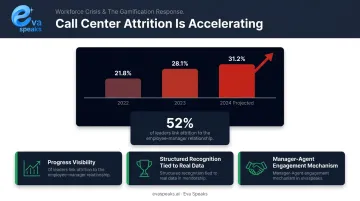
With 52% of contact centers reporting that remote work created significant cultural challenges (ICMI, 2024), active engagement systems have moved from a nice-to-have to an operational requirement. Dashboards surface data; structured recognition and peer competition are what actually shape culture.
Have questions about applying these analytics to your call center? Talk to an AI Communication Expert
How These Trends Are Reshaping the Industry
Operational Impact
Real-time dashboards have replaced end-of-shift reporting in high-performing operations. AI routing is reducing unnecessary transfers. Automated QA is enabling 100% interaction coverage without proportional headcount growth.
The NBER data makes the efficiency gains concrete: AI assistance produced a 14% increase in issues resolved per hour and a 9% reduction in AHT across nearly 5,200 agents. For a 200-seat contact center, that translates to meaningful throughput gains with no additional labor cost.
Business Impact
The strategic framing has shifted. Contact centers built their identity around cost containment — minimize handle time, minimize headcount, minimize expense. The data now supports a different argument: performance management directly drives revenue outcomes.
SQM Group research shows that every 1% improvement in FCR increases customer satisfaction by 1% and raises interactional NPS by 1.4 points for the average call center. When FCR improvement maps to CSAT, and CSAT maps to retention and lifetime value, the contact center becomes a revenue lever — not just an overhead line.
Workforce Impact
Coaching is becoming a data discipline. Supervisors still review calls and apply experience-based judgment, but that process is now augmented by systems that surface exactly which skills need development, for which agents, and in which interaction types.
Analytics fluency is becoming a real competency requirement for supervisors. ICMI's 2025 measurement data shows that contact centers track abandonment rates (85%), AHT (84%), quality (77%), and ASA (76%) — a metric-dense environment where supervisors who can interpret and act on data outperform those who can't.
Future Signals Worth Watching
The five trends above represent current adoption, not the ceiling. Three developments point to where it goes from here:
- Autonomous AI performance loops — systems that don't just surface coaching recommendations but execute targeted interventions automatically: real-time script prompts, automated feedback delivery, and live escalation alerts without supervisor involvement
- Individualized agent development paths — AI builds roadmaps from each agent's interaction history, identifies skill gaps, and recommends next steps based on actual call data rather than one-size-fits-all training curricula
- Live sentiment and emotion analytics — currently applied primarily post-call, real-time emotion detection is moving toward flagging escalation risk during active calls and enabling preemptive customer redirection before frustration peaks
Frequently Asked Questions
What are the key KPIs for call routing and call center team performance?
The core KPIs are First Call Resolution (FCR), Average Handle Time (AHT), Call Abandonment Rate, Average Speed of Answer (ASA), and Customer Satisfaction Score (CSAT). FCR and CSAT connect directly to customer experience outcomes, while AHT, abandonment rate, and ASA measure operational efficiency and routing effectiveness.
What is the best call tracking software for call routing analytics and team performance?
Unified platforms that integrate QA, WFM, and CRM data outperform point solutions for most teams. In 2026, evaluate AI-enabled platforms with automated scoring and predictive routing as the baseline — team size and existing tech stack will narrow the shortlist from there.
What is CTM in a call center?
CTM (Call Tracking Metrics) refers to the software category used to monitor and attribute inbound call activity by tracking source numbers, call outcomes, agent performance data, and conversion rates. It helps organizations identify which channels generate the highest-value calls and where routing breaks down.
How does AI improve call center performance management?
AI automates QA scoring across 100% of interactions, generates coaching recommendations from real data, and powers routing decisions that match callers to the best-fit agent. An NBER study tracking nearly 5,200 agents found a 14% productivity increase and 9% AHT reduction with AI assistance.
What is first call resolution (FCR) and why does it matter?
FCR is the percentage of calls resolved without a callback or transfer. It's a leading indicator of both customer satisfaction and operational efficiency — SQM Group data shows every 1% FCR improvement drives a 1% CSAT increase and a 1.4-point NPS gain, making it one of the highest-leverage metrics in call center management.
How can call center analytics help reduce agent turnover?
Analytics identifies struggling agents before they disengage, enabling targeted coaching that builds confidence early. Paired with gamification tied to real KPIs and recognition for genuine performance progress, this approach tackles the root causes of attrition — not just the symptoms.