Blended call routing software manages both call flows from a single agent interface. Supervisors can shift agents between inbound queues and outbound campaigns dynamically, route by skill or CRM data, and maintain TCPA compliance without toggling between platforms.
This article reviews the top platforms built for exactly that — covering routing engine depth, dialing modes, CRM integration, and compliance tooling across different team sizes.
Key Takeaways
- Blended call routing handles inbound and outbound from one platform, shifting agents automatically based on call volume
- Top picks: Eva Speaks (AI-native routing), Five9 (dialer-mode depth), Genesys Cloud (enterprise predictive routing), RingCentral RingCX (compliance + reliability), NICE CXone (campaign management at scale)
- Key criteria: routing flexibility, dialing modes, CRM sync depth, TCPA compliance, and scalability
- TCPA violations carry fines of $500–$1,500 per call — compliance tooling isn't optional
- AI-native routing makes real-time decisions from live conversation content — most legacy platforms can't match it
What Is Call Routing Software for Blended Campaigns?
Blended call routing software lets the same agent pool handle both inbound demand and outbound campaigns — from a single interface, managed by one routing engine. When inbound volume drops, agents are pushed to outbound queues automatically. When inbound surges, outbound campaigns pause and agents re-queue for incoming calls.
The "blended" distinction matters operationally. Without it, contact centers either overstaff inbound (wasting outbound opportunity) or understaff inbound during surges (blowing SLAs). A unified routing engine eliminates that tradeoff by treating agent availability as a shared resource across both directions.
The platforms covered here were evaluated specifically for blended inbound/outbound operations — meaning tools built with unified routing at their core, not general call center software with blending bolted on as an afterthought.
Watch how blended call routing flows work in practice. Watch AI Call Flow Demo
Best Call Routing Software for Blended Inbound/Outbound Campaigns
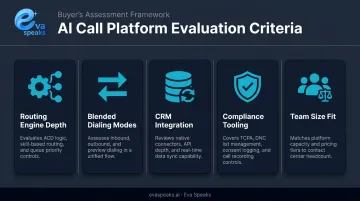
Each platform below was evaluated across five criteria:
- Routing engine depth — logic sophistication beyond basic queue assignment
- Blended dialing modes — support for both inbound ACD and outbound dialing
- CRM integration — native connectors and data surfacing at the agent desktop
- Compliance tooling — TCPA, STIR/SHAKEN, and related outbound safeguards
- Team size fit — minimum seat requirements and scalability ceiling
Eva Speaks
Eva Speaks is an AI-powered communication platform built around customizable call-flow scripts and LLM-driven routing logic. Its conversational AI processes what a caller is actually saying in real time — enabling routing decisions based on caller intent before a human agent is engaged, rather than relying on availability metrics or menu selections alone.
The platform handles AI-enabled call answering, real-time transcription, and dynamic routing rule configuration. Its LLM integration means routing logic can adapt to conversation content rather than static decision trees or queue depth thresholds.
For blended campaigns, this means inbound calls can be intelligently triaged and routed while outbound flows are configured around the same intent-aware logic — keeping both directions consistent.
| Category | Details |
|---|---|
| Key Features | AI-driven call routing, customizable call-flow scripts, real-time transcription, LLM integration, blended inbound/outbound support |
| Best For | Businesses seeking AI-native routing that adapts to caller intent and conversation context across blended campaigns |
| Pricing | Contact Eva Speaks at evaspeaks.ai for current pricing — subscription-based model with packages tailored to business requirements |
Five9
Five9 is a cloud contact center platform built specifically for blended operations. Its dialer supports predictive, progressive, power, preview, Manual Touch, and TCPA-compliance modes — giving operations managers granular control over outbound pacing alongside inbound queue management.
The unified agent desktop handles both directions from one view, with AI Agent Assist reducing after-call work. For CRM connections, Five9 offers 50+ pre-built connections to popular business applications, including native integrations with Salesforce, ServiceNow, Microsoft, Oracle, and Zendesk.
One practical note from Five9's own documentation: predictive dialing is best suited for teams with more than 10 active agents, while progressive dialing works better for smaller teams where abandoned-call rates and agent readiness matter more.
| Category | Details |
|---|---|
| Key Features | Multiple auto-dialer modes, blended ACD, AI Agent Assist, interaction analytics, workflow automation |
| Best For | Mid-to-large blended contact centers needing robust dialing options alongside inbound queue management |
| Pricing | Digital: $119/seat/month; Core: $159/seat/month; Plus, Pro, Enterprise: contact sales. Minimum 50 seats applies. (Pricing retrieved May 2026) |
Genesys Cloud
Genesys Cloud is an enterprise-grade CCaaS platform with predictive routing that uses AI to match inbound callers with the agent most likely to resolve their issue — analyzing historical, customer, agent, and interaction data and refining its models over time.
Beyond routing, the platform covers outbound campaign management, omnichannel blending across voice and digital, customer journey orchestration, and workforce management including multi-channel forecasting and scheduling. For enterprise contact centers running simultaneous inbound support and outbound sales, the combination of predictive routing and native workforce management in a single platform removes the need for separate point solutions.
| Category | Details |
|---|---|
| Key Features | Predictive routing, omnichannel blending, outbound campaign tools, workforce management, real-time analytics |
| Best For | Enterprise contact centers running complex blended operations needing predictive routing and workforce optimization |
| Pricing | CX 1: $75; CX 2: $115; CX 3: $155; CX 4: $240 per user/month, billed annually. (Pricing retrieved May 2026) |
RingCentral RingCX
RingCX delivers blended dialing (predictive, preview, progressive, HCI, and manual) with agent screen pops that surface CRM context before each interaction. Its Human-Computer Initiation (HCI) mode requires human initiation before a call connects — a deliberate compliance feature for teams navigating TCPA outbound requirements.
The platform supports 20+ digital channels and maintains 99.999% availability, making it a reliable choice for large enterprises where downtime in either direction creates immediate revenue impact. AI Supervisor Assist provides live transcripts across all agent interactions, giving supervisors visibility without requiring manual monitoring.
| Category | Details |
|---|---|
| Key Features | Five dialer modes including HCI, blended ACD, AI Supervisor Assist, STIR/SHAKEN support, 20+ digital channels |
| Best For | Large enterprises needing a reliable, compliance-forward blended platform with broad channel coverage |
| Pricing | $65/user/month (annual); $75/user/month (monthly). (Pricing retrieved May 2026) |
NICE CXone
NICE CXone pairs AI-powered omnichannel routing with purpose-built outbound campaign management. Its Personal Connection dialer handles predictive, progressive, and preview modes, while Proactive Outbound Engagement supports proactive AI outreach across omnichannel campaigns.
The Automation Finder tool — a task-mining solution that uses unsupervised machine learning — identifies where automation can reduce handle time and prioritizes opportunities by ROI. For organizations running targeted blended campaigns at scale, the combination of campaign-level routing controls and 30+ messaging channels covers most operational complexity.
| Category | Details |
|---|---|
| Key Features | Predictive/progressive/preview dialers, outbound campaign management, omnichannel AI routing, Automation Finder, workforce forecasting |
| Best For | Telemarketing, sales, and enterprise blended centers needing campaign-level routing controls and broad channel support |
| Pricing | Omnichannel Suite: $110; Essential: $135; Core: $169; Complete: $209; Ultimate: $249 per agent/month. (Pricing retrieved May 2026) |
Blended Routing Approaches: Side-by-Side Comparison
Not all blended routing platforms are built the same way. Here is how AI-native, cloud CCaaS, and legacy on-premise approaches compare across the dimensions that matter most for inbound/outbound operations:
| AI-Native (EvaSpeaks) | Cloud CCaaS (NICE, Genesys) | Legacy On-Premise | |
|---|---|---|---|
| Features | AI handles inbound, automated outbound campaigns, CRM sync | Full ACD, predictive dialer, workforce management | Fixed routing rules, manual blending |
| Best-fit Business Size | SMB to scaling mid-market | Mid-market to large enterprise | Large enterprise |
| Key Strengths | Fast deploy, predictable cost, AI containment | Full feature CCaaS suite | Maximum control |
| Implementation Complexity | Low - hours | Medium to High | High |
| Integration Capability | CRM, scheduling, EHR native | Extensive, often custom | Custom dev |
EvaSpeaks stands out for teams that need a flexible, low-overhead setup: no long onboarding cycles, no per-seat billing surprises, and routing logic that adapts to real conversation content from day one.
Key Features to Look For in Blended Call Routing Software
Skills-Based and Intelligent Routing Engine
Round-robin routing is a blunt instrument. A blended routing platform needs to route inbound calls based on agent skill sets, CRM data, campaign source, and caller history — not just who's available. This directly affects first-call resolution and conversion rates: the right agent the first time closes more calls and fewer escalations.
Blended Queue and Agent Mode Switching
The platform must automatically move agents between inbound queues and outbound campaigns based on real-time volume thresholds. During low-inbound periods, idle agents shift to outbound; during surges, outbound pauses and agents re-queue for incoming calls.
Without this automation, supervisors handle that switching manually — which is slow and introduces errors under pressure.
Dialing Modes for Outbound Control
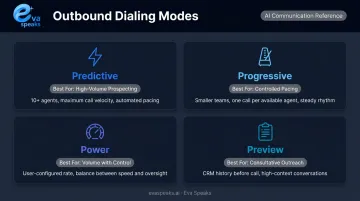
Different campaigns need different dialing approaches:
- Predictive — best for high-volume prospecting with 10+ active agents; maximizes live connections
- Progressive — controlled pacing for smaller teams; dials next lead after a preset pause
- Power — user-configured calls per available agent; more control than predictive with similar volume
- Preview — delivers CRM history before the call; best for consultative outreach, renewals, and complex accounts
CRM Integration and Screen Pops
Deep CRM sync (Salesforce, HubSpot, Zoho) lets agents see caller history, deal stage, and campaign source before answering. Bi-directional sync means post-call notes, dispositions, and outcomes write back to the CRM automatically — eliminating manual entry that agents skip under volume pressure.
TCPA Compliance and DNC Management
Compliance tooling is required for any outbound component of a blended campaign. The penalties for getting it wrong are severe.
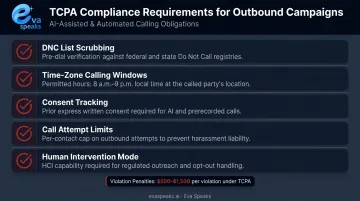
Under 47 U.S.C. 227, TCPA violations carry $500 per violation, with courts able to triple that to $1,500 for willful violations. The FCC imposed a $299,997,000 robocall penalty in 2023 and a $6M fine for AI deepfake robocalls in 2024.
Platforms must include:
- DNC list scrubbing before each dial
- Time-zone-aware calling windows (no calls before 8 a.m. or after 9 p.m. local time)
- Prior express written consent tracking for AI-generated voice calls
- Call attempt limits per contact
- Human intervention modes (HCI) for regulated outreach scenarios
The FCC's February 2024 ruling confirmed that AI-generated voices are classified as "artificial" under TCPA — meaning AI outbound calls carry the same consent requirements as traditional robocalls.
See how businesses in your industry use blended routing. See Industry Use Cases
How We Chose the Best Call Routing Software
Each platform was assessed across six criteria:
- Routing engine flexibility
- Native blended-mode support
- CRM integration depth
- Compliance tooling
- AI capabilities
- Pricing transparency
One mistake buyers make consistently: prioritizing per-seat price over total cost of ownership. Setup, training, integration maintenance, and compliance risk all carry real costs that don't appear in the seat price.
The factors most directly tied to blended campaign outcomes:
- Agent utilization rates — blended platforms reduce idle time by keeping agents productive in both directions
- First-call resolution — skills-based and AI routing improves match quality
- Compliance risk reduction — built-in TCPA tooling prevents violations that seat pricing never captures
Team size and campaign complexity shape which platform actually fits. A 10-agent team running basic blended outreach needs something fundamentally different from a 200-agent contact center managing simultaneous inbound support and outbound sales. Platforms that scored well across all three dimensions — routing depth, compliance readiness, and CRM integration quality — made this list.
Want a routing setup built for your inbound and outbound mix? Get a Customized Workflow Recommendation
Conclusion
Choosing the right blended call routing platform changes how agents work, how managers forecast, and how campaigns perform across both directions. It's an architectural decision with real operational consequences.
When evaluating options, focus on these criteria over brand name or per-seat price:
- Routing logic depth — can it handle blended queues and real-time rebalancing?
- Compliance readiness — built-in TCPA controls, not manual workarounds
- CRM integration quality — bidirectional data sync, not just screen pops
The right platform for a 15-agent sales team looks different from the right platform for a 300-agent enterprise center — and the wrong choice shows up quickly in idle time, missed SLAs, or a TCPA violation.
For teams that want call flows to adapt in real time based on conversation intelligence rather than static rules, Eva Speaks provides customizable routing logic and LLM-powered call handling built for that use case. For contact centers running blended campaigns, this means inbound and outbound calls can share the same intent-aware routing logic — callers aren't funneled through separate systems depending on direction. Learn more at evaspeaks.ai.
Frequently Asked Questions
What is the best call routing software for blending inbound and outbound campaigns?
The best fit depends on your team size, CRM stack, and campaign complexity. Five9 suits high-volume blended operations, Genesys Cloud handles enterprise predictive routing, and Eva Speaks is built for AI-native routing that adapts to real-time conversation context. Each excels in different scenarios.
What is advanced call routing?
Advanced call routing goes beyond round-robin distribution by using skills-based logic, AI-driven intent signals, CRM data, and caller history to connect each caller to the right agent on the first attempt — precision matching, not just availability matching.
Can call dialers integrate with CRM?
Yes — most enterprise blended platforms offer native integrations with Salesforce, HubSpot, Zoho, and others, enabling bi-directional data sync, screen pops, click-to-dial, and automatic post-call logging. Agents spend less time on manual updates and more time on conversations.
Are outbound AI calls legal?
AI-generated outbound calls are legal under TCPA when prior express written consent has been obtained, DNC lists are respected, and calls occur within permitted time windows (8 a.m.–9 p.m. local time). The FCC's February 2024 ruling classifies AI-generated voices as "artificial" under TCPA — the same consent rules apply.
Is outbound calling still effective?
Outbound calling remains effective when paired with intelligent routing, CRM context, and local presence dialing. Blended operations push results further — agents dial when inbound volume dips, keeping productivity high in both directions instead of treating outbound as secondary.
Which AI software delivers the best ROI for outbound calling campaigns?
ROI from AI outbound tools comes from reduced after-call work, higher connect rates through spam prevention and local presence, and AI coaching that improves conversion over time. Eva Speaks, Five9, and NICE CXone are strong contenders depending on the scale and depth of AI routing required.