The conversational AI market is projected to grow from $17.05B in 2025 to $49.80B by 2031 — a signal that businesses across industries are moving fast on automation. AI receptionists are a big part of that shift.
Yet most business owners adopting these tools have only a surface-level understanding of how they actually work. That leads to poor vendor selection, underutilization, and unmet expectations. This guide covers the mechanics, must-have features, real benefits, and leading providers — so you can make an informed decision.
Key Takeaways
- An AI receptionist uses Natural Language Processing to understand spoken requests and respond conversationally — no button-press menus required
- It operates 24/7, handles simultaneous calls, and connects to CRMs, calendars, and phone systems
- Key benefits: zero missed calls, lower front-desk costs, freed-up staff, and structured data from every interaction
- Strong fit for healthcare, legal, home services, real estate, automotive, and any business where phone responsiveness affects revenue
- Providers differ in conversation quality, integration depth, pricing models, and industry focus — evaluate on all four, not just features
What Is an AI Receptionist?
An AI receptionist is a software agent that answers inbound calls — and sometimes texts — using Natural Language Processing (NLP) to understand what callers want and respond conversationally, without a human picking up every time.
That's a meaningful distinction from older auto-attendant systems. Traditional IVR forces callers through rigid menus: "Press 1 for Sales, Press 2 for Support." If a caller says something off-script, the system breaks. An AI receptionist interprets full sentences and caller intent — someone can say "I need to move my appointment to Thursday afternoon" and the system handles it.
What Problem Does It Actually Solve?
After-hours calls go unanswered, peak-hour volume overwhelms front-desk staff, and a full-time receptionist means salary, benefits, and training costs. Callers don't adjust their schedules to match your business hours.
EvaSpeaks, for example, describes its AI Virtual Receptionist as a system that "answers your business calls 24/7 — every call, every hour, no missed leads." The platform handles calls identically whether they come in at 3 PM or 3 AM, routing, booking, or qualifying based on configured rules. EvaSpeaks is designed to be accessible to businesses that don't have a dedicated IT team: the call-flow configuration happens in a dashboard, integrations connect through standard tokens, and most businesses are operational within a day of signing up.
What It Is Not
- Not a replacement for human judgment in complex or emotionally sensitive conversations
- Not a basic chatbot or voicemail system
- Not the same as a human virtual receptionist service (which staffs real people)
Those distinctions map to a clear spectrum: simple auto-attendants (rule-based, menu-driven) on one end, human virtual receptionist services (staffed agents) on the other. AI receptionists sit in the middle — more capable than IVR, faster and cheaper than human staffing.
Here is how AI receptionists, human receptionists, and traditional IVR compare across the dimensions that matter most:
| AI Receptionist (EvaSpeaks) | Human Receptionist | IVR Auto-Attendant | |
|---|---|---|---|
| Features | Natural conversation, 24/7, scheduling, CRM sync | Full interaction, judgment, adaptive | Pre-recorded prompts, DTMF menus |
| Best-fit Business Size | SMB to mid-market | Any size | Large enterprise |
| Key Strengths | Zero missed calls, consistent, scales free | Human empathy, complex situations | Familiar, structured |
| Implementation Complexity | Low - hours | None (hire) | High |
| Integration Capability | CRM, scheduling, EHR native | Manual entry | Custom dev required |
How Does an AI Receptionist Work?
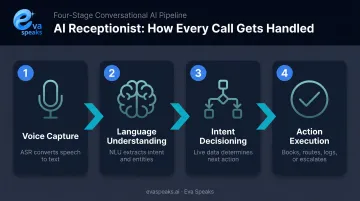
When a call comes in, the AI receptionist moves through a processing pipeline — voice capture, language understanding, intent decisioning, action execution — all in near real-time.
Speech Recognition and Language Understanding
The system first converts spoken words into text using Automatic Speech Recognition (ASR). Then Natural Language Understanding (NLU) interprets the text to extract:
- Intent — what the caller wants (book an appointment, check an order status, report an emergency)
- Entities — specific details like dates, names, service type, and location
ASR accuracy has a direct impact on call outcomes. A 2023 empirical study testing 11 major ASR services found word error rates ranging from 2.9% for the best-performing system to over 20% for others, with an average of 7.0% across vendors on native English speech. Modern systems built on large language models handle accents, casual phrasing, and mid-sentence corrections with far greater reliability than earlier keyword-matching approaches.
Eva Speaks' platform is built on LLMs for understanding and reasoning, with premium text-to-speech for voice output and accurate speech-to-text for transcription. The result: a system that understands context across multi-turn conversations and handles interruptions without losing the thread.
Intent Processing and Real-Time Decisioning
Once intent is identified, the system combines it with live data — caller history, CRM records, calendar availability, time of day — to decide what action to take:
- Answer the question directly
- Route to a specific department or person
- Book an appointment
- Escalate to a human with full context
This decisioning layer separates a capable AI receptionist from a basic answering bot. It dynamically determines the next best step rather than following a fixed script.
Action Execution and Integration
The most valuable AI receptionists complete tasks during the conversation, not just route calls. Eva Speaks executes the following actions live:
- Books appointments directly into connected calendars (Calendly, Google Calendar, Acuity, EHR systems)
- Qualifies leads in real time, capturing contact info, intent, and budget
- Logs structured data into CRM platforms (Salesforce, HubSpot, GoHighLevel)
- Sends SMS or email confirmations and automated reminders
- Transfers to a human agent with full conversation context when needed
After the call, every interaction generates a transcript with speaker labels, timestamps, and extracted data: caller name, intent, requested action, and appointment details. That transcript feeds automatically into your CRM or help desk, so every call becomes a searchable, structured record.
Watch an AI receptionist handle a real call from start to finish. Watch AI Call Flow Demo
Key Features of a Modern AI Receptionist
Not all AI receptionists are built the same. These are the features that separate capable platforms from expensive auto-attendants.
Natural Language Conversation Quality
This is the most important feature to evaluate. The AI should handle:
- Interruptions without losing context
- Follow-up questions across multiple turns
- Different accents and speaking speeds
- Multi-step requests ("Cancel my Thursday appointment and rebook for Friday at 2")
LLM-based systems handle these scenarios far better than older rule-based approaches. Eva Speaks' platform understands context across multi-turn conversations, handles interruptions, asks clarifying questions, and adapts tone to match the business's brand. A rule-based system collapses as soon as a caller deviates from the expected path — LLM-based platforms don't.
CRM and Calendar Integration
Native integrations — not generic webhook connectors — allow the AI to pull caller history, update records, and book appointments without manual follow-up. Look for support across:
- CRM platforms: Salesforce, HubSpot, GoHighLevel
- Calendar and scheduling: Google Calendar, Calendly, Acuity
- Industry-specific systems: Epic and athenahealth for healthcare; Clio and MyCase for legal; CDK and Dealertrack for automotive; AppFolio and Yardi for property management
Customizable Call Flows and Routing Rules
Every business routes calls differently. A medical clinic triages clinical versus administrative calls. A law firm runs conflict checks during intake. A property management company separates leasing inquiries from maintenance emergencies.
Eva Speaks allows businesses to build call-flow scripts in the dashboard and set routing rules per department (caller intent, business hours, language, VIP status, or custom logic) without writing any code. The result: a system that conforms to how the business already operates, not the other way around.
24/7 and After-Hours Coverage
Top systems operate continuously, including weekends and holidays. Eva handles calls the same way at 3 AM as at noon — greeting, qualifying, routing, or escalating to on-call staff via SMS or voice for true emergencies. For a medical practice or law firm, a single missed after-hours call can mean a lost patient or a signed retainer going to a competitor — consistent coverage eliminates that exposure.
Benefits of Using an AI Receptionist
Zero Missed Calls, Around the Clock
Every inbound call gets answered — during peak hours, after close, on holidays. Healthcare is a clear example: BLS data shows healthcare and social assistance employs 45% of all receptionists, yet clinics still struggle with after-hours coverage. An AI receptionist closes that gap without additional staffing.
For law firms, the data is stark. According to the 2024 Clio Legal Trends Report, only 40% of law firms answered phone calls in a secret-shopper study. That's 60% of potential clients hitting voicemail or a busy signal.
Lower Cost Than Human Staffing
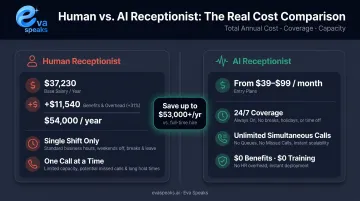
The BLS reports a median annual salary of $37,230 for receptionists as of May 2024. Factor in benefits — which BLS data shows add roughly 31% to compensation for office and administrative workers — and the fully-loaded cost runs approximately $54,000 per year per receptionist. That's one person, one shift.
AI receptionist pricing looks very different:
| Provider | Entry-Level Pricing |
|---|---|
| RingCentral AI Receptionist | $39/month (100 minutes) |
| Nextiva XBert | $99/month (100 interactions) |
| Aircall AI Voice Agents | 50 free minutes/month + paid tiers |
| Dialpad AI Agents | Quote-based |
Even mid-market AI receptionist plans cost a fraction of a single full-time hire — and they cover every shift, every day.
Staff Productivity and Reduced Burnout
BLS notes that receptionists "may need to answer numerous phone calls or deal with difficult visitors" — and that this creates genuine stress. Offloading repetitive, high-volume tasks — FAQ calls, appointment booking, basic routing — lets human staff focus on higher-value work: client relationships, complex problem-solving, and service delivery that requires real context.
The automation effect is already showing up in staffing patterns. BLS observes that employment growth for receptionists is constrained because "organizations increasingly use software and other technologies for public and customer interactions." In practice, that means front-desk staff shifting toward relationship management and exception handling rather than call volume.
Operational Visibility from Every Call
AI receptionists turn an opaque communication channel into structured data. Every call generates:
- Call volume by time of day and day of week
- Common questions and topics
- Escalation rates and reasons
- Missed-opportunity patterns
With that data, you can see exactly when call volume peaks, what callers ask for most, and where routing breaks down — then make targeted adjustments based on actual evidence.
See how AI receptionists keep businesses covered after hours. See How AI Handles After-Hours Calls
Who Should Use an AI Receptionist?
Industries With the Clearest ROI
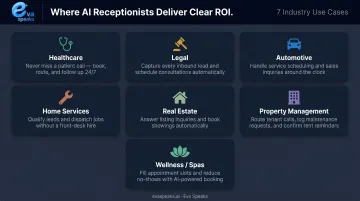
| Industry | Primary Use Case |
|---|---|
| Healthcare | Appointment booking into EHR systems, after-hours triage routing, new-patient intake |
| Legal | Initial intake with practice-area questionnaires, consultation scheduling, after-hours emergency routing |
| Automotive | Service appointment booking, lead qualification, dealership overflow handling |
| Home Services (HVAC, Plumbing) | Emergency call capture, appointment booking, after-hours coverage |
| Real Estate | Lead qualification from listings, showing scheduling, after-hours inquiry capture |
| Property Management | Leasing inquiries, maintenance request routing, emergency escalation |
| Wellness / Spas | Booking automation, cancellation handling, reminder workflows |
See how different industries are using AI receptionists today. See Industry Use Cases
When Not to Use One
Assess your call patterns before adopting. AI receptionists handle routine and semi-structured calls well. They're not the right tool when:
- Daily call volume is low enough that a small team handles it without friction
- Nearly every call involves emotionally sensitive, complex conversations requiring deep human judgment
Even then, a hybrid model often makes sense: the AI handles volume and routine calls while human agents take the exceptions. Eva Speaks' routing logic is built for this, escalating to live agents, on-call rotations, or voicemail based on configurable rules.
What to Evaluate Before Adopting
- Map your call types — what do callers typically ask? What percentage is routine vs. complex?
- Estimate daily call volume — even moderate volume (20–50 calls/day) justifies AI handling
- Identify automation candidates — booking, FAQs, routing, and lead qualification are usually automatable
- Check integration support — does the provider support your CRM, calendar, and phone system?
- Verify compliance — healthcare and legal businesses should confirm HIPAA support and BAA availability before signing up
Top AI Receptionist Providers
The right provider depends on your industry, call volume, integration requirements, and how much customization you need.
Provider Comparison
| Provider | Best For | Pricing | Compliance |
|---|---|---|---|
| RingCentral AI Receptionist | Businesses wanting generative AI call handling with English/Spanish support | From $39/month (100 min) | HIPAA-aligned, handles PHI |
| Nextiva XBert | SMBs across healthcare, legal, and home services needing CRM-connected AI | $99/month (100 interactions) | HIPAA-compliant comms; BAA available |
| Aircall AI Voice Agents | Teams wanting AI integrated into an existing cloud phone system | 50 free min/month + paid tiers | HIPAA compliant; SOC 2 Type 2 |
| Dialpad AI Agents | AI-native contact center environments with complex routing needs | Quote-based | BAA available on paid plans |
| Eva Speaks | Businesses needing tailored call flows and LLM-powered routing without technical complexity | Contact for pricing | U.S. data centers; HIPAA-friendly |
Decision Framework
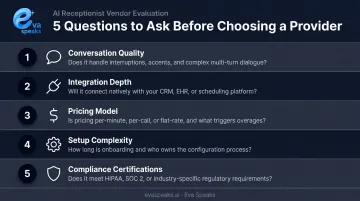
The table above narrows the field. These five criteria help you pressure-test whichever option looks most promising:
- Conversation quality: Run live tests with off-script phrasing, mid-sentence interruptions, and edge-case requests — not just the happy path
- Integration depth: Verify native support for your CRM, calendar, and any industry-specific system (EHR, DMS, practice management) before committing
- Pricing model: Flat monthly, per-minute, and per-conversation structures produce very different costs at high call volumes — run the math at your actual usage
- Setup complexity: Determine whether you can configure routing rules yourself or need developer support every time something changes
- Compliance certifications: Healthcare and legal businesses should confirm HIPAA coverage and request a signed BAA before signing any contract
Before finalizing a vendor, call the AI yourself. Use off-script phrasing, interrupt mid-sentence, and ask to speak with a human. That 10-minute test reveals more about real-world performance than any sales demo will.
Ready to see it in action for your business? Request Live Demo
Frequently Asked Questions
What is the difference between an AI receptionist and a traditional IVR system?
IVR forces callers through fixed button-press menus — "Press 1 for Sales." An AI receptionist uses NLP to understand natural speech, so callers speak freely and the system determines intent without requiring a specific menu option. If a caller goes off-script, an AI receptionist adapts; an IVR fails.
Can an AI receptionist transfer calls to a live human agent?
Yes. All leading platforms support call escalation and transfer. Full conversation context passes to the human agent automatically — the caller never has to repeat themselves. Eva Speaks routes to live agents, on-call rotations, or voicemail based on configurable business rules.
How much does an AI receptionist cost?
Entry points in official sources range from $39/month (RingCentral, 100 minutes) to $99/month (Nextiva XBert, 100 interactions), with many plans usage-based or quote-only at higher volumes. Contrast that with a fully-loaded human receptionist running approximately $54,000/year — most businesses break even within the first few months of deployment.
What integrations does an AI receptionist typically support?
Most platforms connect with CRM tools (Salesforce, HubSpot), scheduling apps (Google Calendar, Calendly, Acuity), VoIP systems, and industry-specific platforms such as EHR systems for healthcare or DMS for automotive. Native integrations are more reliable than generic API connections.
Is an AI receptionist suitable for small businesses?
Yes — small businesses are often the best fit. An AI receptionist provides professional, 24/7 coverage without the cost of a dedicated front-desk hire. Entry-level plans are designed for SMB budgets, and the setup process on leading platforms requires no technical expertise.
What are the main limitations of AI receptionists?
AI receptionists handle routine and semi-structured calls well but can struggle with emotionally complex or highly nuanced conversations. Initial setup and periodic tuning are also required as call patterns evolve over time.