The discussion around AI in dealerships has sometimes drifted toward the abstract — future-of-retail speculation that doesn't help a service manager whose phones are ringing off the hook on a Saturday. The real value of AI call handling isn't theoretical. It shows up in filled service bays, booked test drives, and advisors who spend their time advising instead of triaging a call queue.
This article breaks down the practical case for AI call handling: what it is, the three operational advantages it delivers, what ignoring it costs over time, and how to extract maximum value once it's deployed.
Key Takeaways
- Nearly 1 in 3 dealership calls goes unanswered — AI eliminates that gap with instant, 24/7 coverage.
- AI handles routine, high-volume calls so your BDC and service advisors can focus on the conversations that actually close.
- Core advantages include 24/7 coverage, smarter call routing with live data capture, and staff efficiency that scales without adding headcount.
- Without AI call handling, missed revenue accumulates invisibly and management rarely sees the gap until it's costly.
- To get full value, integrate with your CRM/DMS, review call data regularly, and build follow-up protocols around AI-captured leads.
What Is AI Call Handling for Dealerships?
AI call handling is a voice-enabled system that automatically answers inbound calls, understands what the caller needs, routes them to the right person or department, and captures lead and appointment data — without requiring a human to pick up first.
The technology works in three layers: speech-to-text converts the caller's words into processable text, large language models (LLMs) interpret intent from natural language, and text-to-speech delivers a response that sounds conversational. Platforms like Eva Speaks build on this foundation with customizable call-flow scripts and routing rules — giving dealerships precise control over how calls are triaged and which interactions trigger which workflows.
Where It Applies in a Dealership
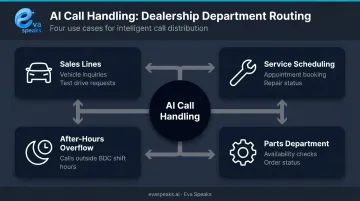
The use cases span every department that handles inbound call volume:
- Sales lines — vehicle inquiries, test drive requests, trade-in questions
- Service scheduling — appointment booking, repair status updates, recall inquiries
- Parts department — availability checks, pricing questions, order status
- After-hours overflow — any call that arrives outside BDC shift hours
AI call handling isn't a replacement for your team. It closes the gap between call volume and available staff. Think of it the way a digital scheduling tool works alongside a service advisor — it handles the intake so the advisor can focus on the customer in front of them.
Watch how AI handles a real dealership call from start to finish. Watch AI Call Flow Demo
Key Advantages of AI Call Handling
The three advantages below map directly to KPIs dealerships already track: missed call rates, appointment volumes, response times, staff utilization, and CSI scores. Each one has a measurable operational impact.
Advantage 1: 24/7 Coverage That Eliminates Missed Revenue
The most direct advantage is simple: every inbound call gets answered, regardless of the hour, the day, or how many calls are already in queue.
A BDC team of four cannot handle 80 simultaneous calls during a Saturday rush. No amount of overtime closes the gap between 9 PM and 8 AM. AI has no shift schedule — it answers instantly, identifies caller intent (service booking, vehicle inquiry, parts question), and either completes the interaction or routes to a human with full context.
The structural reality of after-hours volume:
Numa's research reports that 30–50% of daily dealership call volume occurs before 8 AM or after 6 PM, depending on the store. That's not a rounding error — it's potentially half your inbound leads arriving when nobody's there to answer. The same source found that 75% of callers who reach voicemail don't leave a message, with hang-up rates climbing to 62–66% by 7–8 PM.
The revenue math:
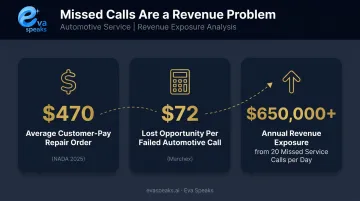
With an average customer-pay repair order at $470 (per NADA's 2025 mid-year data summarized by Digital Dealer), even modest missed-call recovery adds up fast. Marchex's research puts each failed automotive call at approximately $72 in lost opportunity — and estimates that 20 missed service calls per day can represent $650,000+ in annual revenue exposure.
KPIs this moves:
- Missed call rate
- After-hours appointment bookings
- Call-to-appointment conversion rate
- Total inbound lead capture
When it matters most: End-of-month rushes, promotional events, short-staffed weekends, holiday service surges, and any store where the service-to-staff ratio means the phones regularly outpace the team.
Advantage 2: Intelligent Routing and Real-Time Data Capture
This advantage works on two tracks simultaneously: every call reaches the right person faster, and every interaction generates structured data in the CRM without manual entry.
Instead of bouncing callers through IVR menus or hoping the front desk transfers correctly, AI interprets natural language — "I need to bring my truck in for a brake job" — identifies the appropriate department, and routes accordingly. When the handoff happens, the receiving staff member already has the caller's history, vehicle information, and stated intent. The conversation starts further along.
Platforms with customizable call-flow scripts and LLM-based routing — such as Eva Speaks — let dealerships define exactly how calls are triaged: by department, time of day, staff availability, or call type. Routing logic reflects actual operations, not a generic template. For dealerships that have tried general-purpose VoIP systems and found them inflexible for automotive workflows, Eva Speaks' configuration model allows routing logic to be updated as staffing or service lines change — without requiring a vendor call or a technical implementation engagement.
Why data capture matters as much as routing:
Every manually handled call that goes unlogged is a gap in your customer record. Over time, those gaps degrade follow-up timing, personalization, and campaign targeting. Cox Automotive's 2025 Service Industry Study found that 45% of vehicle owners are dissatisfied with dealership service, largely due to poor communication — and that dealerships have lost 12% of service visits to competitors since 2018. Richer, more complete customer records are a direct countermeasure.
There's also a visibility benefit for managers. Structured call data surfaces where calls are dropping, which departments are underperforming on inbound volume, and what intent patterns look like across the week — intelligence that's invisible when calls are handled manually and never logged.
KPIs this moves:
- Call routing accuracy and transfer rate
- CRM data completeness
- Lead response time
- Manager visibility into call performance
- CSI scores
When it matters most: Multi-department dealerships where calls routinely land in the wrong place; dealer groups managing multiple rooftops with inconsistent routing; operations where CRM data quality is a known weakness affecting follow-up and retention.
See how AI keeps dealership lines covered after closing. See How AI Handles After-Hours Calls
Advantage 3: Staff Efficiency and Scalability Without Headcount
AI absorbs the high-volume, routine calls — appointment confirmations, directions, service status updates, basic pricing questions — freeing advisors for work that actually requires their expertise. Marchex estimates that roughly 15% of service calls involve customers needing clarification about repairs. That's the category where a trained advisor earns their value. Routine scheduling and status calls don't.
The burnout and quality connection:
When service advisors and BDC reps spend the majority of their time on low-value calls, their capacity for high-value conversations suffers. AI triage directly protects advisor talk time on high-intent callers — the conversations that drive appointment conversion and gross.
The scalability gap traditional BDCs can't close:
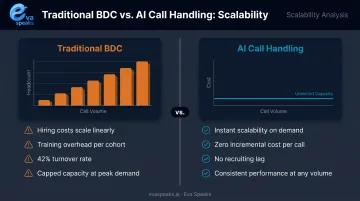
BDC growth is linear. More calls require more headcount, which requires more recruiting, training, and management overhead — especially challenging given the automotive industry's 42% turnover rate (per a Quantum5 summary of NADA workforce data). AI scales to any call volume instantly, with zero incremental cost per additional call. During a July promotional surge or a seasonal service peak, that scalability determines whether your phones keep up or your leads go elsewhere.
Advanced AI systems can also provide post-call transcriptions and summaries that managers use to identify coaching opportunities and track performance trends — structured records that turn call volume into actionable performance data.
KPIs this moves:
- Staff utilization rate
- Appointment conversion rate per staff member
- Headcount relative to call volume
- Advisor talk time on high-intent calls
- Training time and consistency
When it matters most: high-volume stores where the BDC is consistently at capacity; operations growing service revenue without proportionally growing staff costs; dealerships with high turnover where consistent call quality is hard to maintain through traditional training.
How the Options Compare
Here is how AI-powered, outsourced BDC, and traditional IVR approaches compare for dealership call handling:
| AI Call Handling (EvaSpeaks) | Outsourced BDC | Traditional IVR | |
|---|---|---|---|
| Features | Conversational AI, DMS integration, scheduling, 24/7 | Human BDC agents, script-based, after-hours | DTMF menus, hold queue, voicemail |
| Best-fit Business Size | Single-location to dealer groups | Mid-size dealer groups | Large chains |
| Key Strengths | No missed calls, real-time DMS data, no overages | Human rapport, trained agents | Cost-effective at scale |
| Implementation Complexity | Low - CDK/Reynolds connectors | Medium | High |
| Integration Capability | CDK, Reynolds, Tekion native | Varies by BDC | Custom dev |
What Happens When AI Call Handling Is Ignored
Relying solely on manual call handling doesn't fail all at once. The damage accumulates in the background — missed opportunities, eroding trust, and reactive management — until the gaps are too wide to close without structural change.
Missed calls accumulate invisibly. Without call analytics, management assumes calls are being handled. A 20–30% missed call rate that goes unmeasured is also a 20–30% revenue leak that goes unaddressed. The problem grows before anyone notices.
Inconsistent experience erodes trust. When different staff handle the same inquiry differently, customers lose confidence — especially in service, where trust is the primary retention driver. Cox found only 54% of owners with newer vehicles returned to their purchasing dealership for service in 2025, down from 72% in 2023. Poor phone experiences accelerate that attrition.
Reactive management replaces proactive. Without call data or AI-driven call prioritization, managers are constantly responding to complaints, dropped appointments, and lost leads rather than managing the pipeline. No data means no pattern recognition — and no pattern recognition means the same problems repeat.
Scaling becomes a headcount problem. As call volume grows, the only lever without AI is hiring — which adds cost, complexity, and management overhead without closing the structural gap.
How to Get the Most Value from AI Call Handling
Deploying AI call handling is the starting point, not the finish line. The value compounds when the system is integrated properly, reviewed regularly, and connected to clear follow-up protocols.
Integration First
The system needs to connect to the CRM, DMS, and service scheduler to capture structured data in real time. Without integration, AI answers calls but the real benefits (richer customer records, accurate scheduling, smarter follow-up) are lost. Integration quality is the single most important factor when evaluating vendors.
Regular Review of Call Data
The dealerships that see continuously improving conversion rates are the ones where managers regularly audit call transcriptions, track missed-call rates, and act on routing or script gaps. Platforms like Eva Speaks that offer call transcription and customizable routing rules make this review process systematic rather than ad hoc — turning one-off audits into a repeatable performance habit.
Staff Alignment and Follow-Up Protocols
AI captures leads and books appointments, but those interactions still need timely human follow-up. If the system logs a 9 PM test drive inquiry and nobody reviews it until 10 AM the next day, the structural fix hasn't changed the culture problem.
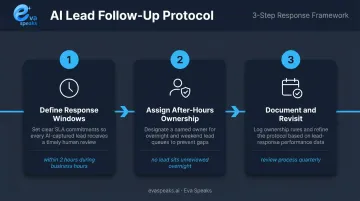
To close that gap, set clear protocols and hold the team to them:
- Define response windows for AI-captured leads (for example, within 2 hours during business hours)
- Assign ownership for after-hours inquiries so no lead sits unreviewed overnight
- Document the process in writing and revisit it quarterly
Ready to see it working at your dealership? Request Live Demo
Conclusion
AI call handling gives dealerships control over a channel that has historically been their biggest blind spot. The phone converts to revenue 10–15x better than web leads (per CDK Global) — and yet nearly a third of those calls never reach a human. That's not a staffing problem. It's a structural one that AI is built to solve.
The advantages compound quickly:
- Every call answered is one less opportunity handed to a competitor
- Every data point captured sharpens future follow-up
- Every routine call deflected gives staff more time for the conversations that close deals
The dealerships that get the most from this shift are those that treat call handling as a managed, measurable system — not a one-time technology deployment. That means reviewing data regularly, refining routing and scripts, and using the insights AI surfaces to coach their teams over time.
Frequently Asked Questions
What percentage of dealership calls typically go unanswered?
Industry data puts the range at roughly 19% to nearly one-third of inbound calls — CDK Global reported 19% in 2022, while Car Wars' 2025 analysis of nearly 3,000 dealerships found close to one-third were lost before a conversation began. The gap is structural, not a staffing failure, and tends to spike sharply after hours and during high-volume periods.
How much does an AI answering service cost?
Pricing varies widely by vendor and model. One publicly listed automotive AI platform, DealerAI, prices plans from $599 to $2,299 per rooftop per month. Key cost drivers include call volume, CRM/DMS integration complexity, and feature set — and in most cases, that cost is far lower than the revenue exposure from a 20–30% missed call rate.
Do car dealerships use call centers?
Yes — many operate in-house BDC teams or outsource to third-party call centers for lead handling and appointment setting. Traditional call centers are limited by staff availability and scale linearly: more calls require more people. AI call handling is increasingly adopted as a scalable complement, particularly for after-hours and high-volume coverage.
Can AI call handling integrate with a dealership's CRM or DMS?
Modern AI call handling platforms are built to integrate with major automotive CRMs and DMS systems. That integration enables automatic lead capture, real-time appointment scheduling, and structured customer records. Integration depth and reliability should be a top evaluation criterion when selecting a vendor.
Does AI call handling replace BDC staff or salespeople?
No. AI handles routine, high-volume calls — scheduling, confirmations, basic inquiries — so BDC and sales staff can focus on higher-value conversations requiring human judgment. The best deployments use AI to route the right calls to the right people with context already attached, making human staff more effective, not redundant.
What types of calls can an AI system handle at a dealership?
Primary use cases include inbound service appointment scheduling, sales inquiries and lead capture, parts availability questions, after-hours calls, appointment confirmations and reminders, basic inventory or pricing questions, and routing to the appropriate department or staff member based on caller intent.