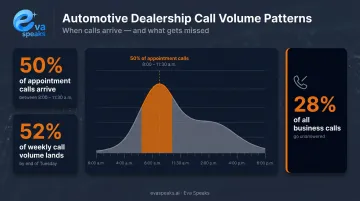
Traditional front-desk staffing has no elastic response to this problem. You can't hire half a receptionist for Monday mornings. According to CallRail's 2025 analysis, 28% of all calls to businesses go unanswered — and Invoca's data adds a sharper edge: fewer than 3% of callers routed to voicemail actually leave a message. That means the vast majority of callers who hit a busy signal simply disappear.
AI virtual receptionists change that equation. This article breaks down what they are, how they perform under load, and which platforms are worth considering in 2025.
See how AI scales to handle your busiest call periods. Explore AI Call Automation
Key Takeaways
- AI virtual receptionists answer every inbound call instantly — no hold times, no busy signals, no matter how many calls arrive simultaneously
- They scale automatically with call volume, handling concurrent calls without added cost
- Strong platforms offer LLM-powered conversations, CRM/calendar integrations, and customizable call flows
- AI receptionist subscriptions start around $95/month, well below the $37,230 median annual salary for a full-time receptionist
- Eva Speaks, Smith.ai, Ruby, Numa, and Moneypenny are the strongest options for businesses managing high-volume periods
What Is an AI Virtual Receptionist?
An AI virtual receptionist is a voice-AI system that answers inbound calls, understands caller intent through natural language processing, and resolves or routes requests without human intervention — unlike a basic auto-attendant or IVR menu, which can't hold a real conversation.
The difference comes down to what happens when a caller speaks freely. An IVR plays pre-recorded options and waits for a keypress. An AI receptionist responds to what the caller actually says:
- Understands free-form questions without requiring menu navigation
- Books appointments, answers FAQs, or confirms account details in context
- Routes calls to the right department based on caller intent
- Escalates to a human agent when the situation requires it
Why Busy Periods Expose the Limits of Human Reception
The problem isn't average call volume. It's spikes. Simultaneous call surges, after-hours inquiries, and seasonal rushes all create the same bottleneck: more calls than available staff.
Numa's 2024 analysis of roughly 600 U.S. dealership service departments found that half of all appointment calls arrive between 8:00 and 11:30 a.m., with more than 52% of weekly call volume landing by end of Tuesday. That's a predictable, recurring spike — and human staffing alone can't absorb it without queues or missed calls.
AI receptionists process unlimited concurrent calls using cloud infrastructure. There's no queue. The 10th caller gets the same immediate response as the first.
Watch how AI manages a surge of simultaneous calls live. Watch AI Call Flow Demo
AI Receptionist vs. Human Receptionist vs. Voicemail: Peak-Period Comparison
Here is how AI receptionists, human receptionists, and voicemail compare for handling peak-period call volumes:
| AI Receptionist (EvaSpeaks) | Human Receptionist | Voicemail / Call Queue | |
|---|---|---|---|
| Features | Unlimited simultaneous calls, 24/7, CRM sync, scheduling | One call at a time, full interaction | Passive hold or recording |
| Best-fit Business Size | Any business with call peaks | Small operations | Very small businesses |
| Key Strengths | Handles any call spike without added cost | Full human quality | Zero cost |
| Implementation Complexity | Low | None (hire) | None |
| Integration Capability | CRM, scheduling, EHR native | Manual | None |
Best AI Virtual Receptionists for Managing Busy Periods
Each solution below was evaluated on four criteria: scalability under load, conversation quality, integration depth, and fit for businesses with unpredictable call volumes.
Eva Speaks
Eva Speaks is an AI-powered communication platform built for US businesses that need real-time call handling. Its core offering covers AI-enabled call answering, call transcription, and customizable call-flow scripting — all built around LLM integration for more natural, context-aware conversations.
EvaSpeaks runs a fully AI-driven model — no hybrid agents, just real-time responses and adaptable routing rules that mirror specific business workflows. As businesses increasingly experience call volume spikes that human-staffed models can't absorb — from marketing campaigns, seasonal demand, or unexpected events — EvaSpeaks' ability to handle concurrent calls simultaneously without any capacity ceiling makes it a practical infrastructure choice for businesses that prioritize never missing a call during peak periods.
The platform supports time-based routing through office hours configuration, custom call-flow scripts, and third-party integrations. That combination gives businesses precise control over how calls are handled during peak periods, after hours, or across departments.
| Details | |
|---|---|
| Key Features | LLM-powered conversational AI, call transcription, custom call-flow scripting, real-time routing rules, office hours configuration, third-party integrations (CRM, calendar, booking), STT/TTS technologies |
| Best For | Businesses of any size seeking a fully AI-driven receptionist with deep customization for peak-period and after-hours call management |
| Pricing | Contact Eva Speaks directly at evaspeaks.ai for current pricing — subscription plans are available, with specifics tailored to business requirements |
Smith.ai
Smith.ai is a US-based virtual receptionist service combining AI with live human agents, serving thousands of businesses across legal, medical, real estate, home services, and e-commerce.
During busy periods, the hybrid model prevents dropped interactions: overflow calls that exceed the AI's confidence threshold transfer seamlessly to trained human receptionists. Lead qualification, appointment booking, and call screening run automatically, with human backup available when a call gets complex.
| Details | |
|---|---|
| Key Features | 24/7 AI + live human answering, CRM/calendar/ticketing integrations, call recording and transcription, lead qualification, AI scheduling, live agent handoff ($3/call) |
| Best For | Businesses that want AI efficiency with a human safety net for sensitive or complex calls during high-volume periods |
| Pricing | Self-service plans from $95/month (~2 calls/day); scales to $800/month (~15 calls/day). Annual "done for you" plans from $500/month with rollover calls and a dedicated customer success manager |
Ruby
Ruby is a virtual receptionist and live chat provider with an established US market presence, offering AI-assisted and human-backed answering for small and mid-sized businesses.
For busy periods, Ruby's strength is consistency. Calls are answered with brand-aligned scripting regardless of volume, and the platform adds AI-powered transcripts, sentiment analysis, and AI-assisted call flows at no extra cost. Bilingual Spanish answering, robocall filtering, and 5,000+ dynamic integrations extend that coverage for businesses with diverse caller bases.
| Details | |
|---|---|
| Key Features | 24/7 live answering, AI-powered transcripts and sentiment analysis, custom greetings, appointment scheduling, payment collection, bilingual Spanish support, robocall filtering, mobile app, 5,000+ integrations |
| Best For | Small businesses and professional service firms (legal, healthcare, home services) that need polished, branded reception during busy hours without adding headcount |
| Pricing | Plans priced by included minutes: $250/month (50 min), $395/month (100 min), $720/month (200 min), $1,725/month (500 min). No setup or hidden fees |
Numa
Numa is an AI-first communication platform purpose-built for automotive dealerships. Its Voice AI and AI Agents handle the main line, responding to missed or unanswered calls so every caller gets an immediate reply — even when all service advisors are occupied.
The numbers behind Numa's pitch are specific: its 2024 analysis found dealerships miss roughly 158 appointment calls per month on average, with top-quartile operations missing 216. Numa's AI Agents handled nearly 16,500 calls annually per dealer, converting missed calls into booked appointments. For a service department where the morning window is peak demand, that's material revenue recovery.
| Details | |
|---|---|
| Key Features | Operator AI receptionist, context-aware Voice AI, Smart Inbox, AI Agents, HeatCase sentiment alerts, call and text monitoring, Google Business Messages integration, dealership tool integrations |
| Best For | Automotive dealership service departments where phone overflow during the morning peak directly translates to lost appointment revenue |
| Pricing | Custom pricing — contact Numa via numa.com/demo for a tailored quote |
Moneypenny
Moneypenny combines AI call triaging with dedicated human receptionists for businesses that need both speed and judgment. AI handles routine triage and FAQ calls first; a dedicated Moneypenny receptionist takes everything else.
Proprietary tools KnowledgeBase and MessageMaker surface company details in real time and generate instant call summaries, which keeps the dedicated receptionist briefed without manual lookups. CRM integrations include Salesforce, HubSpot, Clio, and ServiceTitan — a useful list for legal, construction, and field-service firms.
| Details | |
|---|---|
| Key Features | Dedicated receptionist model, AI call triaging, KnowledgeBase and MessageMaker proprietary tools, 24/7 coverage, appointment booking, CRM integrations (Salesforce, HubSpot, Clio, ServiceTitan), bilingual English/Spanish, returning caller recognition |
| Best For | Mid-to-large businesses and professional firms that need reliable, branded overflow management combining AI speed with human judgment |
| Pricing | Call-volume-based packages; custom/tailored pricing — contact Moneypenny directly. Note: three-month minimum contract, then one month's notice to cancel |
How We Chose the Best AI Virtual Receptionists
The evaluation focused on performance during busy periods specifically — not general call-answering capability. A common mistake is choosing on price alone, then discovering the platform struggles under heavy call volume or loses conversation quality exactly when it matters most.
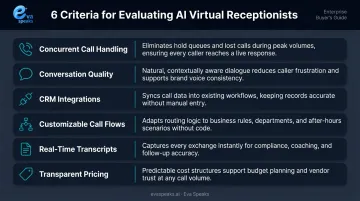
Key Evaluation Criteria
Each criterion maps directly to a business outcome:
| Criterion | Why It Matters |
|---|---|
| Concurrent call handling | True unlimited capacity = zero missed calls during surges |
| Conversation quality (AI) | Natural dialogue = callers stay on the line instead of hanging up |
| CRM/calendar/POS integrations | Automatic data sync = no manual entry during high-volume periods |
| Customizable call flows and routing | Tailored logic = correct routing without human oversight |
| Real-time transcripts and analytics | Post-call visibility = quality control at scale |
| Transparent, predictable pricing | No surprise overages = budget stability during seasonal spikes |
Gartner's 2024 survey of 5,728 customers found that 53% would consider switching to a competitor if a company used AI for customer service and they couldn't reach a human. That makes escalation quality — not just AI accuracy — a core selection criterion.
That escalation finding shapes three additional criteria the table doesn't fully capture:
- Onboarding speed: How quickly can the platform go live before your next busy period?
- Escalation quality: Does the handoff to a human include full conversation context?
- Vendor support: Is there responsive support available when the system encounters issues during peak periods?
Want a setup built for your busiest hours? Get a Customized Workflow Recommendation
Conclusion
At scale, managing busy periods comes down to infrastructure. The right AI virtual receptionist answers every call instantly, scales without advance notice, and integrates cleanly with the tools your team already uses.
When making a final decision, prioritize scalability, LLM conversation depth, and integration compatibility over brand recognition. Test any solution with a real call scenario before committing — specifically during a simulated surge.
If those criteria match your requirements, Eva Speaks is worth evaluating — an AI-driven receptionist built around customizable call-flow scripting and LLM-powered responses, designed for businesses that can't afford a missed call.
Frequently Asked Questions
What is the difference between an AI receptionist and a virtual receptionist?
A virtual receptionist typically means a remote human agent answering calls on behalf of a business. An AI receptionist uses machine learning and NLP to handle calls autonomously, without human intervention. Some services — like Smith.ai and Moneypenny — combine both models.
What capabilities does an AI receptionist need to work effectively?
The core requirements are natural language understanding, intent recognition, call routing logic, and real-time response generation. It also needs a reliable escalation path to a human agent for queries it can't confidently resolve.
How does an AI virtual receptionist handle multiple calls during peak hours?
AI receptionists process calls in parallel using cloud infrastructure — there's no queue or busy signal. The 20th simultaneous caller gets the same instant answer as the first, regardless of total inbound volume.
How much does an AI virtual receptionist cost compared to hiring a human?
AI receptionist subscriptions start around $95/month. A full-time human receptionist costs a median of $37,230 annually in salary alone — before benefits. At that gap, the subscription pays for itself after the first month of avoided overtime or missed-call losses.
Can an AI virtual receptionist integrate with my CRM or booking system?
Yes. Most platforms connect natively with tools like HubSpot, Salesforce, Google Calendar, and Calendly. Those native integrations sync data automatically — no manual entry, no records falling through the cracks during a call surge.
What happens when the AI can't answer a caller's question?
AI receptionists detect when a query falls outside their knowledge base and transfer the call to a human agent. The handoff should include full conversation context — the caller shouldn't have to repeat themselves from the beginning.