Hiring a full-time receptionist to solve this costs $40,000–$57,000 per year when you account for salary, benefits, and payroll taxes. For a five-person team, that's a significant share of payroll for a single role. Virtual receptionists — particularly AI-powered ones — offer a way out of that bind.
This article breaks down the concrete benefits of virtual receptionists for small businesses: what you actually get, what it costs, and what you risk by skipping it.
Key Takeaways
- A virtual receptionist answers calls, routes inquiries, schedules appointments, and handles routine interactions — no physical office, no full-time salary
- Cost savings are substantial: virtual receptionist plans start at $41–$329/month vs. $39,000–$57,000+ annually for an in-house hire
- 28% of inbound calls go unanswered across businesses, and fewer than 3% of callers sent to voicemail leave a message
- AI-powered systems handle unlimited simultaneous calls 24/7, making them especially valuable for businesses with time-sensitive service needs — you can Explore AI Call Automation to see what a full AI virtual receptionist setup looks like
- Without a virtual receptionist, businesses lose leads, frustrate customers, and pull staff away from core work to manage call overflow
What Is a Virtual Receptionist?
A virtual receptionist is a remote call-handling solution — either a trained human agent or an AI-powered system — that answers inbound calls, collects caller information, and routes or responds on behalf of your business. No front desk, no dedicated office space, no full-time headcount required.
Two main types exist:
- Live human services — real agents who answer calls on your behalf, typically during business hours or extended coverage windows
- AI-powered systems — software that handles calls around the clock using conversational AI, with no wait times, no hold music, and no coverage gaps
Small businesses across legal, home services, healthcare, real estate, and property management are the most common users — any operation that receives consistent inbound call volume but doesn't need (or can't afford) a dedicated front-desk employee.
A virtual receptionist ensures every caller reaches someone — or something — capable of helping them, so qualified leads don't disappear into voicemail while you're focused on running the business. EvaSpeaks, for example, operates as an AI virtual receptionist that handles calls 24/7 using conversational AI — answering questions, routing inquiries, and capturing lead details without a human on duty, which is why small businesses use it as a cost-effective alternative to both staffed reception and traditional live answering services.
How the Main Options Compare
Here is how AI-powered, live, and traditional phone-only options compare as virtual receptionists for small businesses:
| AI Virtual Receptionist (EvaSpeaks) | Live Virtual Receptionist | Traditional Phone + Voicemail | |
|---|---|---|---|
| Features | 24/7 AI calls, scheduling, routing, CRM sync | Human agents, message-taking, call forwarding | Voicemail, basic call forwarding |
| Best-fit Business Size | 1-50 person businesses | Any size | Very small businesses |
| Key Strengths | No missed calls, 24/7, zero overages | Human warmth, complex interactions | No setup cost |
| Implementation Complexity | Low - hours | Low | None |
| Integration Capability | CRM, scheduling, calendar sync | Manual or limited | None |
Key Benefits of a Virtual Receptionist for Small Businesses
The benefits below are tied to outcomes small businesses actually track: cost, revenue, team time, and customer experience. Not abstract service claims.
Significant Cost Savings Over In-House Staffing
According to the U.S. Bureau of Labor Statistics, receptionists and information clerks earn a mean annual wage of $39,460 as of May 2025. Factor in the BLS Employer Costs for Employee Compensation data — which shows benefits add roughly 45% on top of wages for private-industry office and administrative support roles — and the loaded cost of a full-time receptionist reaches approximately $57,000 per year before any equipment, recruiting, or management overhead.
Virtual receptionist services cost a fraction of that:
| Service Type | Entry-Level Monthly | Mid-Tier Monthly |
|---|---|---|
| AI-powered | $41–$99/month | $165–$299/month |
| Live human | $25–$250/month | $395–$599/month |
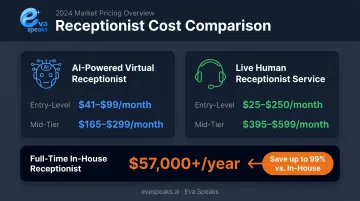
That's roughly $500–$7,000 per year for most small business plans, compared to $57,000+ for a full-time hire. For businesses with fewer than 10 employees — or solo operators where a receptionist salary would represent a disproportionate share of payroll — this gap is the difference between a viable and unviable hire.
The cost structure shifts, too. Instead of a fixed headcount expense, you pay only for the call handling you actually use. A predictable, scalable variable cost rather than permanent overhead.
24/7 Availability and Zero Missed Calls
Missed calls are a direct revenue problem — and the data shows how common they are. CallRail's 2025 platform data shows an average 28% unanswered rate across businesses. Invoca's 2023 home services benchmarks found that home services companies specifically miss 27% of inbound calls. What happens to those callers? According to Invoca's 2024 research, fewer than 3% of callers pushed to voicemail actually leave a message.
The rest don't wait.
For service-based businesses — emergency repair, legal intake, medical scheduling — this is a direct revenue problem. Invoca's 2025 home services benchmark (based on 60M+ calls) found that only 55% of home services callers successfully speak with a person, and when they do reach someone, 46% convert during that call. Miss the call, miss the conversion.
A virtual receptionist eliminates this gap. Calls are answered every time — at 11pm on a Saturday, during a busy stretch when every team member is occupied, or on a holiday when your office is closed. AI-powered systems like Eva Speaks handle this 24/7 by default, with overflow handling built in so no caller ever encounters a busy signal.
KPIs most affected: inbound call capture rate, lead-to-contact conversion, after-hours inquiry volume. The impact is highest for businesses where speed of response determines whether you win or lose the client. You can See How AI Handles After-Hours Calls to see what it looks like when AI captures a lead that arrives outside business hours.
Scalable, Professional Presence Without Adding Headcount
A virtual receptionist does two things simultaneously that are hard to achieve any other way at this cost level: it makes your business sound established and professional on every call, and it scales to handle volume spikes without new hires.
Why does the phone experience matter so much? Invoca's 2022 buyer survey of 500 consumers found:
- 68% prefer to call when making significant purchasing decisions
- 62% call a business before making a purchase
- 76% stop doing business with a company after one negative experience
- 63% are willing to pay more for superior customer service
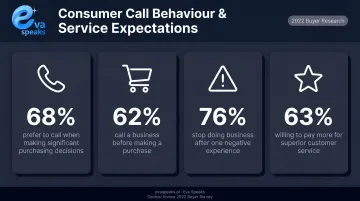
That first phone interaction carries significant weight. A call answered professionally — consistent greeting, correct routing, no hold music or rushed handoff — sets a different tone than a distracted team member picking up mid-task.
For a growing small business, the scalability piece matters just as much. A five-person team using Eva Speaks, for example, can handle the same call volume as a much larger competitor because the AI manages routine interactions and routes only the calls requiring a human decision-maker. During a seasonal spike, a product launch, or a new market entry — when call volume jumps unpredictably — there's no scramble to hire or onboard coverage.
KPIs most affected: customer satisfaction, first-impression conversion, call abandonment rate, team hours reclaimed from phone interruptions. Small businesses ready to see this in practice can Request Live Demo.
What Happens When Small Businesses Skip a Virtual Receptionist
Going without a dedicated call-handling solution creates compounding problems — and they build on each other fast.
- Missed calls become missed sales. Fewer than 3% of voicemail-directed callers leave a message. The rest move on — often to a competitor who picked up.
- Inconsistent handling damages first impressions. Calls routed to personal cell phones or answered by a distracted team member mid-task erode caller confidence before a single service has been delivered.
- Staff productivity suffers. Every time a team member breaks from their core work to handle a call, there's a recovery cost. The interruption isn't just the call — it's the context-switching that follows.
- The problem scales with the business. More inbound volume amplifies every one of these issues. A bottleneck at 10 calls per day becomes a crisis at 40.
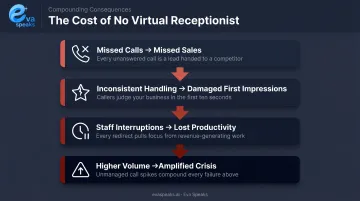
That last point matters most in time-sensitive industries like home services or healthcare. When roughly half of callers connect with a live person and nearly half of those convert immediately, every unanswered call isn't a maybe — it's a near-certain lost sale.
How to Get the Most Value from Your Virtual Receptionist
A virtual receptionist works best when it's configured around your specific workflows, not treated as a generic answering service.
Start with call-type mapping. Identify the top call types your business receives — new inquiries, scheduling requests, FAQs, escalations — and build routing rules for each. The goal is for every caller to be handled correctly from the first interaction, without unnecessary escalations or dead ends.
Review performance on a regular cadence. The metrics that matter most:
- Call capture rate — are calls being answered, or still going to voicemail?
- Call disposition — what percentage of calls are converting to appointments, qualified leads, or resolved inquiries?
- Escalation rate — if too many calls escalate to human staff, the scripts or routing logic need adjustment
Once you spot a pattern in those numbers — say, a spike in escalations after a pricing change — that's the signal to update your scripts. Eva Speaks lets you adjust routing rules, revise scripts, and reconfigure after-hours behavior directly through the dashboard, without rebuilding from scratch.
Keep your setup current as the business changes. Scripts and routing logic written at launch rarely match a business twelve months later. The businesses that get the most from virtual receptionist services treat it as a living system — not a one-time configuration. Small businesses that want a recommendation matched to their specific call types and growth stage can Get a Customized Workflow Recommendation.
Conclusion
For small businesses, a virtual receptionist delivers three things that are hard to replicate at this cost level: consistent availability, professional call handling, and the operational freedom to focus on revenue-generating work.
The compounding effect is real. After-hours calls get captured instead of lost. Weekend leads convert because someone actually picked up. Team hours stop disappearing into routine call management. Each of these gains is modest on its own — added together over months, they represent a measurable shift in both revenue and capacity.
For most small businesses, the right time to set this up isn't after growth — it's before the missed calls and dropped leads add up to a number worth regretting.
Frequently Asked Questions
What does a virtual receptionist do?
A virtual receptionist answers inbound calls, collects caller information, routes calls to the right person or team, manages scheduling, and handles routine inquiries. It operates without a physical office presence and can be either a live human agent or an AI-powered system.
Is a virtual receptionist worth it for a small business?
For most small businesses losing calls after hours or burning team time on phone management, yes. The cost of a virtual receptionist plan is typically far lower than the revenue lost from missed leads — and a fraction of the $57,000+ fully loaded cost of a full-time hire.
How much does a virtual receptionist service cost per month?
AI-powered services currently range from $41–$99/month at entry level and $165–$299/month at mid-tier. Live human answering services range from $25–$329/month for entry plans and $395–$599/month for mid-tier packages, based on call volume and plan tier.
What's the difference between a virtual receptionist and a virtual assistant?
A virtual receptionist focuses on inbound call handling — answering, routing, and managing caller conversations. A virtual assistant typically handles internal administrative tasks like email management, scheduling, and research on behalf of a specific person or team.
Can a virtual receptionist handle multiple calls at the same time?
AI-powered virtual receptionists handle unlimited simultaneous calls with no hold times or busy signals — overflow handling is built into the infrastructure. Live human services, by contrast, may have capacity limits depending on team size and contracted call volume.
How quickly can a small business set up a virtual receptionist?
AI-powered systems typically go live within 24–48 hours after script configuration — some providers offer setup in as little as five minutes for basic use cases. Live human answering services generally take one to two weeks due to agent training requirements.