According to MGMA, eligibility and prior authorization tasks consume the most phone time for 45% of practices, with scheduling close behind at 31%. Meanwhile, nearly 60% of practice leaders reported being below target staffing levels in early 2023. Hiring more receptionists addresses the symptom, not the cause.
Conversational AI offers a different approach: handle routine front desk interactions automatically, without sacrificing the patient experience. This article covers what conversational AI is, what it actually does at the front desk, how it compares to legacy phone systems, and how to evaluate and adopt it for your practice.
Key Takeaways
- Healthcare front desks face compounding pressure from high call volume, 40% front-office staff turnover, and rising patient expectations
- Conversational AI uses natural language processing to understand and respond to patient requests — not rigid phone menus
- Core automation capabilities include appointment scheduling, call routing, after-hours coverage, and reminder delivery
- Medical secretaries earn a median $42,820/year before benefits — AI handles the same call volume at a fraction of that cost
- HIPAA compliance, EHR integration, and a signed BAA are non-negotiable evaluation criteria
Why the Traditional Healthcare Front Desk Is Struggling
The phones have always been busy. What's changed is the gap between call volume and the staff available to handle it.
MGMA's 2022 data from nearly 1,000 organizations found 40% front-office staff turnover — a figure that compounds quickly when you factor in recruiting, onboarding, and the institutional knowledge that walks out with every departing employee. A 2025 MGMA poll found 29% of practices reported turnover was still higher than the prior year.
The Downstream Effects Nobody Tracks
Front desk overload doesn't just create hold music. The damage spreads:
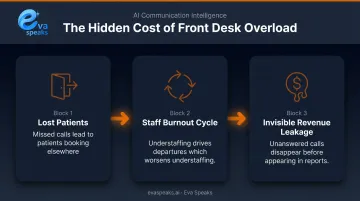
- Missed calls translate directly to lost patients — someone who can't get through often books elsewhere or skips rescheduling entirely
- Burnout feeds the turnover cycle — understaffing increases stress, which drives more departures, which worsens understaffing
- Revenue leaks without a trace — unanswered calls during peak hours or after closing disappear before they ever show up in a report
Why Old Workarounds Fall Short
These problems don't go away with answering services or phone trees. Those tools predate modern EHR systems and online scheduling — and it shows:
- Answering services add per-call fees and introduce third parties who don't know your workflows
- Phone trees (press 1 for scheduling, press 2 for billing) only route calls — they can't complete anything
- Both solutions sit outside your EHR and scheduling systems, so every handoff still requires manual follow-up
Conversational AI addresses all three failure points — handling calls end-to-end, integrating directly with your systems, and scaling without adding headcount.
What Is Conversational AI for Healthcare?
Conversational AI is software that uses natural language processing (NLP) and large language models to understand and respond to spoken or written requests in a natural, back-and-forth exchange. It's not a phone tree with better branding.
HIMSS describes NLP as technology that enables computers to derive actionable data from natural human language. In practice, a patient who says "I need to move my Thursday appointment" and one who says "Can I reschedule for next week?" are understood as the same request — without the caller navigating a menu or selecting the right option.
How It Differs from Scripted Automation
Legacy phone systems respond to exact inputs. Conversational AI interprets intent and context. That distinction is what makes the technology usable for real patients in real situations — stressed, rushed, or simply unfamiliar with how your phone system is laid out.
Modern platforms handle two primary channels:
- Inbound voice calls — the AI answers, identifies the caller's need, and either resolves it or routes appropriately
- Text and chat-based messaging — the same logic applied to SMS or web chat interactions
Well-designed systems also know their limits. Clinical concerns, urgent triage situations, and patient distress signals should always escalate to a human staff member. Conversational AI handles the repetitive and transactional; it doesn't replace clinical judgment.
HIPAA Is Not Optional
Any AI platform that handles calls or messages involving patient information is a business associate under HIPAA. HHS is explicit: a cloud service provider that creates, receives, maintains, or transmits ePHI — even encrypted ePHI it cannot decrypt — is a business associate and must sign a BAA.
Before deploying any conversational AI in a healthcare setting, practices should request compliance documentation, confirm ePHI safeguards, and execute a signed Business Associate Agreement.
Hear how AI-powered front desk conversations actually sound. Listen to Sample AI Call
What Can Conversational AI Actually Do at the Front Desk?
The practical question isn't whether the technology works — it's which specific workflows it can take off your staff's plate.
Appointment Scheduling and Management
Conversational AI can check provider availability, book new appointments, confirm reschedules, and process cancellations in real time — within a single phone call or text exchange, without staff involvement. Platforms like EvaSpeaks handle this through customizable call-flow scripts and routing rules, letting the AI follow the same logic a trained front-desk staffer would — without putting anyone on hold. EvaSpeaks connects to appointment scheduling systems in real time, which means when a patient calls to reschedule, the AI checks live availability and confirms a new slot during the same call — the same workflow a human receptionist would follow, but available around the clock without staffing costs.
Call Routing and Triage
The AI identifies the purpose of each call — scheduling, billing, directions, prescription refill, clinical concern — and routes accordingly. Routine requests get resolved on the spot, while complex or clinical calls transfer to the right team member with a call summary already generated — so staff aren't starting from scratch.
After-Hours Coverage
Phones don't stop ringing at 5 PM, but staff do go home. Conversational AI can answer calls 24/7, provide information, accept scheduling requests, and connect urgent callers to on-call providers based on configurable escalation rules.
An AMA STEPS Forward case study found that fewer than 10% of primary care after-hours calls required physician escalation, and fewer than 5% required ED triage. The vast majority of after-hours contacts can be resolved without involving anyone on-call.
Appointment Reminders
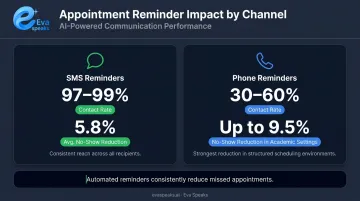
Automated reminders via SMS or voice call reduce no-shows without requiring staff to manually dial through a list. A peer-reviewed systematic review found automated reminders reduced non-attendance by 5.8%, with personalized phone reminders achieving up to 9.5% reduction in academic outpatient clinic settings. SMS contact rates in the same review reached 97–99%, compared to 30–60% for telephone reminders.
FAQ and Informational Responses
Office hours, directions, insurance accepted, parking — the calls that take 90 seconds each but add up to hours across a week. Conversational AI handles these without staff involvement, using content configured by the practice.
See how healthcare clinics are deploying this today. See Industry Use Cases
The Real Impact: Benefits for Clinics and Patients
The Cost Math
BLS data puts the median annual wage for medical secretaries and administrative assistants at $42,820. Benefits add roughly 30.9% on top of wages, based on BLS employer compensation data for office and administrative support roles — bringing total employment cost well above base salary before factoring in recruiting and turnover expenses.
Conversational AI platforms run at a fraction of that cost and handle simultaneous calls without hold times or lunch breaks. A single AI system can field dozens of concurrent calls at once — something no staffing model can match at equivalent cost.
Staff Reallocation, Not Replacement
The more accurate framing is reallocation. When conversational AI absorbs scheduling calls, FAQ requests, and after-hours volume, your front desk staff spend their time on tasks that actually require human judgment:
- In-person patient support and check-in
- Care coordination and complex scheduling
- Insurance and billing escalations
- Situations where empathy and context matter
Staff who spend less time on repetitive call volume and more time on meaningful patient interactions tend to stay longer. That's a retention benefit most clinics don't account for when evaluating AI tools.
Patient Access and Satisfaction
Patients who call a conversational AI-powered front desk get an immediate answer. No hold music. No voicemail. A 2023 systematic review in Healthcare identified accessibility, waiting time, and effort to secure an appointment as direct determinants of patient satisfaction. A companion study found longer outpatient waiting times consistently and negatively affect satisfaction scores. When patients reach someone — or something — immediately, that first interaction sets the tone for everything that follows.
Consistency Nobody Has to Train
Conversational AI delivers the same accurate response on call 1 and call 500. No off days, no miscommunication about accepted insurance, no inconsistent answers about office hours. For practices building patient trust, that consistency compounds over time.
Conversational AI vs. Legacy IVR Systems
IVR — the press-1-for-appointments, press-2-for-billing system most patients know and dislike — was a genuine step forward from fully manual call handling. But it has a hard ceiling.
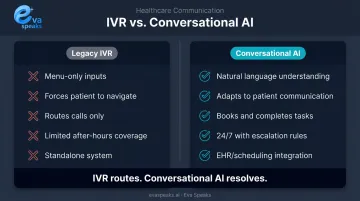
| Dimension | Legacy IVR | Conversational AI |
|---|---|---|
| Language understanding | Exact menu inputs only | Natural language, intent-based |
| Patient experience | Menu navigation | Conversational exchange |
| Task completion | Routes calls only | Can book, reschedule, confirm |
| After-hours capability | Limited | 24/7 with escalation rules |
| Integration | Typically standalone | API-based EHR/scheduling integration |
The core difference is structural: IVR forces patients to fit the system's rigid menu logic. Conversational AI adapts to how patients actually communicate — and completes tasks instead of just routing them.
One practical note: most practices don't need to rip out their phone infrastructure to upgrade. Modern AI platforms are designed to layer on top of existing telephony setups rather than replace them, which keeps implementation risk and upfront cost low.
How the Three Options Stack Up
Here is how conversational AI, traditional IVR, and human front desk staff compare for healthcare clinic operations:
| Conversational AI (EvaSpeaks) | Traditional IVR | Human Front Desk | |
|---|---|---|---|
| Features | Natural language, scheduling, triage, EHR sync | DTMF menus, appointment reminders | Full patient interaction, adaptive |
| Best-fit Business Size | Clinics to health systems | Large hospital networks | Small to medium practices |
| Key Strengths | 24/7, no hold time, HIPAA-compliant, consistent | Widely deployed, proven | Human empathy, complex situations | | Implementation Complexity | Low - EHR connectors | High - months | None (hire) | | Integration Capability | EHR, scheduling, CRM native | Custom dev required | Manual entry |
How to Evaluate and Implement a Conversational AI Solution
Key Evaluation Criteria
Before selecting a platform, verify these non-negotiables:
- HIPAA compliance documentation and BAA availability — required, not optional
- EHR and scheduling system integration — confirm compatibility with your specific system
- **Customizable call scripts and routing logic** — your workflows are not generic
- Natural language model quality — test it with real patient call scenarios
- After-hours coverage and escalation rules — how does it handle urgent calls?
- Transparency with patients — the AMA states patients should be informed when AI is involved in their care interactions
- Data governance — understand how call recordings and PHI are stored, retained, and whether you can opt out of AI training data use
Once you've confirmed a platform meets these criteria, the next step is getting it live without disrupting your practice.
A Realistic Implementation Approach
Implementation timelines vary by platform complexity and integration requirements. Here's what that path typically looks like:
- Audit your call volume — categorize current inquiry types to identify which workflows are highest volume and lowest complexity
- Build and configure call flows — define scripts, routing rules, escalation triggers, and after-hours behavior
- Test before going live — run real scenarios through the system before patient-facing deployment
- Go live with a defined scope — start with appointment scheduling and FAQ calls; expand from there
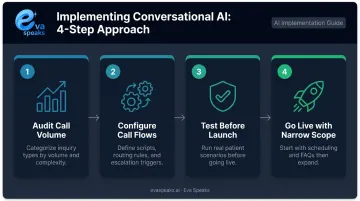
Starting narrow reduces risk and gives your staff time to adapt. Once scheduling and FAQ calls run reliably, adding more workflows becomes straightforward.
Want to talk through the right fit for your clinic? Talk to an AI Communication Expert
Frequently Asked Questions
Is conversational AI for healthcare HIPAA compliant?
HIPAA-compliant platforms include encrypted data handling and restricted PHI access as standard features. Still, compliance is your responsibility to verify — always request documentation and a signed BAA before deployment.
Can conversational AI integrate with my existing EHR or scheduling system?
Most modern platforms integrate with common EHR and practice management systems, enabling real-time appointment booking and updates. Confirm compatibility with your specific system during the evaluation process.
Will patients actually respond well to talking to an AI?
Patient acceptance tends to be high when the AI is fast, accurate, and hands off to a human without friction. Resistance comes when the AI feels like a barrier rather than a helpful first step.
What front desk tasks can conversational AI handle independently?
The following tasks run without staff involvement:
- Appointment scheduling, rescheduling, and cancellations
- Office hours and location FAQs
- Appointment reminders
- Basic call routing
Clinical triage always escalates to staff.
How long does it take to implement conversational AI at a clinic?
Many platforms can be configured and live within days to a few weeks, depending on call flow complexity and required integrations. Starting with a narrow scope — scheduling only, for example — shortens the timeline.
Can conversational AI handle calls after business hours?
Yes. 24/7 availability is one of the primary advantages. The system answers after-hours calls, provides information, accepts scheduling requests, and connects urgent callers to on-call providers based on configurable escalation rules.