Why Call Routing Is Getting a Major Upgrade in 2026
Customers call a business expecting to be recognized — someone (or something) that already knows who they are and why they're calling. What they still often get is "Press 1 for sales, press 2 for billing." Advanced AI routing agents are closing that gap — and fast.
Legacy IVR systems were built for a different era. They rely on rigid menus, keyword triggers, and hard-coded decision trees that break down the moment a caller steps outside a predicted path. Meanwhile, contact center AI investment surged through 2023 and 2024, with more than 70% of contact centers increasing AI spending — and triage bots ranking among the top areas of that investment.
Here's what this guide covers — from how the technology works to how to deploy it:
- What advanced AI routing agents are and how they differ from traditional IVR
- How the processing pipeline works from voice input to routing decision
- The key routing patterns businesses are deploying today
- Measurable operational benefits
- Practical steps to deploy and optimize routing agents
TLDR: Key Takeaways
- AI routing agents use LLMs to understand caller intent dynamically — no rigid menus required
- Context carries across multi-turn calls, and routing decisions improve as the system learns from past outcomes
- Core routing patterns include intent-based, predictive, sentiment-based, skill-based, and multi-agent
- Faster resolution, fewer misdirected calls, and round-the-clock capacity — without adding headcount
- Successful deployment starts with a single high-volume use case and clean CRM integration
What Are Advanced AI Agents for Call Routing?
An AI call routing agent is an LLM-powered system that dynamically directs each caller to the right agent, department, or self-service path — based on their intent, prior interaction history, real-time sentiment, and current queue conditions. It does not require callers to navigate menus or speak specific keywords.
The Evolution from Rules to Intelligence
Routing technology has gone through three distinct phases:
- Rule-based routing — Hard-coded decision trees and keyword spotting. If a caller said "billing," they went to the billing queue. Anything outside the script failed.
- ML-based routing — Trained classification models that improved on keyword matching but still required extensive labeled data and periodic retraining.
- LLM-based routing — Generative AI that interprets natural language, handles multi-intent queries, and asks clarifying questions when needed. This is the 2026 standard.
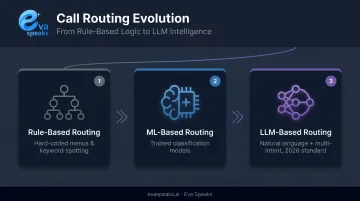
Microsoft's 2026 intent-driven routing documentation confirms that intent is now a native attribute in modern unified routing systems — usable across voice, live chat, and cases without separate intent model builds for each channel.
How AI Routing Differs from IVR and Older NLU Bots
| System | How It Routes | Limitation |
|---|---|---|
| Traditional IVR | Menu selections (press 1, press 2) | Breaks on any deviation |
| NLU bots | Trained intent classifiers | Requires extensive scenario planning |
| LLM routing agents | Natural language understanding + context | Requires LLM integration and latency management |
The Traffic Controller in a Multi-Agent Ecosystem
The routing agent doesn't handle conversations — it directs them. It evaluates every incoming call and decides whether it goes to an AI support agent, AI sales rep, AI receptionist, or a human specialist. Platforms like Eva Speaks power this logic through LLM integration and real-time AI responses, so businesses can configure call-flow scripts and routing rules without standing up a custom intent model.
Three converging improvements have made AI routing production-ready in 2026:
- Lower LLM latency — Response times now fall within acceptable thresholds for live call handling
- Real-time CRM access — Routing decisions draw on live customer data, not cached snapshots
- Multi-turn context retention — The system tracks the full conversation, not just the last utterance
Watch how advanced AI routing handles complex queries live. Watch AI Call Flow Demo
How Advanced AI Call Routing Agents Work in 2026
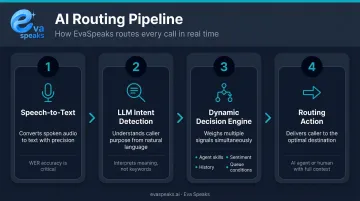
Every routing decision follows a four-stage pipeline executed in near real time.
The Four-Stage Processing Pipeline
Speech-to-text — The caller's voice is digitized and transcribed. Five9 identifies Word Error Rate as a critical foundation — poor transcription accuracy cascades into poor routing decisions downstream.
LLM intent detection — The transcribed input is analyzed not for literal words but for meaning. "I want to check on my delivery" and "where's my package?" map to the same intent without separate rules for each phrasing.
Dynamic decision engine — The AI simultaneously evaluates multiple real-time inputs before making a routing choice. According to Genesys, predictive routing analyzes:
- Agent skills and current workload
- Customer sentiment and urgency signals
- Past interaction history and channel preferences
- Issue type and complexity
- Queue conditions and agent availability
Routing action — The call is directed to an AI agent for self-service or to the most appropriate human agent, with full context attached to the work item before the handoff completes.
Context Retention Across Multi-Turn Conversations
Traditional routing systems treat each caller statement as isolated input, which means callers who change their mind or add context mid-call often get bounced or misrouted. LLM-based routing tracks the full conversation throughout the call rather than resetting between turns. Microsoft's 2026 documentation notes that Copilot agents can detect intent, ask follow-up questions, and carry identified intent fields through to the work item at escalation — so context survives the transfer intact.
Continuous Learning
The routing layer doesn't stay static after deployment. Feedback loops analyze outcomes — was the issue resolved on first contact? Was the caller transferred again? These signals feed back into routing logic over time. Genesys describes this as using resolution rates, CSAT scores, and agent performance data to sharpen match accuracy — no manual rule updates required.
Types of AI Call Routing Patterns Businesses Use Today
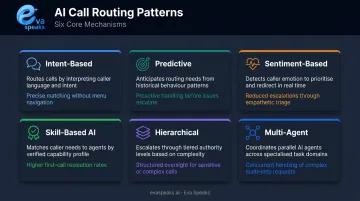
Intent-Based and Predictive Routing
Intent-based routing interprets why someone is calling, not just the words they use. A caller saying "I need help with my invoice" and one saying "there's something wrong with my bill" both reach the same destination — no separate keyword rules required for each phrasing. Microsoft's intent-driven routing uses detected intent, intent group, and line of business as live work item attributes, feeding them directly into queue assignment logic.
Predictive routing goes a step further: it matches callers to the specific agent most likely to resolve their issue. It factors in agent expertise, past performance with similar cases, and caller profile data — not just who's available. Genesys defines this as AI that matches customers to the best available resource using both real-time and historical data, resulting in fewer transfers and higher first-contact resolution rates.
Sentiment-Based and Skill-Based Routing
Sentiment-based routing analyzes vocal tone, word choice, and emotional cues in real time. A visibly frustrated or distressed caller can be prioritized in queue or sent directly to a senior agent before things escalate. In practice, this input feeds into predictive routing models rather than operating as a standalone layer.
Skill-based routing has always matched callers to agents with the right product knowledge. The AI-enhanced version adds a layer on top: it identifies which agents have the strongest resolution rates with specific caller profiles or problem types — not just who holds the right certification.
Microsoft's 2026 documentation confirms that classification rules can attach skills and priority levels based on detected intent, with the routing engine assigning work to the most qualified available agent automatically.
Hierarchical and Multi-Agent Routing
Hierarchical routing uses stacked decision logic: a top-level router sends calls to a department, and a second-level router within that department refines the assignment further — distinguishing existing customers from new ones, or Tier 1 from Tier 2 support cases, without requiring one sprawling routing tree.
Multi-agent routing handles callers with more than one need at once. Rather than forcing a caller to choose between "billing" and "account upgrades," the routing layer identifies both intents and either prioritizes the primary one or sequences handoffs to specialized agents. CX Today's 2025 analysis calls this multi-agent orchestration — where specialized AI agents collaborate on complex queries instead of each handling only a slice of the problem.
Here's a quick summary of how these patterns compare in practice:
| Routing Type | Core Mechanism | Primary Benefit |
|---|---|---|
| Intent-based | Understands call reason, not keywords | Fewer misdirected calls |
| Predictive | Matches caller to best-fit agent | Higher first-contact resolution |
| Sentiment-based | Detects emotional cues in real time | Escalation prevention |
| Skill-based (AI) | Weighs resolution history + skills | Better agent-problem fit |
| Hierarchical | Stacked decision layers | Scalable without complex trees |
| Multi-agent | Handles multiple caller intents | Fewer repeat contacts |
Want advanced routing built for your team's call types? Get a Customized Workflow Recommendation
Benefits of AI Call Routing Agents Over Traditional Systems
Operational Improvements
The core problem with IVR-based routing is that it evaluates a single input — a menu selection — and applies static rules. AI routing evaluates caller intent, history, agent availability, skills, and workload simultaneously — then adapts in real time.
Here is how advanced AI agents, rule-based cloud routing, and legacy call routing compare for handling complex call queries:
| Advanced AI Agent (EvaSpeaks) | Rule-Based Cloud Routing | Legacy IVR Routing | |
|---|---|---|---|
| Features | Intent detection, multi-turn conversation, CRM context, dynamic routing | Skill-based routing, configurable rules | Fixed DTMF menus, static routing trees |
| Best-fit Business Size | SMB to mid-market | Mid-market to enterprise | Large enterprise |
| Key Strengths | Handles complex queries naturally, easy to update | Proven, flexible routing logic | Predictable, widely deployed |
| Implementation Complexity | Low - no code | Medium | High |
| Integration Capability | CRM, EHR, scheduling native | CRM via API | Custom dev required |
Key operational gains include:
- Fewer misdirected calls — Intent detection catches nuance that keyword matching misses, reducing the volume of calls landing in the wrong queue
- Faster queue assignment — Real-time evaluation of agent availability, skills, and workload means shorter wait times and better first-contact match rates
- Reduced unnecessary transfers — Context persists with the call, so agents receive pre-populated work items rather than asking callers to repeat themselves
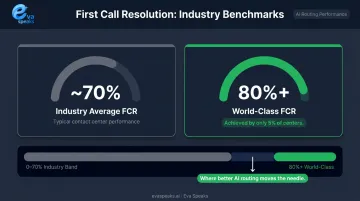
SQM's 2025 benchmarking data puts the average first contact resolution rate across contact centers at just under 70%, with world-class performance at 80% or higher — reached by only 5% of centers. Better initial routing is one of the clearest levers for moving that needle.
Cost Efficiency and 24/7 Scalability
AI routing agents handle unlimited concurrent inbound calls at a flat software cost. This matters most for growing businesses with unpredictable or seasonal call volumes — adding 500 concurrent calls during a peak period doesn't require hiring and training 50 additional agents.
Genesys data shows that predictive routing directs high-complexity or high-value calls to experienced agents while simpler issues go to automated systems or newer staff — optimizing cost allocation without manual intervention.
For SMBs, this eliminates the trade-off between understaffing during quiet periods and overstaffing for peaks. The same dynamic shapes caller experience — and that's where AI routing's impact becomes most visible.
Customer Experience
The most immediate improvement for callers: no menu navigation. No "Press 1 for..." prompts. No repeating the same information after a transfer. Context transfers with the call, so the receiving agent — human or AI — already knows who the caller is and what they need.
Per CX Today's 2025 research, AI agents now handle initial triage around the clock, freeing human agents to focus on escalations and higher-value conversations where judgment matters most.
How to Implement AI Call Routing Agents: Practical Steps
Pre-Deployment Groundwork
Before configuring a single routing rule, get three things right:
- Define specific use cases with measurable success criteria — "Reduce Tier 1 transfer rate by 20%" is actionable. "Improve routing" is not. Start with one high-volume, well-understood call type.
- Map existing call flows — Identify where callers currently get stuck, misrouted, or transferred. These are the highest-value points for AI intervention.
- Clean your CRM data — Routing agents are only as good as the data they query. Incomplete or outdated caller records degrade intent matching and context handoff.
Platforms like EvaSpeaks offer configurable call-flow scripts and routing rules that let teams set up routing logic without deep engineering resources — so deployment doesn't require a dedicated engineering team to get started. EvaSpeaks also captures routing outcomes and transcripts as part of every interaction, which feeds the continuous learning loop that good routing systems depend on: each call provides data that can inform routing refinements, turning call volume into a source of operational intelligence over time.
Deployment and Testing
Five9's 2026 deployment guidance recommends starting with simpler AI tasks — transcription and summarization — before scaling to full self-service routing. The same principle applies to routing complexity.
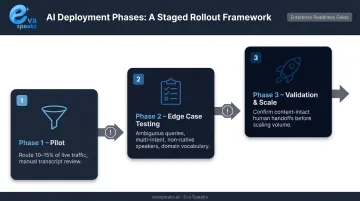
A phased approach:
- Phase 1 — Route 10-15% of live traffic through the AI agent; review transcripts and routing decisions manually
- Phase 2 — Test edge cases: ambiguous queries, multi-intent callers, non-native speakers, domain-specific vocabulary
- Phase 3 — Validate that human handoffs work with full context intact before scaling volume
Five9 also recommends an engine-agnostic AI strategy — avoiding lock-in to a single speech-to-text or LLM provider so you can swap components as models improve.
Ongoing Optimization and Human Fallback
Routing models require maintenance. Call patterns shift with new product launches and seasonal demand, and your routing logic needs to keep pace. Build in:
- Track routing accuracy, escalation rates, and customer satisfaction through a dedicated monitoring dashboard
- Activate human fallback automatically when AI routing confidence drops below your defined threshold — or the moment a caller asks for a person
- Retrain the model as new call data accumulates, particularly after significant product or service changes
McKinsey's 2025 contact center research argues for a hybrid model that combines AI and human agents rather than treating automation as a wholesale replacement — with AI handling high-volume triage while humans focus on complex, high-empathy conversations.
Have questions about AI routing for your organization? Talk to an AI Communication Expert
Frequently Asked Questions
What is the difference between AI call routing and traditional IVR?
Traditional IVR routes calls based on fixed menu selections ; the caller must pick from predefined options or get stuck. AI routing uses LLM-based intent detection and real-time data to understand what the caller needs without menus, handling natural language and adapting to context that IVR simply can't process.
How do AI call routing agents handle multi-intent calls?
Advanced routing agents detect multiple intents in a single caller statement, ask clarifying questions to confirm priority, and either route sequentially to specialized agents or flag both needs simultaneously. Rule-based systems can only evaluate one routing path at a time, so multi-intent calls typically result in a transfer.
Can AI call routing integrate with my existing CRM or phone system?
Most modern AI routing platforms support native or API-based integration with CRMs like Salesforce and HubSpot, as well as existing CCaaS infrastructure. Bi-directional data sync means the routing agent reads caller history before deciding where to send the call, then writes a summary back once the interaction ends.
What types of businesses benefit most from AI call routing?
Businesses with high call volumes, time-sensitive needs, or complex routing requirements benefit most. Common examples include healthcare scheduling, e-commerce fulfillment support, SaaS technical support tiers, and financial services — with healthcare particularly notable, as Five9 reports AI mapping roughly 600 medical synonyms to routing targets.
How long does it take to deploy an AI call routing agent?
Timelines vary by complexity, but LLM-based platforms can reduce intent training from weeks to days. Most organizations go live with initial routing flows in a few weeks by starting with one well-defined use case, then expanding from there.
Do AI routing agents replace human agents?
No. AI routing agents automate call classification and triage — not the conversations themselves. They ensure human agents handle complex, high-empathy interactions rather than spending time on initial routing decisions. McKinsey's hybrid contact center model treats AI and human agents as working together, each handling what they do best.