The question isn't whether you need answering coverage. It's which kind fits your business.
AI answering services and live answering services each solve the missed-call problem differently. They diverge sharply on cost, call complexity, customer trust, and operational fit. This guide breaks down both options so you can make a clear-eyed choice.
Key Takeaways
- AI answering delivers 24/7 coverage, lower cost, and scales without adding headcount—best for routine, high-volume, or after-hours calls
- Live answering offers real empathy and judgment—essential for emotionally sensitive or complex calls
- Cost gap is real: AI services start as low as $0–$29/month; live services typically run $250–$1,700+/month depending on volume
- No universal winner—the right choice depends on your call types, budget, and customer expectations
- Hybrid models (AI for routine calls, humans for escalations) often deliver the best of both
AI vs. Live Answering Services: Quick Comparison
| Dimension | AI Answering | Live Answering |
|---|---|---|
| Cost | $0–$349/month (usage-based) | $250–$1,725/month (minute bundles) |
| Availability | 24/7, no holidays or breaks | Limited unless 24/7 staffing contracted |
| Scalability | Handles unlimited simultaneous calls | Scales linearly; costs rise with volume |
| Call Complexity | Routine FAQs, booking, routing | Complex, sensitive, or unpredictable calls |
| Personalization | Script-driven; consistent but limited | Human judgment; adapts in real time |
| Setup Time | Fast (hours to days) | Slower (training, scripting, onboarding) |
| Integration | CRM, calendar, third-party tools | Varies by provider |
| Winner | Routine, high-volume, cost-sensitive | Emotional, complex, trust-critical calls |
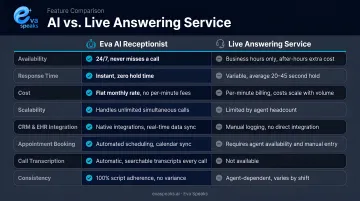
The right choice depends entirely on what your phones actually handle. A business fielding 200 appointment-booking calls per week has very different needs than a law firm managing personal injury intake. Look at your call mix first — volume, complexity, and emotional stakes — then match the tool to those realities.
Hear the difference for yourself. Listen to Sample AI Call
What Is an AI Answering Service?
An AI answering service uses voice AI and large language models (LLMs) to handle inbound calls without a human agent. When a customer calls, the AI greets them, identifies their need, and resolves it—whether that's answering a question, booking an appointment, capturing lead information, or routing the call to the right person. EvaSpeaks is a concrete example of this model: it processes each inbound call using LLM integration and speech recognition, then handles it through configurable call-flow scripts — so businesses set the rules once and the AI executes them consistently across every call, including after hours.
Core Capabilities
- 24/7 uptime with no sick days, holidays, or lunch breaks
- Simultaneous call handling—no busy signals during peak hours
- Real-time responses drawn from your business's configured knowledge base
- Automated integrations with CRMs, calendars, and business tools
- Call transcription for quality assurance and follow-up
How It Differs From Old-School IVR
Traditional IVR (Interactive Voice Response) systems force callers through fixed menus: "Press 1 for billing, press 2 for support." Modern AI answering—powered by LLMs—handles open-ended, conversational queries. A caller can say "I need to reschedule my Thursday appointment" and the AI understands intent, not just keywords.
As TTEC explains, conversational AI uses natural language processing so callers can speak naturally rather than navigating touch-tone menus. That difference translates directly to lower abandonment rates and fewer frustrated callers.
The cost efficiency case is also worth noting. McKinsey's 2025 research found AI implementations in contact centers achieved 50% reductions in cost per call—though those figures come from enterprise environments, not SMB answering services.
Use Cases Where AI Excels
AI performs best when calls are predictable and high-volume:
- Appointment-heavy businesses: salons, dental clinics, home services
- After-hours lead capture: HVAC, plumbing, real estate—industries where calls come in at 9pm and need same-day response
- High call volume with routine inquiries: FAQs, pricing questions, booking confirmations
- Businesses without dedicated reception staff: solopreneurs, lean teams, remote operations
Eva Speaks, for example, provides AI-enabled call handling built on LLM integration with customizable call-flow scripts and routing rules. It's built for businesses that need reliable, intelligent call routing without hiring dedicated reception staff.
See how AI handles calls across different industries. See Industry Use Cases
What Is a Live Answering Service?
A live answering service puts a trained human agent on your inbound calls. That agent follows your custom script but can go off-script when the conversation demands it. Three main formats exist:
- In-house receptionists: employees on your payroll
- Virtual receptionist services: remote agents who answer as if they're in your office (Ruby, PATLive)
- Outsourced call centers: higher-volume operations, often offshore
Core Strengths
- Genuine empathy: humans read emotional tone and respond accordingly
- Ability to navigate unexpected or sensitive conversations
- Brand representation through voice, judgment, and relationship-building
- Adaptability when a caller's situation doesn't fit any script
Honest Drawbacks
- Higher cost: Ruby's plans run from $250/month for 50 minutes to $1,725/month for 500 minutes; PATLive scales from $250/month for 75 minutes to $1,170/month for 600 minutes
- Limited simultaneous capacity: a team of five agents can only handle five calls at once
- Variable quality: agent experience varies, and quality assurance requires active management (ATSI's industry award program uses mystery callers over six months, requiring an 80%+ average score)
- Coverage gaps: evenings, weekends, and holidays require extra staffing or contracts
Use Cases Where Live Agents Win
Human agents consistently outperform AI in:
- Legal intake — a personal injury caller describing an accident needs empathy and careful handling of sensitive details
- Patient distress calls, where clinical judgment and human reassurance matter
- Complex, high-value sales conversations where trust is built in real time
- Crisis situations (bereavement, financial hardship) where emotional intelligence isn't optional
ABA Formal Opinion 512 (2024) spells out lawyers' ethical duties around AI use — covering competence, confidentiality, and supervision. For legal intake specifically, that regulatory weight makes fully automated call handling a compliance risk, not just a trade-off.
AI vs. Live: Which Is Better for Your Business?
The right choice depends on five factors. Here's how to work through each one.
Call Complexity
If most of your calls follow a predictable pattern—booking, FAQs, lead capture—AI handles them reliably and consistently. If your calls regularly involve emotional content, multi-step problem-solving, or sensitive disclosures, live agents earn their cost.
Budget
The cost gap is substantial:
- AI services: $0–$349/month depending on included minutes and features (Smith.ai starts at $0 + $0.15/minute; Goodcall runs $79–$249/month with unlimited minutes; Dialzara ranges from $29–$349/month)
- Live services: $250–$1,725/month for virtual receptionists at comparable minute volumes
- In-house receptionist: the BLS reported a median receptionist wage of $37,230/year in May 2024—before payroll taxes, benefits, or after-hours coverage
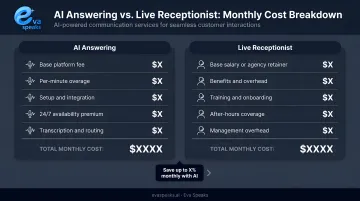
For high call volumes, AI's cost advantage compounds quickly. Live services bill by the minute, so volume growth means linear cost growth.
Scalability
AI handles unlimited simultaneous calls at no additional cost per call. A live service with three agents can manage three concurrent calls, then callers hit hold queues or voicemail. For businesses with seasonal spikes or rapid growth, that ceiling matters.
Customer Trust
Gartner's 2024 survey found that 64% of customers would prefer companies didn't use AI for customer service, and 53% would consider switching to a competitor if they discovered AI was being used. Five9's 2024 research put that human preference figure even higher—75% for phone and in-person support.
That data doesn't make AI wrong—it makes how you deploy AI critical. For routine calls, many customers don't object. For sensitive calls, they do.
Decision Framework
| Your Situation | Best Choice |
|---|---|
| Mostly routine, high-volume calls | AI |
| After-hours coverage with no staff | AI |
| Budget-constrained, lean team | AI |
| Emotionally sensitive call types | Live |
| Legal, medical, or financial intake | Live |
| Mixed call types across the day | Hybrid |
| Rapid growth with unpredictable volume | AI or Hybrid |
Real-World Scenarios: When Each Option Wins
Scenario 1: AI Wins — Home Services After-Hours
An HVAC company gets emergency calls at 11pm from homeowners with broken furnaces. Without coverage, those leads go to a competitor. Avoca's documented case study with Reliable Comfort—an HVAC and plumbing company—showed 100% after-hours coverage, 150+ simultaneous calls, and zero extra staff using AI phone answering. Invoca's data reinforces why: home services businesses miss 27% of inbound calls, and almost none of those callers leave voicemails.
AI answering captures the lead, books the appointment, and routes the emergency. No staff required. No missed opportunity.
Scenario 2: Live Wins — Personal Injury Law Intake
A caller describes a car accident that happened three hours ago. They're shaken, confused about their rights, and asking whether they have a case. AI can collect basic intake information, but it can't navigate the emotional weight of that call or exercise the legal judgment the situation requires. The ABA's 2024 ethics guidance makes clear that lawyers bear supervisory responsibility over AI tools—making human oversight at the intake stage not just preferable, but professionally appropriate.
For high-stakes intake calls like this, a live agent isn't just better—it's what professional responsibility standards are built around.
Scenario 3: Hybrid Wins — Medical Practice
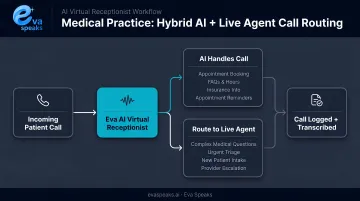
A busy medical practice uses AI to handle routine calls during peak hours: appointment booking, directions, prescription refill requests, and insurance questions route automatically. Calls flagged for urgency—a patient reporting symptoms, or one who sounds distressed—escalate to a live nurse or front desk staff immediately.
Routine callers get faster service. Patients who need a human voice get one. EvaSpeaks' customizable call-routing rules are built for this kind of configuration—defining which call types go to AI handling and which trigger escalation, without requiring a technical team to manage it. This ease of deployment is part of what makes EvaSpeaks a practical alternative to enterprise systems for practices and clinics that need intelligent call handling without a large IT footprint.
Ready to explore the right fit for your business? Talk to an AI Communication Expert
Here is how the three most common answering options compare on the factors that matter most to growing businesses.
| EvaSpeaks AI | Live Answering Service | Legacy IVR / Enterprise System | |
|---|---|---|---|
| Best-fit Business Size | SMBs, lean teams, multi-location businesses | Small to mid-size with complex call needs | Enterprise with large IT budgets |
| Key Strengths | 24/7 coverage, LLM-driven conversations, fast deploy | Human empathy, off-script flexibility | High call volume processing, deep legacy integrations |
| Implementation Complexity | Low - configurable scripts, no IT team required | Medium - scripting, training, onboarding | High - IT-led rollout, long timelines |
| Integration Capability | CRM, calendar, third-party tools out of the box | Varies widely by provider | Custom-built; expensive to extend |
Frequently Asked Questions
How much does an AI answering service cost per month?
AI answering services currently range from $0/month (usage-based, like Smith.ai) to around $349/month for higher-volume plans (like Dialzara's Business Elite). Most small businesses land in the $29–$129/month range. That's significantly less than staffing a receptionist at a median wage of $37,230/year.
Is an AI receptionist worth it?
For most businesses with routine or high-volume calls, yes. AI receptionists capture leads around the clock, reduce overhead, and integrate with existing scheduling tools. Companies handling emotionally complex or legally sensitive calls should pair AI with live escalation rather than relying on AI alone.
What is a live answering service?
A live answering service uses trained human agents (remote or on-site) who answer calls on behalf of your business following custom protocols. They adapt in real time to unexpected conversations and bring genuine empathy that scripted systems cannot replicate.
Can AI answering services handle complex or emotional calls?
Modern AI has improved, but it still struggles with emotionally sensitive or unpredictable conversations. For those call types, live agents or a hybrid escalation model remain the more reliable choice.
What industries benefit most from live answering services?
Legal (intake calls), healthcare (patient concerns), financial services, and high-touch service businesses like luxury hospitality or estate planning. These industries share a common thread: callers are often in high-stakes situations where human empathy directly affects trust and retention.
Can I use both AI and live answering services together?
Yes—and that's often the smarter approach. AI handles routine, high-volume, or after-hours calls; live agents manage escalations and sensitive interactions. You get the cost efficiency of AI with the reassurance of human backup when it actually matters.
Conclusion
There's no universal winner here. AI excels where speed, scale, and cost efficiency matter most—after-hours coverage, high call volumes, routine inquiries. Live agents earn their place where human connection and judgment are the product, not a nice-to-have.
The practical starting point: audit your actual call types for one week. Count how many are routine versus complex, and how many come in outside business hours. That breakdown tells you more than any comparison table.
The decision isn't really AI vs. live agents—it's about matching the right tool to each call type. Build your routing rules around that audit, and both options do their job well.