The numbers reflect this pressure. According to ContactBabel's 2023 US Contact Center Decision-Makers' Guide, the average US contact center sees a 12% call transfer rate and a 6.3% abandonment rate — both direct symptoms of routing that isn't working well enough.
Most businesses have some form of call routing already. The problem is that static IVR menus and basic queue logic break down under volume spikes, complex customer needs, or distributed teams. This guide explains how advanced call routing actually works — and why the gap between basic and advanced matters more than most businesses realize.
Key Takeaways
- Advanced call routing uses real-time data and configurable rules to send calls to the right agent — not just a static menu
- The process runs through four stages: call arrival and identification, rule evaluation, agent matching, and fallback handling
- Key methods include skills-based, time-based, priority-based, and load-balancing routing — most businesses use a combination
- Poor routing has measurable costs: transfers, abandonment, and longer handle times add up fast
- Eva Speaks uses LLM integration and customizable call-flow logic to route calls dynamically, not along rigid preset paths
Watch how AI-powered advanced routing handles real calls. Watch AI Call Flow Demo
What Is Advanced Call Routing?
Advanced call routing is a call management approach that uses real-time signals, predefined rules, and contextual data to direct inbound calls to the most appropriate agent, department, or channel — not simply the first available person.
Basic routing distributes calls mechanically. A caller presses 2 for billing, gets placed in the billing queue, and waits for whoever answers next. Advanced routing adds intelligence layers on top of that: caller history, agent skill scores, account tier, time-of-day rules, and CRM data all feed into the decision before a human ever picks up.
What it is not:
- Simple call forwarding, which redirects a single number to another number with no logic applied
- Basic IVR, which collects menu input but doesn't use contextual data to match callers to agents
Phone calls remain the channel customers turn to when stakes are high. Research from Contact Center Pipeline found that 47% of customers prefer telephony for complex interactions and 49% for high-urgency situations — figures that have grown significantly since 2018. Misrouting those calls — even once — erodes the trust that prompted the customer to call in the first place.
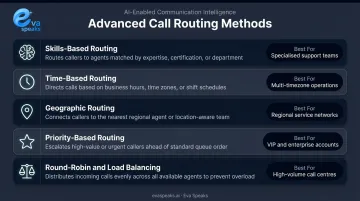
Advanced routing can be configured across several methods, and most businesses combine more than one:
- Skills-based routing — matches callers to agents with the relevant expertise
- Time-based routing — adjusts call handling based on business hours or shifts
- Geographic routing — directs calls by the caller's location or regional team
- Priority-based routing — fast-tracks high-value or urgent accounts
- AI-driven contextual routing — uses CRM data and conversation history for real-time decisions
The right combination depends on business size, call volume, and customer base.
How Advanced Call Routing Works
Advanced call routing operates as a real-time decision engine, evaluating multiple inputs in sequence before a human ever picks up. Here's how that process unfolds across four stages.
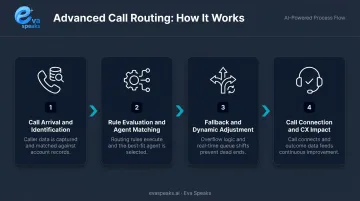
Stage 1: Call Arrival and Identification
The moment a call enters the system, the platform captures the inbound number and begins identification. Depending on configuration, this can involve:
- Caller ID lookup against contact records
- Account matching against CRM or support ticket data
- Interaction history retrieval (previous agents, issues, resolutions)
- Account tier or SLA status flagging
This enrichment happens before any routing decision is made. A call that arrives with full context — account status, last interaction, open tickets — routes far more precisely than one that enters as an anonymous inbound number.
The initiation can be fully automated, condition-based (triggered by IVR input), or hybrid. Eva Speaks' platform, for example, collects call and message metadata including caller ID, routing outcomes, and transcriptions as part of its call handling infrastructure — data that feeds back into routing decisions.
Stage 2: Rule Evaluation and Agent Matching
This is where routing decisions get made. The engine evaluates a ranked set of business rules against the enriched caller data, then selects the best-matching available agent or team. Rules at this stage may include:
- Agent skill requirements for the call type
- SLA tier or account priority
- Current queue depth per team
- Time of day or day of week
- Caller priority flags from CRM
AI-powered platforms create measurable differences at this stage. By integrating with large language models (LLMs) and using customizable call-flow scripts, routing engines like EvaSpeaks can interpret caller intent more accurately and apply dynamic logic rather than rigid static rules. EvaSpeaks also captures caller ID, routing outcomes, and transcriptions as part of each interaction — which means the data generated during calls feeds back into routing improvements over time without requiring a separate analytics platform.
SQM Group's benchmarking data shows that intelligent routing can increase first-call resolution (FCR) and CSAT by up to 5% — and that each 1% FCR improvement correlates with a 1% reduction in operating costs. Smarter matching at this stage reduces unnecessary transfers, shortens handle time, and improves resolution on the first contact.
Stage 3: Fallback and Dynamic Adjustment
No routing system works perfectly when primary agents are unavailable. Well-configured advanced routing handles this automatically through:
- Rings an entire agent pool simultaneously (parallel ringing) to reduce wait time
- Overflows to generalist queues when specialized agents are unavailable
- Offers callbacks rather than forcing customers to hold indefinitely
- Routes non-urgent inquiries to voicemail with automatic transcription
- Activates after-hours rules automatically based on configured office hours
Eva Speaks supports after-hours routing through configurable office hours within its call-flow setup — meaning the system redirects calls appropriately without manual intervention when business hours end.
High-volume conditions trigger overflow rules. VIP callers jump queue tiers. These adjustments happen without anyone touching a dashboard.
Stage 4: Call Connection and CX Impact
The caller reaches the right person. When routing is working well, the agent already has context surfaced — account status, call history, open issues — before they say hello. The customer doesn't repeat themselves. The agent resolves the issue faster.
This output stage is where routing quality becomes visible in metrics: wait time, abandonment rate, average handle time, and CSAT all reflect how accurately the first three stages performed.
See it live for your specific call types. Request Live Demo
Advanced Call Routing Methods
Advanced call routing covers a range of methods. Most businesses combine several depending on call type, volume, and team structure.
Skills-Based Routing
Skills-based routing matches callers to agents based on capability, not just availability. Agent profiles are scored across dimensions like language, product expertise, or account type — and the system routes to the best-fit agent rather than the next available one.
According to ContactBabel, only 34% of organizations currently identify agent skills before routing a call, meaning the majority still route on availability alone. That gap is where skills-based routing creates an edge.
When specialized agents are scarce, wait times increase. Overflow to generalist queues with warm-transfer escalation is a standard safeguard.
Time-Based and Geographic Routing
Time-based routing directs calls based on business hours, time zones, or scheduled exceptions. After-hours callers reach a regional office, voicemail flow, or callback queue instead of ringing an empty desk. Eva Speaks supports this through configurable office hours in its routing rules.
Geographic routing adds location awareness — by area code or account region — to connect callers to teams familiar with their market, language, or regulatory context. This matters for multi-location businesses or those serving distinct regional customer bases.
Priority-Based and VIP Routing
Priority routing elevates certain callers in the queue based on CRM tags, account tenure, or SLA flags. High-value customers or urgent cases reach qualified agents faster than standard queue order would allow.
ContactBabel data shows only 29% of contact centers currently use customer type or VIP status for personalization — a largely untapped lever given the direct impact on customer retention.
Overusing priority tiers without reserving capacity for standard queues creates frustration among non-priority callers. Businesses should audit priority usage regularly and set fixed capacity thresholds per tier.
Round-Robin, Least-Idle, and Load Balancing
For equal-skill agent pools, distribution methods handle peak volume management:
- Round-robin cycles calls evenly across available agents to prevent overload
- Least-idle routes to the agent idle longest, distributing attention fairly
- Percentage-based routing splits call volume across teams or locations proportionally
These methods work alongside skills-based and priority routing. They're best for managing volume within a group, not for matching complex needs to specific expertise.
See how businesses in your industry use advanced routing. See Industry Use Cases
Advanced AI Routing vs. Rule-Based Cloud vs. Legacy On-Premise
Here is how advanced AI routing, rule-based cloud routing, and legacy on-premise routing compare:
| Advanced AI Routing (EvaSpeaks) | Rule-Based Cloud Routing | Legacy On-Premise Routing | |
|---|---|---|---|
| Features | Intent detection, dynamic real-time rules, CRM context, AI containment | Skill-based routing, ACD, configurable rules | Fixed dial plans, manual updates |
| Best-fit Business Size | SMB to mid-market | Mid-market to enterprise | Large enterprise |
| Key Strengths | Adapts in real time, easy to update, no IT needed | Proven, feature-rich, flexible | Maximum control |
| Implementation Complexity | Low - no code | Medium | High |
| Integration Capability | CRM, scheduling, EHR native | CRM via API | Custom dev required |
Why Your Business Needs Advanced Call Routing
For any business managing inbound call volume, poor routing has direct and measurable costs. Missed calls mean lost revenue. Misrouted calls extend handle time and frustrate customers. Unbalanced workloads drive agent burnout.
The stakes around customer experience are high. According to PwC's Customer Loyalty Survey, 55% of consumers would stop buying from a company after several bad experiences, and 32% would leave due to inconsistent experiences — outcomes that poor call routing accelerates directly.
The Operational Upside
Advanced routing delivers operational gains that scale without proportionally increasing headcount:
- Extends effective coverage hours by routing to distributed or remote agents
- Reduces operational costs through self-service and voicemail deflection for simple inquiries
- Balances agent workloads to reduce burnout and attrition
- Eliminates manual queue management during volume spikes
The CX Upside
When customers reach the right person quickly — with context already visible to the agent — the interaction improves across every dimension:
- Fewer transfers required
- Shorter calls overall
- Less need for customers to repeat themselves
- Higher satisfaction scores tied to faster resolution
These gains aren't theoretical. One NICE case study of a 10,000-agent healthcare organization found that shifting to AI-powered routing produced 12% fewer transfers year-over-year, a 5% CSAT improvement, and an 8% reduction in average handle time — alongside $11M in annual operating savings. While this is a single vendor case study, the results align with what FCR benchmarking consistently shows: smarter routing compounds into meaningful cost and satisfaction gains.
Who Benefits Most
The businesses that gain the most from advanced routing share a few characteristics:
- High inbound call volume with variable demand patterns
- Multiple departments, locations, or agent skill sets
- Complex customer queries that require specific expertise
- Distributed or remote team structures
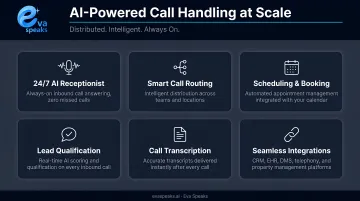
Platforms like EvaSpeaks address this directly: LLM integration and configurable call-flow scripts mean routing logic adapts to your business without requiring manual rule updates every time conditions change. This is a meaningful advantage over legacy rule-based routing, where every new call scenario has to be anticipated in advance and coded as a hard rule.
Conclusion
Advanced call routing works because it treats every inbound call as a data event. It captures context, evaluates rules, and matches callers to the right resource in real time, rather than relying on static menus or manual intervention to sort things out after the fact.
The businesses that benefit most aren't the largest ones. They're the ones that understand how routing actually works, configure it correctly for their specific needs, and measure it accurately enough to improve it over time. Moving from basic to advanced routing is fundamentally an operational shift — one with measurable impact on customer experience, agent efficiency, and revenue.
Have questions about your routing architecture? Talk to an AI Communication Expert
Frequently Asked Questions
What does call routing mean?
Call routing is the automated process of directing inbound calls to the appropriate agent, team, or queue based on preset rules. Unlike simple call forwarding, which just redirects a number, routing evaluates criteria like availability, skill, or caller priority before connecting the call.
What is intelligent call routing?
Intelligent call routing uses real-time data — such as caller history, CRM records, agent skill scores, and queue depth — to make smarter decisions than a basic IVR menu can. AI or machine learning powers the matching logic, replacing static decision trees with adaptive rules.
What is contextual routing?
Contextual routing uses information about the caller's history, previous interactions, or current account status to route more precisely. For example, a repeat caller might be connected directly to the agent who handled their last issue rather than entering a general queue.
What is priority call routing?
Priority call routing assigns importance levels to inbound calls based on account tier, SLA flags, or urgency — then moves higher-priority callers to the front of the queue or to specialized agents ahead of standard callers.
What is call routing in CRM?
Call routing in CRM uses customer data stored in a CRM system — such as purchase history, account tier, and open support tickets — to inform routing decisions in real time. The result is routing personalized to who is calling, not just what they selected in an IVR menu.