Two solutions dominate the market: virtual receptionists and automated answering services. They're often conflated — but they serve fundamentally different purposes. Choosing the wrong one can cost you leads, damage customer trust, and quietly erode revenue.
What's changed recently is that "automated" no longer just means press-1-for-sales menus. AI has entered the picture, creating a genuine third option that sits between rigid IVR systems and expensive human-staffed services.
This article breaks down how each solution works, where each one fits, and how to choose the right one for your business.
Key Takeaways
- Virtual receptionists (human or AI-powered) handle calls with real conversation, context, and adaptability — automated answering services route calls through pre-recorded menus with no live interaction.
- Automated services cost less and scale easily but fail on complex or emotionally charged calls.
- Virtual receptionists drive higher customer satisfaction and better lead capture, at a higher per-minute or monthly cost.
- A middle ground now exists: platforms like Eva Speaks use large language models (LLMs) to handle nuanced calls at volume, without human staffing costs.
- Your decision depends on call complexity, customer lifetime value, volume, and budget.
Virtual Receptionists vs. Automated Answering Services: Quick Comparison
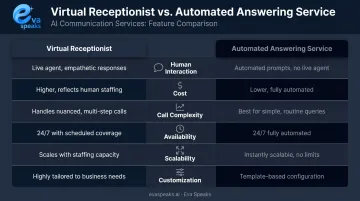
Many businesses confuse these two solutions, but they serve different operational purposes. Here's how they compare across the six dimensions that actually drive the decision:
| Dimension | Virtual Receptionist | Automated Answering Service |
|---|---|---|
| Human Interaction | Live person or AI that converses naturally, adapts to tone, and handles unexpected questions | Pre-recorded prompts and menu trees; no real-time conversation |
| Cost | Higher — typically per-minute or tiered monthly pricing | Lower — flat subscription or bundled into VoIP platform |
| Call Complexity | Handles nuanced requests, lead qualification, appointment booking, urgent calls | Best for simple, predictable routing (hours, directions, department selection) |
| Availability | 24/7 with the right plan; human-staffed tiers may vary | Always-on, 24/7 with no staffing dependency |
| Scalability | Scales with needs; cost increases proportionally with volume | Handles high volume without incremental cost per call |
| Customization | Custom scripts, business-specific workflows, judgment-based escalation | Configurable menus and routing rules within pre-set parameters |
Hear the difference for yourself. Listen to Sample AI Call
What Is a Virtual Receptionist?
A virtual receptionist is a remotely operating agent, traditionally a trained human professional, who answers calls on behalf of a business. They manage caller interactions in real time and represent the brand exactly as an in-house receptionist would.
There are two distinct subtypes:
- Human virtual receptionist services — outsourced live agents trained on your scripts and workflows (examples: Smith.ai at $300/month for 30 calls, Ruby at $299/month for 50 receptionist minutes)
- AI virtual receptionists — LLM-powered systems that carry on natural conversations, transcribe calls, and trigger routing workflows without a human on every line
Either way, callers feel heard, complex questions get answered, leads get qualified, and appointments get booked — all without the cost of in-house staffing.
Why Callers Still Want a Real (or Real-Feeling) Conversation
Five9's 2024 survey of 4,000 U.S. and U.K. consumers found 75% prefer talking to a real human for customer support — with that preference rising to 86% among Baby Boomers and remaining at 66% even among Gen Z. For businesses where calls carry real stakes, this matters.
Use Cases for Virtual Receptionists
Virtual receptionists deliver the most value in these scenarios:
- Service-based businesses with complex or emotionally sensitive calls — law firms, medical practices, HVAC contractors, financial advisors
- Startups projecting a professional image without the budget for in-house staff
- High-ticket businesses where one mishandled call could cost a significant client
- After-hours coverage for businesses that can't staff a phone line around the clock
Specific tasks virtual receptionists handle that a phone menu simply cannot:
- Lead intake and qualification through probing questions
- Appointment scheduling with calendar access
- Call screening and warm transfer to the right person
- Message-taking and relay via email, SMS, or CRM
- Bilingual caller support
- Urgent call prioritization based on context
What Is an Automated Answering Service?
An automated answering service — typically an IVR (Interactive Voice Response) system or auto-attendant — answers inbound calls, plays pre-recorded greetings, presents menu options, and routes callers based on keypad or voice input, with no live person involved at any stage.
The core advantages are straightforward:
- Always available at any call volume, with no staffing dependency
- Consistent — every caller hears the same greeting and options
- Low cost — usually bundled into a VoIP plan or flat subscription
- Easy to configure for predictable, repeating call paths
Three Variations to Know
- Basic auto-attendant — greeting and single-layer menu ("Press 1 for sales, press 2 for support")
- Multi-level IVR — branching menus with self-service capability (account lookups, appointment confirmations)
- AI-enhanced IVR — voice recognition and intent detection, which begins to overlap with AI virtual receptionist territory
Where Automated Services Break Down
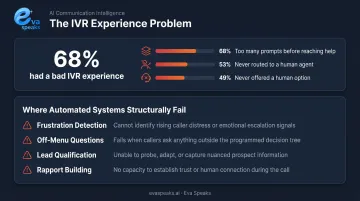
Verint's 2024 survey of 1,500 consumers found 68% had a bad IVR experience. Among those:
- 68% cited too many "press this number" prompts
- 53% said the IVR never routed them to a human
- 49% were never given the option to speak with a person
Beyond frustration metrics, automated systems have structural limits that matter for revenue-sensitive calls:
- Cannot detect or respond to caller frustration in real time
- Cannot adapt when a question falls outside the pre-built menu
- Cannot qualify a lead through natural conversation
- Cannot build the rapport that converts a first call into a long-term client
Where Automated Services Fit
They perform well for:
- Retail order status lines and utility billing inquiries
- Clinic appointment confirmation reminders
- After-hours routing when no agent is available
- Overflow handling during predictable peak periods
Virtual Receptionist vs. Automated Answering Service: Which One Is Better?
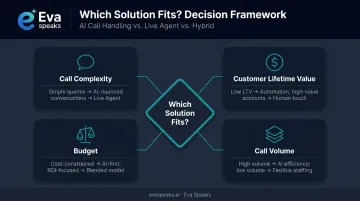
There's no universal answer — the right choice depends on four variables:
- Call complexity — Are most calls simple routing tasks or nuanced conversations?
- Customer lifetime value — Would a poorly handled call cost you a high-ticket client?
- Call volume — Dozens per day or hundreds?
- Budget — What's the cost of a missed call versus the cost of the service?
Choose an Automated Answering Service If:
- Your calls are mostly predictable: hours, directions, basic department routing
- Budget is tight and a missed personal connection won't cost significant revenue
- You need reliable after-hours overflow without staffing costs
Best for: e-commerce order lines, utility and billing departments, appointment confirmation systems.
Choose a Virtual Receptionist If:
- Your business runs on first impressions — legal, healthcare, financial services
- You're losing leads to voicemail (Invoca's 2024 platform data found less than 3% of callers sent to voicemail leave a message)
- Callers frequently have nuanced, emotional, or complex needs
- Customer trust and brand perception are central to your value proposition
Best for: law firms, medical practices, HVAC and home services, financial advisors, any business where the first call often determines whether a prospect becomes a client.
Consider an AI-Powered Solution If:
You need conversation quality close to a virtual receptionist, with the 24/7 scalability and cost profile closer to automation.
Eva Speaks occupies this middle ground: an AI-powered platform that handles inbound calls through natural conversation rather than rigid menu trees. Businesses can configure routing rules, office hours, and call-flow scripts, while the underlying LLM generates context-aware responses and logs full transcriptions. Because Eva Speaks activates through call forwarding on an existing business number, it doesn't require a new phone system or carrier contract — it's an AI layer that sits on top of what's already in place. For businesses that can't justify human receptionist costs but need more than a press-1 system, it's a practical third option.
Here is a quick side-by-side comparison of all three options:
| AI Virtual Receptionist (EvaSpeaks) | Live Virtual Receptionist | Traditional Automated Phone Service | |
|---|---|---|---|
| Features | Full AI conversation, 24/7, scheduling, CRM sync | Human agents, message-taking, routing | Pre-recorded prompts, DTMF, voicemail |
| Best-fit Business Size | SMB to mid-market | Any size | Very small businesses |
| Key Strengths | No missed calls, scales free, consistent | Human empathy, complex calls | Zero cost, zero setup | | Implementation Complexity | Low - hours | Low | None | | Integration Capability | CRM, scheduling, EHR native | Manual or limited | None |
The Cost of Getting It Wrong
Businesses routinely underestimate what poor call handling actually costs. Among home-services businesses, Invoca found 27% of inbound calls go unanswered — and with the average furnace replacement generating roughly $900 in profit, each missed call carries real dollar consequences. When you run that math across a month of missed calls, the "cheaper" option often turns out to be the most expensive one.
See how AI handles calls across different business types. See Industry Use Cases
Real-World Example: When the Switch Pays Off
Ziegler Diamond Law Firm, a personal-injury practice, worked with Smith.ai on speed-to-lead and client intake support. According to Smith.ai's published case study, the firm achieved a 52% conversion rate after implementing AI-assisted call answering and intake workflows — a result no phone menu delivers on its own.
The conditions that made the switch worthwhile are worth noting:
- Each retained client represents significant revenue, making every missed call costly
- Intake required qualifying questions and judgment calls — not just call routing
- After-hours calls were going unanswered or disappearing into voicemail
These are precisely the conditions where automated IVR systems underdeliver and where human or AI-powered call handling earns its cost back quickly.
If your business faces the same pressure points — missed calls, voicemail black holes, or first impressions that fall flat — an AI-powered solution like Eva Speaks offers a practical middle ground: the responsiveness of a live receptionist at a fraction of the cost.
Not sure which model fits your call volume? Get a Customized Workflow Recommendation
Conclusion
The right choice here depends almost entirely on what your calls actually look like — and what it costs when they go wrong.
Automated answering services hold up well when calls are simple, predictable, and high-volume. For everything else — complex inquiries, first-time callers, situations where trust drives the outcome — virtual receptionists (human or AI-powered) consistently outperform on quality and conversion. AI-powered platforms like Eva Speaks now offer a credible third path: conversational handling without the per-minute cost of a fully human-staffed service.
The practical question to ask isn't "which solution is better?" It's "what is a mishandled call actually costing me?" If the answer is leads lost to voicemail, callers hanging up in a menu loop, or clients choosing competitors after a poor first impression — the solution becomes clearer. Audit your current call handling, map your call complexity to the framework above, and choose accordingly.
Frequently Asked Questions
What is the difference between an answering service and a virtual receptionist?
An answering service typically refers to an automated IVR or auto-attendant system that routes callers through pre-recorded menus. A virtual receptionist — human or AI-powered — engages callers in actual conversation, handles complex requests, and can take action on behalf of the business, such as booking appointments or qualifying leads.
What is the difference between an AI receptionist and a virtual receptionist?
A traditional virtual receptionist is a live human agent working remotely. An AI receptionist uses large language models to simulate natural conversation, respond in real time, and manage call workflows without a human — offering comparable conversational quality at greater scale and typically lower cost.
Is a virtual receptionist worth it?
For businesses where call quality directly affects lead conversion or client trust — law firms, medical practices, home services contractors — yes. The ROI comes from reducing missed calls, capturing more leads, and ensuring every caller gets a professional response from the first ring.
Can a virtual receptionist take messages?
Yes — message-taking is a core function. A virtual receptionist captures the caller's name, contact information, and reason for calling, then relays it via email, SMS, or CRM integration — keeping your team informed and ready to follow up.
What is the role of a virtual receptionist?
A virtual receptionist answers inbound calls on the business's behalf, greets callers professionally, qualifies leads, schedules appointments, routes urgent calls, takes messages, and provides basic customer information — with no in-house staffing required.
Do people still use answering services?
Yes, automated answering services remain widely used — especially for after-hours coverage, overflow routing, and high-volume transactional calls. That said, many businesses are shifting to AI-powered systems that handle natural conversation at a price comparable to traditional IVR setups.