The best call routing software in 2026 addresses both sides of that problem. These platforms don't just direct calls; they track whether those routing decisions actually improve First Call Resolution (FCR), Average Handle Time (AHT), and customer satisfaction. That connection between routing logic and measurable outcomes is what separates modern contact center platforms from legacy systems.
This article covers what to look for, which platforms lead the market, how their monitoring capabilities stack up, and how to choose the right fit for your business.
Watch how AI-powered routing with built-in monitoring actually works. Watch AI Call Flow Demo
Key Takeaways
- Call routing software with native performance monitoring connects call direction and outcome measurement in one system
- Top 2026 platforms combine skills-based routing, real-time dashboards, AI analytics, and omnichannel support
- Leading options include NICE CXone, Genesys Cloud CX, Five9, Talkdesk, and RingCentral RingCX — each with different strengths in routing depth and monitoring granularity
- Monitoring depth varies significantly by pricing tier — features like WFM, QA scoring, and interaction analytics are often locked to higher plans
- AI-native platforms worth evaluating combine customizable routing rules with real-time transcription and LLM-powered call handling
What Is Call Routing Software — and Why Does Performance Monitoring Matter?
Call routing software directs incoming calls to the right agent, queue, or self-service option using caller data, agent skills, and predefined business rules. The spectrum runs from basic IVR menus (press 1 for billing, press 2 for support) to AI-driven intelligent call routing (ICR) that predicts caller intent before anyone picks up.
Performance monitoring is what makes routing intelligence actionable. Without it, you're making routing decisions blind.
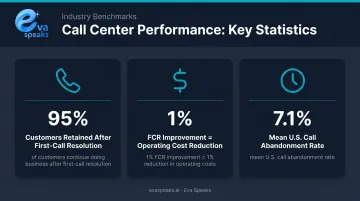
The numbers make the stakes concrete. According to SQM Group, 95% of customers continue doing business when their issue is resolved on the first call — and each 1% improvement in FCR corresponds to a 1% reduction in operating costs. On the other side of that equation: 30% of customers currently call back about the same issue, and customer dissatisfaction occurs nine out of ten times when FCR fails.
Poor routing is a direct contributor to those repeat contacts. When calls reach the wrong agent — or the wrong queue — resolution rates drop and handle times stretch. ContactBabel's 2024 US Contact Center Decision-Makers' Guide found that 61% of customers say not knowing how long they'll wait is extremely frustrating, while mean U.S. call abandonment sits at 7.1%.
The comparison below covers five platforms with native performance monitoring, evaluated on routing intelligence, analytics depth, and real-world usability — so you can identify what will actually move those numbers in 2026.
Best Call Routing Software with Performance Monitoring in 2026
These platforms were evaluated on routing sophistication, built-in monitoring and reporting, AI capabilities, scalability, and integration support — not marketing claims. Monitoring depth is noted by plan tier, because that detail matters when you're budgeting.
NICE CXone
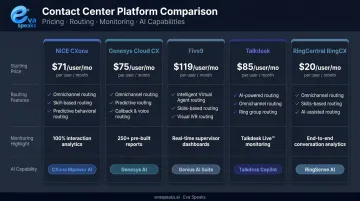
NICE CXone is a comprehensive cloud contact center platform built for large enterprises, offering omnichannel routing across voice, chat, email, and social channels alongside a deep Workforce Engagement Management (WEM) suite covering QA scoring, agent analytics, and workforce management.
The monitoring layer is where it earns its price point. AI routing is included from the Core plan upward, while Interaction Analytics — which analyzes 100% of interactions including sentiment — is reserved for Complete and Ultimate tiers. Supervisors get a unified view of queue health, agent performance, and customer sentiment without switching tools.
| Category | Details |
|---|---|
| Key Routing Features | Omnichannel ACD, skills-based routing, AI routing, IVR, universal queue for 30+ digital channels |
| Performance Monitoring | Real-time dashboards, Interaction Analytics (100% of interactions), QA scorecards, WFM forecasting, sentiment analysis |
| Pricing | Omnichannel Suite $110 / Core $169 / Complete $209 / Ultimate $249 per agent/month; Interaction Analytics included in Complete and above |
Genesys Cloud CX
Genesys Cloud CX is a globally trusted cloud-native platform serving both enterprise and mid-market teams. Its routing engine is highly configurable — supporting skills-based, priority-based, and AI-assisted routing — with native WEM tools included in higher tiers.
Predictive routing uses real-time and historical data to match customers with the agents most likely to resolve their issue on the first attempt. Speech and text analytics alongside real-time performance dashboards give contact center leaders a continuous read on both routing efficiency and customer experience quality.
| Category | Details |
|---|---|
| Key Routing Features | Skills-based routing, AI predictive routing, speech-enabled IVR, callback scheduling, blended inbound/outbound |
| Performance Monitoring | Real-time KPI dashboards, QA evaluations with AI scoring, agent scorecards, speech/text analytics, WFM adherence tracking |
| Pricing | CX 1 $75 / CX 2 $115 / CX 3 $155 / CX 4 $240 per user/month (billed annually); WEM included in CX 3 and CX 4, add-on for lower tiers |
Five9
Five9 is a cloud-based contact center platform built for scalability, with a full suite of intelligent routing tools and real-time reporting that gives supervisors immediate performance visibility.
Its Intelligent Cloud Contact Center combines AI-powered routing with live supervisor dashboards, call recording, and interaction analytics. AI features like live transcription and agent assist are included from the Core plan, but WEM and advanced analytics require Pro or Enterprise — a cost gap that adds up quickly at scale.
| Category | Details |
|---|---|
| Key Routing Features | Intelligent ACD, skills-based routing, IVR with visual flow builder (Inference Studio), predictive dialing, omnichannel routing |
| Performance Monitoring | Real-time dashboards/wallboards, 140+ prebuilt reports, call recording, WFO tools, customizable KPI tracking |
| Pricing | Digital $119 / Core $159 per seat/month (public pricing); Plus, Pro, and Enterprise require sales quote; 50-seat minimum applies |
Talkdesk
Talkdesk is a cloud-native platform known for its AI-first architecture and fast deployment, serving mid-market to enterprise teams that want routing intelligence and performance management in one place.
Automated Quality Management (AQM) evaluates 100% of interactions using AI — scoring on tone, sentiment, and intent — rather than relying on manual sample reviews. Talkdesk Studio handles custom routing flow design via drag-and-drop, and Talkdesk Navigator adds generative AI-powered intent routing without heavy configuration overhead.
| Category | Details |
|---|---|
| Key Routing Features | Skills-based routing, AI-powered intent routing (Navigator), IVR, omnichannel ACD, custom routing flows (Studio) |
| Performance Monitoring | Automated QM (100% interaction coverage), live call monitoring, sentiment analysis, real-time dashboards, interaction analytics |
| Pricing | Digital Essentials $85 / Voice Essentials $105 / Elite $165 / Industry Experience Clouds $225 per user/month; WFM and Performance Management included in Elite and above |
RingCentral RingCX
RingCX is a cloud-based platform built for businesses across size categories, with a rich routing feature set and live call monitoring tools that let supervisors listen, whisper, or barge into calls in real time.
At $65 per user/month, it carries one of the lowest public starting prices in this group and supports 20+ digital channels alongside voice. Reporting depth is a genuine differentiator here — 250+ prebuilt reports and a metric builder with 350+ metrics give operations teams significant flexibility without requiring custom builds.
| Category | Details |
|---|---|
| Key Routing Features | ACD (rotary, fixed-order, talk-time, skills-based), AI-assisted and predictive behavioral routing, AI-infused IVR, omnichannel (voice + 20+ digital channels) |
| Performance Monitoring | Live monitoring (listen/whisper/barge/takeover), call recording, real-time dashboards, 250+ prebuilt reports, 350+ metrics builder, CRM-integrated call logs |
| Pricing | Starting at $65 per user/month; enterprise requirements and 120+ integrations available via sales; up to 15% discount for annual billing |
Want routing and monitoring built for your team's call structure? Get a Customized Workflow Recommendation
Here is how AI-native, cloud CCaaS, and basic routing tools compare on built-in performance monitoring:
| AI + Monitoring (EvaSpeaks) | Cloud CCaaS (Genesys, NICE) | Basic Call Routing Tool | |
|---|---|---|---|
| Features | Real-time AI transcription, intent tagging, routing rules, CRM push | Full CCaaS reporting, WFM, routing analytics | Basic call logs, manual reporting |
| Best-fit Business Size | SMB to mid-market | Mid-market to enterprise | Small teams |
| Pricing Model | Flat monthly, all-in | Per-seat + enterprise contract | Per-seat add-on |
| Key Strengths | Zero manual tagging, instant insights, unified call + data | Deep enterprise analytics, WFM | Low cost, simple |
| Implementation Complexity | Low | High | Low |
| Integration Capability | CRM, BI tools, ticketing native | Extensive, often custom | Limited |
How to Choose the Right Call Routing Software
Many buyers evaluate routing software based on brand recognition or feature volume, then discover too late that the performance monitoring tools live in a separate system — creating data silos and delaying the identification of routing failures.
The right evaluation focuses on whether routing and monitoring are actually connected, not just co-marketed.
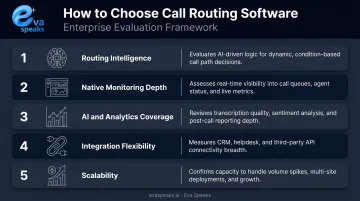
Five criteria that matter:
- Routing intelligence — Does the system support AI-powered, skills-based, and intent-based routing, or only basic IVR menus?
- Native monitoring depth — Do dashboards reflect routing outcomes like FCR, AHT, and abandonment in real time, or do they require third-party exports?
- AI and analytics coverage — Can the system analyze 100% of interactions, or is it limited to manual sampling? ContactBabel's research confirms that manual QA processes make listening to every call impossible — 100% coverage requires automated analytics.
- Integration flexibility — Does the platform connect to your CRM and existing tools without custom development?
- Can it grow from SMB to enterprise without forcing a platform migration?
One additional consideration for 2026: AI governance. A 2025 CallMiner survey found that 80% of CX organizations now use AI, but 67% are implementing it without adequate governance structures.
When evaluating AI routing claims, ask vendors how their models are validated, how often routing logic is updated, and what controls exist over automated decisions.
Businesses that want intelligent routing without a full contact center deployment should also look at Eva Speaks, which pairs LLM-powered call handling with real-time transcription and customizable call-flow scripting. For teams that find enterprise CCaaS platforms over-engineered for their scale, Eva Speaks provides routing intelligence and AI-backed call handling without the per-seat minimum requirements and implementation overhead that come with platforms built for 500-agent operations.
Conclusion
The best call routing software in 2026 earns its value not from call volume capacity, but from whether its routing decisions actually improve the metrics that matter — FCR, AHT, agent utilization, and customer satisfaction — and whether it gives leaders the tools to continuously refine those decisions.
Before committing to a platform, go beyond the demo dashboard. Ask vendors three questions:
- How does monitoring data connect back to routing logic?
- Can performance gaps trigger automatic routing adjustments?
- How easily does the platform integrate with your existing tech stack?
For businesses that want AI-powered routing, real-time transcription, and customizable call-flow scripting without the overhead of a full enterprise CCaaS platform, Eva Speaks is worth a closer look.
Ready to see it in action for your business? Request Live Demo
Frequently Asked Questions
Which call routing solutions offer built-in performance monitoring?
NICE CXone, Genesys Cloud CX, Talkdesk, Five9, and RingCX all include native performance monitoring. "Built-in" means dashboards, analytics, and QA tools connect directly to routing outcomes — no manual data exports required to see what's happening.
Can I route a phone call without a full contact center platform?
Yes. ACD systems and IVR menus handle routing without a full CCaaS platform. Modern options support rules based on caller input, agent skills, time of day, or AI intent detection. Eva Speaks, for example, offers configurable call-flow scripts without the overhead of an enterprise deployment.
What is a call tracking system?
Call tracking monitors source attribution, call recordings, and customer journey data, answering the question "how did this caller find us." Call routing directs calls to the right agent. Many modern platforms combine both functions into a unified routing and monitoring layer.
How can I reduce hold time in a call center?
Three approaches work: implement skills-based routing so calls reach the right agent on the first attempt, offer callback options to eliminate live wait queues, and use real-time dashboards to spot bottlenecks and redistribute agent capacity during peak periods.
What are the future trends for call centers?
By 2028, Gartner predicts that 70% of customers will use a conversational AI interface to start their service journey. Beyond that, expect 100% automated interaction scoring replacing sampled QA, unified omnichannel queues, and LLM-driven voice agents handling tier-1 inquiries autonomously.
What does CMS mean in BPO?
In a BPO context, CMS refers to Call Management System — software that tracks call volume, queue times, agent availability, and routing metrics in real time. It's the operational command center for supervisors managing distributed teams.