](https://file-host.link/website/evaspeaks-iy3v2i/assets/blog-images/4414a4af-60ca-403b-8540-a91f05989faf/1780059982749317_bd8d0231a0db4fda8b02e71915443c03/360.webp)
Introduction
US contact centers handle 27.1 billion inbound calls per year, and the cracks in legacy systems are showing. The same ContactBabel research reports that 32% of callers entering self-service zero out to reach a live agent — a clear signal that DTMF menus frustrate callers into abandoning self-service entirely. At a mean cost of $6.91 per inbound call, misrouted and repeated calls aren't just an operational nuisance; they're a measurable cost drain.
Modern Voice AI platforms address this directly. They use Natural Language Understanding and Large Language Models to interpret what callers say in their own words, then route based on intent rather than keypad input. That shift translates to faster resolution, fewer transfers, and less agent time spent on routine queries.
This article breaks down the five best Voice AI solutions for inbound call routing, what makes each one stand out, and the evaluation criteria that actually matter when choosing between them.
Watch how AI handles inbound routing from first ring to resolution. Watch AI Call Flow Demo
Key Takeaways
- Voice AI routing uses NLU and LLMs to understand spoken intent — no dial-pad menus, no scripted prompts
- Sub-second latency, CRM integrations, and customizable routing logic separate good platforms from average ones
- Top picks: Retell AI (best overall), PolyAI (enterprise scale), Synthflow AI (SMBs/agencies), Replicant (Tier 1 resolution), Leaping AI (vertical-specific)
- Pricing ranges from ~$0.07/minute pay-as-you-go to custom enterprise contracts
- McKinsey research links AI voice to a ~20% drop in billing calls and up to 60 seconds shaved off authentication
What Is Voice AI for Inbound Call Routing?
Voice AI inbound call routing is software that answers incoming calls, identifies caller intent through natural language understanding, and directs the call to the right destination — a department, agent, or self-service resolution — without requiring key presses or scripted menu navigation.
How It Differs from Traditional IVR
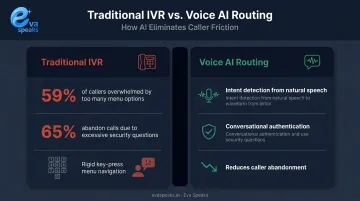
Traditional IVR forces callers through fixed menus: "Press 2 for billing." Voice AI understands spoken intent: "I want to pay my bill." The difference matters because callers think in problems they need solved, not in menu hierarchies.
ContactBabel data makes the friction point concrete: 59% of respondents agree that too many IVR options push customers toward requesting a live agent, and 65% cite excessive security questions as a reason callers abandon telephony self-service altogether. AI routing addresses both issues by handling intent detection conversationally.
Here is how the leading voice AI inbound call routing options compare:
| EvaSpeaks | Retell AI | PolyAI | |
|---|---|---|---|
| Best-fit Business Size | SMB to mid-market | Developer teams, mid-market | Enterprise contact centers |
| Key Strengths | No-code deploy, CRM-native, business-ready | Highly programmable, flexible | Proven at enterprise scale |
| Implementation Complexity | Low - hours to days | Medium - developer needed | High - months |
| Integration Capability | CRM, scheduling, EHR out-of-box | Custom via API | Custom dev |
Market Momentum
A Gartner survey of 187 customer service leaders found that 85% planned to explore or pilot customer-facing conversational GenAI in 2025, up from just 5% who had already deployed it — a gap that signals how fast adoption is moving.
The underlying market reflects that trajectory — MarketsandMarkets projects conversational AI to grow from $17.05 billion in 2025 to $49.80 billion by 2031.
The solutions below were evaluated specifically for inbound routing capabilities: accuracy, scalability, integration depth, and ease of deployment.
Best Voice AI Solutions for Inbound Call Routing
This list ranks platforms by routing accuracy, LLM quality, integration depth, pricing transparency, and fit across business sizes — from lean SMB teams to large contact centers.
Retell AI
Retell AI handles real-time inbound and outbound phone automation with intent-based routing, warm transfers with full conversation context, and native connectors for Twilio, Salesforce, and HubSpot.
What sets it apart for inbound routing is its combination of speed and flexibility. Latency clocks in at around 600ms — fast enough for natural conversation pacing — and the bring-your-own LLM and custom telephony architecture means businesses aren't locked into a single vendor stack. Post-call analysis automatically processes conversations after they end, generating structured insights that make it practical to refine routing logic over time.
| Feature | Detail |
|---|---|
| Key Routing Features | Intent detection, warm transfer with context, conditional routing logic, drag-and-drop agent builder, post-call analysis |
| Pricing | $0.07–$0.31 per connected minute; pay-as-you-go; $10 free testing credit |
| Best For | Product teams and call-heavy businesses that want fast deployment and transparent pricing |
PolyAI
PolyAI is an enterprise-grade managed voice AI service built for high-volume inbound contact centers across hospitality, financial services, and healthcare. Unlike self-serve platforms, PolyAI deploys pre-trained domain assistants ready for authentication, billing, reservations, and intelligent routing — without lengthy onboarding configuration.
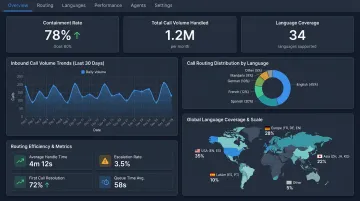
Its verified case results are notable: PG&E achieved 67% call containment and saved 35,000 labor hours using PolyAI. The platform supports 75+ languages with native fluency, handles regional accents and mid-call topic shifts, and integrates natively with Genesys and Five9 for contact centers already running CCaaS infrastructure.
| Feature | Detail |
|---|---|
| Key Routing Features | Pre-trained domain assistants, multilingual routing (75+ languages), high call containment, CCaaS integrations (Genesys, Five9), managed deployment |
| Pricing | Custom enterprise pricing; contact sales for quote |
| Best For | Large enterprises and contact centers needing fully managed, multilingual inbound routing at scale |
See how different industries are applying voice AI routing. See Industry Use Cases
Synthflow AI
For agencies and SMBs that need inbound routing without engineering resources, Synthflow AI offers a no-code visual flow designer, transparent pricing, and HIPAA support — making it one of the most accessible options at this feature level.
The platform delivers sub-500ms latency and 99.99% uptime at the enterprise tier. Bring-your-own-carrier support (SIP trunking, Twilio) means businesses can layer Synthflow onto existing telephony without replacing it. With 200+ integrations including HubSpot and Salesforce, plus voice cloning and 50+ language support, it covers more routing complexity than its price tier typically delivers.
Agencies get an additional lever: white-label capabilities with a custom domain and reseller toolkit, available at $2,000/month or as part of an enterprise plan.
| Feature | Detail |
|---|---|
| Key Routing Features | Visual flow designer, inbound call routing, voice cloning, 50+ language support, CRM integrations |
| Pricing | Free-to-start Pay As You Go; typical PAYG setups run $0.15–$0.24/minute depending on LLM and telephony config; white-label at $2,000/month |
| Best For | Agencies, marketing teams, and SMBs deploying inbound routing without a development team |
Replicant
Replicant takes a different approach than most platforms on this list. Where others focus on routing, Replicant's "Thinking Machine" is designed to resolve Tier 1 inbound calls end-to-end — handling the full interaction, not just deciding where to send it.
That resolution-first model reduces agent load on repeatable queries like account lookups, order status, and basic troubleshooting. When escalation is necessary, agents receive full conversation context at handoff — no recapping required. The platform captures and analyzes 100% of conversations across voice, chat, and SMS, with scoring and dashboards that surface routing accuracy trends over time.
| Feature | Detail |
|---|---|
| Key Routing Features | End-to-end Tier 1 resolution, intelligent escalation with context, multi-channel support (voice, chat, SMS), conversation analytics |
| Pricing | Enterprise contracts only; no public pricing — contact sales |
| Best For | Large contact centers automating a significant share of inbound volume with deep call resolution, not just routing |
Leaping AI
Leaping AI targets inbound call automation in specific verticals — home improvement, travel, insurance, and telco — with deeper domain tuning than generalist platforms. Non-technical operators configure agents through a drag-and-drop interface, and step-specific hallucination guardrails reduce the risk of the AI generating inaccurate information mid-call.
The platform supports 15+ languages and includes a multi-level fallback stack that escalates complex requests to human agents when the AI reaches the boundary of its confidence. Pricing is quote-based with no publicly listed per-agent rate.
| Feature | Detail |
|---|---|
| Key Routing Features | Intent-based routing, appointment scheduling automation, hallucination guardrails, 15+ language support, multi-level fallback stack |
| Pricing | Custom quote; contact sales |
| Best For | Home services, travel, insurance, or telco companies needing fast, reliable inbound routing with vertical-specific expertise |
Want routing built for your specific call types? Get a Customized Workflow Recommendation
How We Chose the Best Voice AI Solutions for Inbound Call Routing
Solutions were assessed on routing accuracy, response latency, integration flexibility, compliance certifications, and pricing transparency. The most common mistake businesses make is choosing a platform based on demo quality alone. A demo optimized for a sales call rarely reflects actual performance on unpredictable, real-world inbound calls.
These criteria cut through the marketing noise and focus on what actually affects call outcomes at scale.
Routing Logic and Customization Depth
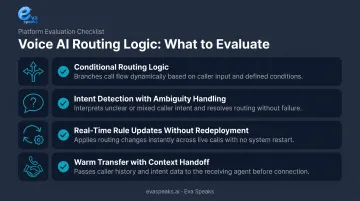
Static routing consistently misroutes callers — and the consequences show up in dropped calls, frustrated customers, and repeat contact. Platforms that let businesses define routing rules based on intent categories, caller history, time of day, or department availability deliver meaningfully better outcomes than one-size-fits-all configurations.
Look specifically for:
- Conditional routing logic (not just linear decision trees)
- Intent detection that handles rephrasing and ambiguity
- Ability to update routing rules without redeployment
- Warm transfer capability that passes conversation context to the receiving agent
Integration and Scalability
The best Voice AI platforms integrate with existing infrastructure rather than requiring a full telephony rebuild. Three areas to verify before committing:
- SIP trunking and Twilio support are the minimum baseline; bring-your-own-carrier flexibility reduces long-term cost exposure as call volume grows
- Native Salesforce and HubSpot connectors keep caller context intact across systems — without them, agents start every transfer blind
- Per-line pricing models can become cost traps at scale — confirm exactly how the platform charges for simultaneous call volume before signing
Conclusion
The right Voice AI solution for inbound call routing isn't the one with the longest feature list. It's the one that matches your call volume, routing complexity, integration requirements, and your team's ability to manage and iterate on it.
Before committing to a platform, run a real pilot. Define two or three of your most common inbound routing scenarios, test with live calls, and measure containment rate and misroute rate — not just voice quality. Those two metrics will tell you more about real-world fit than any sales demo.
For businesses looking for an AI-powered communication solution with customizable call-flow scripts, LLM integration, and real-time routing capabilities, Eva Speaks offers AI-enabled call handling designed to replace legacy IVR without requiring a full infrastructure rebuild. The platform supports configurable routing rules, office hours, and third-party integrations — a workable fit for teams that need routing logic they can actually configure and adjust themselves. Unlike large managed platforms that require dedicated implementation teams and multi-month onboarding, Eva Speaks is designed so that operations teams can manage their own routing configurations and iterate on call flows as business needs change. Visit evaspeaks.ai to see how it fits your routing setup.
Have questions about the right solution for your team? Talk to an AI Communication Expert
Frequently Asked Questions
Which AI domain is most widely used for voice-based inbound call routing?
Natural Language Understanding (NLU) combined with Large Language Models (LLMs) is the dominant approach. NLU handles intent detection and entity extraction from spoken input, while LLMs manage contextual conversation flow and routing decisions. Together, they let callers speak naturally instead of navigating rigid menus.
How is AI inbound call routing different from traditional IVR?
Traditional IVR routes callers through fixed DTMF menus requiring key presses; AI routing understands spoken intent in natural language. This eliminates rigid menu structures and reduces caller abandonment by letting people describe their issue in their own words.
What features should I look for in a Voice AI solution for inbound call routing?
Prioritize intent detection accuracy, sub-second latency, customizable routing rules, CRM and telephony integrations, warm transfer with context handoff, and compliance certifications relevant to your industry (HIPAA, SOC 2, CCPA).
How much does a Voice AI solution for inbound call routing typically cost?
Pricing ranges from usage-based rates ($0.07–$0.31/minute for SMB-friendly platforms) to custom annual enterprise contracts for managed services. Always calculate fully loaded costs including telephony fees and LLM usage charges, which can significantly impact your total bill.
Can Voice AI solutions integrate with existing phone systems and CRMs?
Most modern platforms support SIP trunking, Twilio, and native CRM connectors for Salesforce and HubSpot, letting businesses layer AI routing onto existing infrastructure without replacing their phone system.
How long does it take to deploy a Voice AI inbound call routing solution?
Timelines range from a few hours for self-serve no-code platforms to several weeks for fully managed enterprise implementations. Either way, define your routing scenarios and run live call tests before launch — that step prevents the most common post-launch misrouting problems.