Introduction
Restaurant phones are among the highest-intent touchpoints a business has. When someone picks up the phone to call a restaurant, they're rarely browsing — they're ready to order, book a table, or spend money. Yet according to ReachifyAI, restaurants fail to answer 43% of inbound calls, with peak spikes concentrated between 5–8 PM — exactly when staff are already stretched thin.
The gap is striking given how much restaurants have invested in online ordering systems, delivery app integrations, and loyalty programs. Those channels get tracked, optimized, and A/B tested. The phone? It rings, goes unanswered, and the lost revenue disappears without a trace.
AI receptionists close that gap directly. Every call gets answered instantly, and every interaction gets logged — turning what was once an invisible revenue leak into something measurable and recoverable. Specifically, they:
- Answer calls 24/7 with no hold time or missed pickups
- Handle reservations and orders through natural, conversational responses
- Generate full transcripts and audit trails for every call
Key Takeaways
- Restaurants miss roughly 43% of inbound calls during peak hours, costing some locations $2,000–$5,000+ in lost revenue each month
- An AI receptionist answers every call 24/7 without adding labor costs
- It handles takeout orders, reservations, FAQs, and complex escalations through natural conversation
- Top recovery windows: dinner rushes, after-hours inquiries, and overlapping call surges
- Track call answer rate, AI-handled volume, and call-to-order conversion to measure impact
The Revenue Leak Most Restaurants Never Measure
Most restaurant operators track online order abandonment closely. Cart abandonment rates, conversion funnels, average digital ticket sizes — these numbers get reviewed in weekly meetings. Missed phone calls get reviewed almost never.
Beyond Menu notes that most restaurants don't track phone traffic with anything close to the precision applied to online orders. There's no equivalent of a "cart abandonment" notification when a caller hangs up after four rings during a Friday dinner rush.
What the Numbers Actually Look Like
Here's a concrete framework using HungerRush's revenue loss model:
- A typical QSR receives 50–75 calls per day
- At a 10% missed call rate, that's roughly 150 unanswered calls per month
- If 60% of those callers had intent to order, that's 90 lost orders
- At a $25 average ticket, that's $2,250 in missed revenue every month — over $27,000 per year
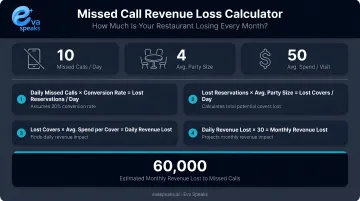
For higher-volume or full-service restaurants, the numbers climb faster. ReachifyAI estimates missed calls can cost up to $1,000 per week for some locations — though treat that as a high-end scenario, not a universal benchmark.
The Compounding Effect
A missed call doesn't just lose one transaction. Customers who can't reach a restaurant often don't call back. They switch to a competitor, open a delivery app, or simply move on. That single unanswered ring can erase not just tonight's order but months of potential repeat business.
During a dinner rush, staff are simultaneously managing dine-in tables, POS entries, incoming online orders, and kitchen coordination. Answering the phone falls last in priority — yet the caller is frequently the most purchase-ready person trying to reach the restaurant at that moment.
That gap isn't a staffing failure. It's a structural mismatch between high call volume and limited staff bandwidth, and adding more phone staff doesn't close it efficiently.
Want to see how AI handles your call volume? Watch AI Call Flow Demo
What Is an AI Receptionist for Restaurants?
An AI receptionist for restaurants answers inbound calls, understands what callers want in real time, and responds conversationally — handling takeout orders, reservations, menu and hours questions, and routing complex requests to staff. Under the hood, it runs on natural language processing (NLP) and large language models (LLMs), but the caller experience is simply a phone call that goes well.
What It Is Not
An AI receptionist is not a phone tree. It doesn't ask callers to "press 1 for reservations." It understands natural speech, handles follow-up questions mid-conversation, and adjusts its responses based on what the caller actually says.
The distinction matters in practice. Revmo's case data found that legacy IVR systems lost roughly 20% of callers before any engagement — and among those who did engage, 65–70% were simply trying to reach a human. A conversational AI system eliminates that friction.
Two Deployment Models
How a restaurant deploys the AI determines how much of that friction it actually eliminates. There are two common models:
- Overflow mode — the AI activates only when staff can't pick up
- Primary answering layer — the AI handles all inbound calls first, escalating selectively to humans
The primary layer model captures substantially more missed revenue because it eliminates the dependency on staff availability as a trigger. Eva Speaks supports both configurations — its call-flow customization and LLM integration let restaurants set the AI as the default first answer, not just a backup when lines go unanswered. For independent operators and smaller regional chains that lack the budget or IT resources of larger enterprise deployments, this flexible model means AI call handling can be activated without replacing existing phone infrastructure.
Curious how deployment works for your setup? Get a Customized Workflow Recommendation
Here is how the main approaches to handling restaurant calls compare:
| EvaSpeaks AI Receptionist | Legacy IVR System | No Dedicated Solution | |
|---|---|---|---|
| Features | Natural conversation, booking, upsell prompts | DTMF menus, message recording | Manual staff answering only |
| Best-fit Business Size | Single location to multi-unit chains | Large chains with IT resources | Very small operations |
| Key Strengths | Captures every call, 24/7, zero overages | Predictable for high volume | No technology overhead |
| Implementation Complexity | Low - hours to deploy | High - requires engineers | None |
| Integration Capability | POS, reservation, CRM systems | Limited, custom dev required | None |
How AI Receptionists Capture Missed Calls
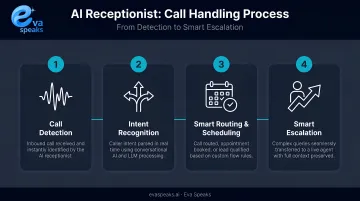
An AI receptionist moves a caller from unanswered ring to completed transaction through a defined sequence. Each stage is critical — a failure at any point reduces the revenue recovered.
Call Detection and Instant Answer
The moment an inbound call arrives — during a dinner rush, after closing, or when every staff member is occupied — the AI picks up within one to two rings. Speed matters more than most operators realize. A 2023 Call Centre Helper survey found that 16.9% of callers abandon in under 29 seconds and another 19.1% hang up within 30–59 seconds. That means roughly a third of callers are gone within one minute if no one answers.
Intent Recognition and Conversation Handling
Within the first few seconds, the AI identifies what the caller wants:
- Placing a takeout or delivery order
- Making or modifying a reservation
- Asking about hours, location, or parking
- Inquiring about allergens or menu items
- Requesting to speak with a manager
It then guides the conversation with natural follow-up questions — collecting order items, party size, preferred time, and special requests without sounding scripted. Eva Speaks builds its call handling on customizable call-flow scripts and LLM integration, letting restaurants configure how the AI responds based on their menu, policies, and brand voice.
Smart Routing and Escalation
Not every call should be completed independently. The system determines when to handle a call end-to-end versus when to transfer to a human:
- AI handles: standard orders, reservation bookings, FAQ responses, hours confirmation
- Escalated to staff: complex complaints, VIP guests, large catering inquiries, unclear or sensitive requests
Without intelligent routing, two problems emerge: the AI mishandles sensitive calls and damages trust, or it over-escalates routine calls and wipes out the efficiency gains. A properly tuned escalation layer prevents both.
Revenue Capture and Logging
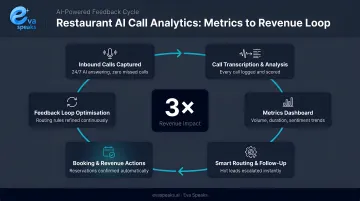
Completed orders are confirmed and sent to the kitchen or POS. Reservations are logged in the booking system. Every call interaction is transcribed and recorded — creating a full audit trail of what was captured versus what was missed.
Call transcription is a core capability of Eva Speaks' platform. That logging layer lets operators review conversion patterns, spot recurring caller questions, and refine call flows over time to push capture rates higher.
Where AI Receptionists Deliver the Biggest Revenue Impact
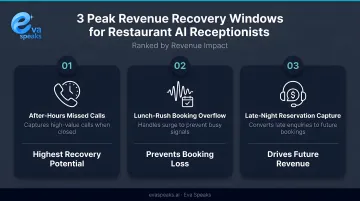
Not all missed calls carry equal weight. The highest-value recovery opportunities cluster in three areas:
After-Hours Calls
Catering inquiries, next-day booking requests, and late reservation changes hit voicemail and get forgotten — by both the caller and the restaurant. The scale of this problem is documented clearly in Revmo's Innovative Dining Group case study: before AI deployment, **nearly 43% of BOA Steakhouse's call volume came outside business hours**, and 100% of those calls went unanswered. After deployment, Revmo captured 5,100+ after-hours calls and converted 479 into confirmed reservations — roughly a 10% conversion rate on calls that previously generated zero revenue.
Peak-Hour Overflow
During dinner service, every staff member is hands-on. A call coming in at 6:45 PM on a Saturday has almost no chance of being answered by a human. The AI handles these calls without competing with the demands of the dining room floor.
Simultaneous Call Surges
During high-volume periods, multiple lines ring at once, and any call beyond the first either waits or drops. AI handles concurrent calls without degradation, which matters especially for restaurants that run promotions, appear in media, or see seasonal spikes.
High-Ticket Inquiry Types
A single unanswered catering inquiry or private dining booking can represent hundreds of dollars in lost revenue, far more than a standard takeout order.
Independent operators and small regional chains feel this most acutely. They lack the budget for dedicated phone staff but still absorb call volume spikes poorly. AI closes that gap:
- Covers all incoming calls without adding headcount
- Handles catering and private dining inquiries at any hour
- Costs a fraction of an additional front-of-house hire
See exactly how AI handles calls when your staff aren't available. See How AI Handles After-Hours Calls
Measuring Revenue Recovery: Key Metrics to Track
Start by establishing a baseline before deployment. Track these metrics in the weeks leading up to go-live:
- Total inbound call volume (daily and weekly)
- Unanswered call rate (calls that ring out or hit voicemail)
- Peak call hours (when volume exceeds staff capacity)
- Average order or cover value
The Primary Recovery Calculation
(Calls captured by AI) × (conversion rate to completed transaction) × (average order value) = recovered monthly revenue
Using the HungerRush framework as a reference: 90 recovered orders per month at $25 each = $2,250 in monthly revenue that previously didn't exist. For restaurants with higher ticket sizes or catering volume, that number scales quickly.
Labor Cost Offset
AI receptionists also reduce front-of-house burden during peak hours. Slang's vendor-reported customer data includes examples of restaurants saving over 100 staff hours per month and $2,000 per month on host labor. Treat those figures as directional benchmarks, not guaranteed outcomes.
Analytics as a Compounding Asset
Call transcription and logging data build measurable value over time. Reviewing which call flows convert best, what callers ask most often, and which time windows drive the highest volume gives operators a clear path to:
- Adjust staffing schedules around actual call patterns
- Refine menu messaging to address common questions proactively
- Optimize AI responses to improve conversion rates continuously
Over time, the analytics layer turns call handling from a reactive function into an operational feedback loop.
Ready to see what recovery looks like for your restaurant? Request Live Demo
Frequently Asked Questions
How much does an AI phone answering service cost?
Pricing varies by provider and typically runs on monthly subscription tiers. Based on publicly available pricing, options range from roughly $149–$249/month per location (ReachifyAI) to $399–$599/location (Slang). For most restaurants, recovered order revenue offsets the subscription cost within the first few weeks.
What is the best AI phone system for restaurants?
The right system depends on whether you need full-time AI answering or overflow coverage. Key criteria: natural language quality, POS and reservation system integration, customizable call flows, and 24/7 availability. Match those criteria to your call volume and top priority — order capture, reservation booking, or both.
What types of calls can an AI receptionist handle?
The main categories: takeout and delivery orders, reservation bookings, hours and location questions, menu and allergen inquiries, and basic complaint routing. Complex or sensitive requests — catering negotiations, VIP situations, unresolved complaints — should escalate to a human staff member.
Will customers know they're talking to an AI?
Modern AI receptionists use natural-sounding voices and conversational responses that feel hospitable rather than robotic — transparency practices vary by operator. Most callers report positive experiences when the AI handles their request effectively.
Can an AI receptionist integrate with my POS or reservation system?
Most AI receptionist platforms integrate with common restaurant POS and booking tools, enabling automatic order logging and reservation syncing without manual entry. Confirm specific integration compatibility with any vendor before committing.
What happens when a caller has a request the AI can't handle?
AI receptionists are configured with escalation rules that transfer the call to an available staff member when the request falls outside the AI's scope. The caller always reaches a resolution.