
The real opportunity isn't picking a side. It's designing a system where AI and human agents each do what they're actually good at. For most businesses in 2025, neither pure AI nor pure human customer service is the optimal model. The hybrid approach — AI handling volume, humans handling complexity — delivers better outcomes at a lower cost than either extreme.
This article covers three things: where AI and human agents each genuinely excel, how hybrid routing works in practice, and what the business case looks like when you run the numbers.
Key Takeaways
- 50–60% of customer interactions are transactional — AI handles these faster and at lower cost
- Human agents remain essential for emotionally complex, high-stakes, or sensitive conversations
- Hybrid models put AI on the front line and escalate a targeted subset of calls to human agents using clear routing rules
- Businesses using hybrid models typically reduce costs while improving coverage and response times
- The ratio of AI to human matters less than the quality of the routing rules between them
What AI Does Best in Customer Service
High-Volume, Repetitive Interactions
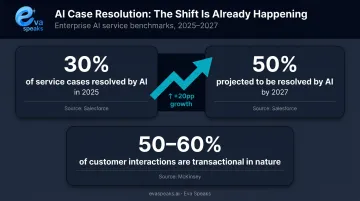
According to McKinsey's 2025 analysis of millions of interactions across 30+ organizations, 50–60% of customer interactions remain transactional. Appointment scheduling, FAQ responses, status updates, call intake — these interactions follow predictable patterns and don't require judgment. That's exactly where AI performs consistently and cost-effectively.
The volume shift is already measurable. Salesforce reported AI resolved 30% of service cases in 2025, with that figure expected to climb to 50% by 2027. For businesses fielding hundreds of calls weekly, that's a significant reduction in operational load.
The Availability Advantage
AI operates around the clock without staffing gaps, hold queues, or after-hours voicemail. It handles concurrent interactions without any drop in quality — something no human team can match at scale. For businesses with off-peak call volume or customers in different time zones, this coverage is hard to replicate with staff alone.
EvaSpeaks' real-time AI call handling uses LLM, text-to-speech, and speech-to-text technologies to process inbound calls as they occur, with no post-call lag in routing or response. As the industry trend toward hybrid customer service accelerates, EvaSpeaks is an example of an AI platform that doesn't require a business to choose between full automation and full human staffing — its configurable escalation rules mean the right calls always reach a human while routine interactions are handled automatically.
Consistency and Integration
Beyond availability, AI brings two structural advantages that human-staffed models struggle to match at scale:
- Consistency: AI delivers identical responses to the hundredth caller as to the first. It never has an off day, never skips a disclosure, and always follows the configured script. For businesses with compliance requirements, this isn't a convenience — it's a necessity.
- Integration: Data captured during AI-handled calls flows directly into downstream systems without manual re-entry. Eva Speaks captures call metadata including caller ID, duration, transcriptions, and routing outcomes, building a complete data record from the first interaction.
Watch a real AI call flow from answer to resolution. Watch AI Call Flow Demo
Where Human Agents Are Still Irreplaceable
AI handles volume well. It doesn't handle everything well.
Emotional Intelligence and Complex Conversations
Human agents read tonal shifts, detect distress, and adapt in real time. Some call types genuinely require this:
- Bereavement notifications or medical anxiety
- Billing disputes with emotional escalation
- Crisis or safety situations
- Complaints spanning multiple unrelated issues
Salesforce found that only 17% of customers are comfortable with AI making financial decisions, and 72% say it's important to know whether they're speaking to an AI. Those numbers show where customer trust actually breaks down — and they're not outliers.
Complex conversations also tend to be non-linear. A customer with overlapping issues — a billing problem tied to a service failure tied to a missed appointment — needs someone who can hold context across threads, improvise, and negotiate a resolution. Pattern-matching doesn't cover that.
Brand, Regulation, and Preference
For some businesses, the voice of the call is the product. High-touch consulting, luxury services, and sensitive professional services — the human warmth isn't a nice-to-have, it's the brand promise.
There's also a regulatory dimension. California and Utah have enacted disclosure requirements for AI in consumer interactions. PwC's 2025 CX survey found 52% of consumers stopped buying from a brand after a bad experience — mishandled or poorly escalated calls carry direct retention risk.
A hybrid model handles both: it meets disclosure requirements and customer preference while preserving the efficiency AI delivers at scale.
See how AI handles overflow and after-hours calls. See How AI Handles After-Hours Calls
Here is how AI-only, hybrid, and live-only answering services compare across the factors businesses care about most:
| AI-Only (EvaSpeaks) | Hybrid (Live + AI) | Live-Only Answering Service | |
|---|---|---|---|
| Features | Full AI conversation, 24/7, CRM sync, scheduling | AI triage + human escalation | Human agents only |
| Best-fit Business Size | SMBs with predictable call types | Businesses with mixed call complexity | High-touch, regulated industries |
| Key Strengths | No overages, consistent, infinitely scalable | Best of both worlds | Full human judgment |
| Implementation Complexity | Low | Low to Medium | Low |
| Integration Capability | CRM, scheduling, ticketing native | Varies by provider | Manual or limited |
The Hybrid Model: How AI and Human Work Together
A hybrid model is an intentional architecture — not a fallback. AI handles the first point of contact for all inbound interactions and resolves the majority of calls end-to-end. A defined subset transfers to human agents when escalation criteria are met.
Three Common Deployment Patterns
| Pattern | AI Owns | Humans Own |
|---|---|---|
| AI-first with live escalation | All inbound calls | Emotional or complex calls mid-conversation |
| Channel routing | After-hours, overflow, routine call types | Business-hours relationship calls |
| Task-based routing | Scheduling, FAQs, transactional tasks | Complaints, consultations, negotiations |
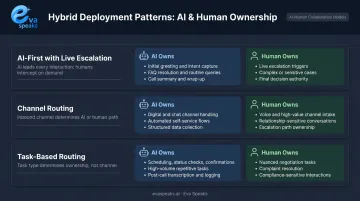
None of these is universally right. The right pattern depends on your call mix, your customer profile, and how your human team is structured.
The Handoff Experience
The transition between AI and human is where many hybrid implementations fail. A poor handoff — one where the caller has to repeat their name, account number, and problem from scratch — undoes the goodwill the AI interaction may have built.
A smooth handoff looks different:
- The AI passes a full transcript and intent summary to the human agent before the call connects
- The agent sees caller history, the reason for escalation, and any sentiment flags
- The transition is framed as a warm transfer, not a cold redirect
Salesforce reports that 85% of professionals say voice-AI-to-human transitions feel seamless — but that holds only when context carries over. When it doesn't, callers notice immediately.
That's the gap structured metadata solves. Eva Speaks captures call transcripts, routing outcomes, and intent summaries during AI-handled interactions, giving human agents the full picture before they say hello.
Hybrid Isn't Static
Escalation patterns change over time. Quarterly reviews should revisit the routing logic with two questions:
- Are there call types escalating to humans that AI could handle with additional training?
- Are there AI-handled calls revealing gaps in the current routing logic?
The hybrid model improves as the routing improves.
Want a setup designed for your exact call mix? Get a Customized Workflow Recommendation
Building Routing Rules That Make Hybrid Work
The operational value of a hybrid model lives in the routing logic. Vague escalation rules lead to one of two failure modes: AI over-escalating (expensive, undercuts the cost case) or under-escalating (poor customer experience on calls that needed a human).
Key Variables for Effective Routing
Good routing rules draw on multiple signals, not just one:
- Intent signals: what the caller is trying to accomplish, captured early in the conversation
- Sentiment and keyword triggers: urgency language, distress cues, or specific topic flags that indicate a human is needed
- Caller history or tier: high-value accounts and repeat complainants often warrant different handling
- Time of day: after-hours calls may follow a different path than those coming in during business hours
- AI confidence thresholds: when the system's confidence drops below a set level, escalation triggers automatically
Eva Speaks supports customizable call-flow scripts and routing rules, allowing businesses to configure these conditions without requiring developer resources.
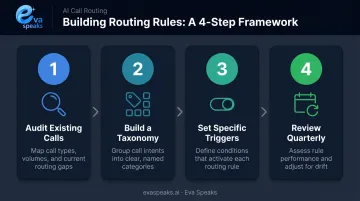
Building Your Initial Routing Rules
Start simple, then refine:
- Audit a sample of existing calls: Pull 50–100 recent inbound calls and categorize by type and complexity.
- Build a taxonomy: Define which call types AI should own and which should escalate, with clear criteria for each category.
- Set specific triggers: Skip vague rules like "complex calls escalate." Define what complex actually means — multiple issues, distress language, billing above a certain threshold.
- Review quarterly: Call patterns shift. Rules that worked in Q1 may need adjustment by Q3.
The ceiling for AI-handled calls will keep rising. Gartner predicts agentic AI will autonomously resolve 80% of common customer service issues by 2029 — but capturing that capacity means building routing rules that evolve alongside the technology, not rules set once and forgotten.
The Business Case for Going Hybrid
Cost Structure Comparison
Pure human answering services come with familiar cost drivers: per-minute billing, after-hours premiums, quality variance across agents, and overflow to voicemail when volume spikes. The BLS reports customer service representatives earned a $20.59 median hourly wage in 2024 — and that's before benefits, training, and management overhead.
Pure AI without escalation paths carries its own costs — abandoned calls when the AI hits its limits, frustrated customers who couldn't get help, and high-value interactions that needed a human to close. Hybrid sits between both extremes on cost, while outperforming both on coverage. The incremental cost of a human escalation layer is offset by what it protects.
Where ROI Actually Comes From
Hybrid ROI flows from two directions simultaneously:
- Automating routine volume frees human capacity for calls that require judgment
- Routing complex or high-value calls to a human protects the interactions most likely to convert or churn
Salesforce reported 95% of service decision-makers saw cost and time savings from AI, and service teams using AI agents anticipate a 20% average decrease in service costs. PwC's finding that 52% of consumers stopped buying after a bad experience quantifies the other side: mishandled calls aren't just a service cost, they're a retention risk.
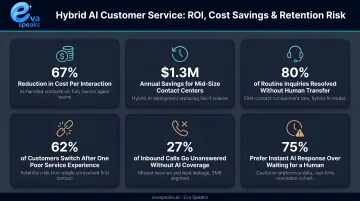
Done well, hybrid doesn't just reduce overhead — it closes the gap between operational efficiency and the quality customers actually notice.
Want to talk through what hybrid looks like for your business? Talk to an AI Communication Expert
Frequently Asked Questions
Frequently Asked Questions
Which is better: AI-only or hybrid answering service?
AI-only works well for businesses with primarily transactional, repetitive call volumes. Hybrid is better for mixed call profiles: it preserves AI efficiency for routine interactions while ensuring complex or sensitive calls reach a human who can handle them properly.
What is an example of a hybrid AI agent?
An AI agent that answers all inbound calls, handles appointment scheduling and FAQ responses autonomously, but detects urgency or emotional distress and transfers to a live human agent. The agent receives a full conversation transcript on-screen before the call connects.
What types of customer calls should always go to a human?
Calls involving emotional distress, complex multi-issue complaints, high-stakes financial decisions, compliance-sensitive topics, and any interaction where the caller explicitly requests a human agent.
How does AI know when to escalate a call to a human?
Escalation is triggered by rule-based conditions: specific keywords, intent signals, and confidence scores dropping below a set threshold. Businesses configure the routing logic based on their call categories and service priorities.
Does switching from AI to a human mid-conversation frustrate customers?
It depends entirely on context transfer. When the human agent receives full conversation context and the caller doesn't have to repeat themselves, escalations typically improve satisfaction rather than harming it.
Is hybrid customer service more expensive than using AI alone?
Yes, hybrid costs more than pure AI, but significantly less than full human coverage at equivalent volume. The added cost of human escalation pays for itself through better outcomes on the calls that most directly affect retention and revenue.