The operational problem is well-documented. According to Orum's 2024 State of Sales Development, 70% of sales teams say most pipeline comes from the phone, yet 67% of reps spend 11+ hours per week on research and follow-up rather than actually calling. Meanwhile, SDR median OTE sits at $85,000 before benefits — which BLS data from December 2025 puts at an additional 29.9% of employer compensation costs.
That gap — between what manual outreach demands and what rep capacity allows — is exactly what AI cold calling was built to address.
This guide breaks down what AI cold calling actually is, how each stage of the process works, and what separates systems that convert from ones that just generate hang-ups.
Key Takeaways
- AI cold calling uses voice agents powered by ASR, NLP, and LLMs to conduct or assist outbound prospect conversations
- The process runs through four stages: initiation, core conversation, real-time regulation, and output/handoff
- Unlike robocalling, AI cold callers hold adaptive, two-way conversations rather than playing pre-recorded messages
- TCPA and DNC compliance is mandatory — willful violations can cost $1,500 per call
- Effective deployments pair AI for high-volume top-of-funnel outreach with humans for complex, relationship-driven conversations
Sales teams ready to see what a fully autonomous AI cold call sounds like can Watch AI Call Flow Demo before reading the full breakdown.
What Is AI Cold Calling?
AI cold calling is the use of AI voice agents or AI-assisted tools to automate or enhance outbound prospecting calls. Two distinct models exist, and confusing them leads to poor buying decisions:
- Fully autonomous AI agents conduct the entire conversation independently — introducing themselves, qualifying the prospect, handling objections, and either booking a next step or disqualifying the lead
- AI-assisted calling tools support human reps in real time with suggested responses, dynamic scripting, and live data pulls — the human drives the conversation, the AI provides the infrastructure
Why It Exists
Human SDRs are expensive, cap out at volume, and lose consistency on repetitive dialing. At $85,000 OTE plus benefits, an SDR calling 50 prospects a day hits a hard ceiling on throughput. AI agents don't.
What AI Cold Calling Is NOT
Regulations treat each of these categories differently — and the differences have real legal consequences:
| Type | How It Works | Regulatory Treatment |
|---|---|---|
| AI Cold Calling | Two-way, adaptive conversation | Treated as artificial-voice calling under TCPA (FCC 24-17) |
| Robocall | One-way pre-recorded message | Broadly illegal for marketing without prior express written consent |
| IVR Menu | Touch-tone or voice prompt navigation | Regulated separately; not conversational |
| Autodialer | Dials numbers automatically, connects to human rep | Covered by TCPA autodialer rules |
The FCC ruled in February 2024 (FCC 24-17) that AI-generated voices fall squarely under TCPA artificial-voice restrictions — meaning AI cold calling must be treated as regulated calling, not as a novel unregulated category.
How Does AI Cold Calling Work?
AI cold calling operates through four sequential stages, each dependent on a specific technology layer. Understanding these stages is what allows businesses to configure systems that actually perform rather than simply dial.
Stage 1: Initiation
The process begins when a contact list (typically imported from a CRM or lead database) triggers the dialing sequence. Campaigns can be:
- Batch-scheduled: a defined list dialed at set times based on time-zone rules and campaign parameters
- Condition-triggered: a new lead enters a pipeline and a call fires automatically within minutes
At this stage, platforms like Eva Speaks allow businesses to configure call-flow scripts and routing rules before the call launches : the agent's purpose, the expected conversation path, and where calls should escalate or terminate.
Caller ID authentication matters at this stage. The FCC requires voice providers to implement STIR/SHAKEN protocols or file in the Robocall Mitigation Database. Providers not in the database can have their traffic refused by downstream carriers, meaning low answer rates may have nothing to do with your script and everything to do with your carrier's compliance status. Verify this before attributing campaign failures to messaging.
Stage 2: Core Conversation
Once a prospect answers, the AI agent processes the call through a continuous loop:
- ASR (Automatic Speech Recognition) transcribes what the prospect says in real time
- NLP (Natural Language Processing) interprets the intent behind the words
- LLM (Large Language Model) generates a contextually appropriate response
- TTS (Text-to-Speech) delivers that response in natural-sounding voice
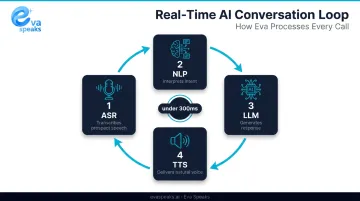
This loop completes within milliseconds on well-architected systems. The speed matters because conversation analysis research shows natural turn-taking gaps in human speech are often under 300ms and any noticeable delay signals to the prospect that something is off.
Where CRM integration is active, the agent pulls context dynamically (company name, industry, recent interactions) so the conversation reflects that specific prospect rather than a generic script. Eva Speaks' platform integrates with LLMs and TTS/STT technologies to support these real-time responses during live calls.
Stage 3: Real-Time Regulation
Conversations don't follow scripts. AI cold calling systems handle deviation through several mechanisms:
- Objection handling: predefined logic or LLM-generated responses address common pushbacks ("we already have a vendor," "not the right time," "send me an email")
- Interruption management: the system detects when a prospect talks over the agent and yields appropriately rather than talking through them
- Dead-air detection: silence beyond a threshold triggers a re-engagement prompt
Escalation logic is the most critical regulation mechanism. Systems monitor NLU confidence scores continuously — platforms like Amazon Lex V2 allow confidence thresholds set between 0.00 and 1.00, triggering fallback when no intent clears the threshold. When the AI detects a scenario outside its configuration (emotional escalation, legal questions, high-value deal signals), the call routes to a human rep.
Effective escalation transfers full context: transcript, lead details, objections raised, and consent status. The rep continues the conversation rather than restarting it. To hear how an escalation handoff sounds during a real AI outbound call, you can Listen to Sample AI Call.
Stage 4: Output and Handoff
Every call produces a structured record, regardless of outcome:
- Call transcript
- Call duration
- Routing outcome and disposition
- Audio recording (where retained)
This data logs automatically to connected systems. Follow-up email triggers, callback scheduling, and pipeline status updates fire based on call disposition. The structured capture is one of AI cold calling's most overlooked advantages over manual dialing : human reps rarely document calls with this consistency, and gaps in CRM data compound over time.
What to Look for in an AI Cold Calling System
Voice Quality and Latency
Response latency is the most immediately noticeable quality signal. A system that pauses for two seconds before every response feels broken, regardless of what it says. When evaluating vendors:
- Ask for end-to-end latency figures across ASR, LLM reasoning, TTS, and telephony transport — not just API response times
- Test on real prospect call recordings, not clean demo audio
- Natural conversation operates under 300ms turn gaps; build your evaluation benchmark from that baseline
Note that ASR performance degrades in real phone-channel conditions. Academic benchmarks on call-domain audio show word error rates that can exceed 48% for major providers — a strong argument for testing on your own call recordings before committing to a platform.
Compliance Infrastructure
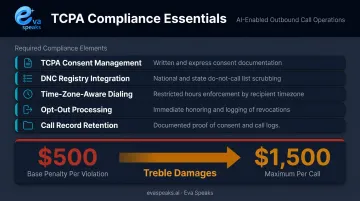
A compliant AI cold calling system must include:
- TCPA consent management: prior express written consent documentation for wireless and residential numbers
- DNC registry integration: the National Do Not Call Registry applies to AI voice outbound sales calls
- Time-zone-aware dialing: California restricts automated calls to 9am–9pm local time; other states have their own windows
- Opt-out processing: immediate and reliable removal when prospects opt out during a call
- Call record retention: documentation for compliance audits
TCPA violations carry $500 per violation, with courts able to award treble damages for willful breaches — making the effective maximum $1,500 per call. At any meaningful call volume, unmanaged compliance exposure becomes a serious financial liability.
State-level rules layer on additional requirements. Maryland's Stop the Spam Calls Act (effective January 1, 2024), Florida Statute 501.059, and Oklahoma's Telephone Solicitation Act each go beyond federal TCPA — and your platform needs to account for all of them. Outbound teams that want a compliance-aware workflow built for their specific campaign can Get a Customized Workflow Recommendation.
CRM and Tech Stack Integration
An AI cold calling platform that doesn't sync bidirectionally with your CRM creates data silos that undermine the efficiency gains the platform promises. At minimum, look for:
- Real-time call transcript logging
- Automatic lead status updates
- Follow-up task creation based on call disposition
- Trigger-based downstream sequences (email, callback scheduling)
Eva Speaks connects call outcomes directly into business workflows via third-party integrations, automatically logging transcripts and updating lead records in real time. Sales ops gets consistent, structured data from every call — no rep note-taking required. For organizations that want to add AI outbound calling without replacing their existing CRM or telephony stack, Eva Speaks is designed to integrate with the tools already in place rather than requiring a parallel infrastructure build.
Customizability of Call Flows
Integration handles the data side. Customizability handles everything else. Rigid pre-built scripts break the moment your product changes or your market shifts — evaluate whether the platform allows:
- Branching conversation logic (not linear scripts)
- Persona and tone configuration
- Knowledge base updates without re-engineering the entire flow
- Adjustable escalation thresholds based on campaign type
Where AI Cold Calling Fits in Business Operations
The Right Stages of the Funnel
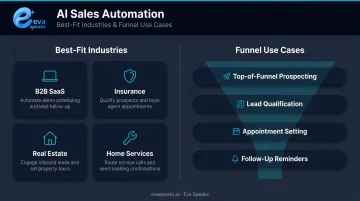
AI cold calling delivers clearest value at:
- Top-of-funnel prospecting: high-volume initial outreach to cold lists before any human time is spent
- Lead qualification: screening for budget, authority, need, and timing across hundreds of simultaneous conversations
- Appointment setting: booking discovery calls for human reps to handle
- Follow-up reminders: low-complexity re-engagement with dormant leads
It underperforms at late-stage negotiation, enterprise relationship management, and any conversation where nuanced judgment or rapport-building drives the outcome. Human reps remain essential for those stages.
Industry Fit
Verticals with high call volumes and relatively standardized qualification criteria are the strongest candidates:
- B2B SaaS: outbound prospecting to defined ICP segments
- Insurance: initial coverage conversations and quote qualification
- Real estate: buyer/seller inquiry follow-up and appointment setting
- Home services: estimate scheduling and job qualification
The common thread is repeatable qualification criteria. When the questions stay consistent from one prospect to the next, automation delivers reliable execution at a fraction of the per-call cost. You can See Industry Use Cases to explore how specific verticals are deploying AI cold calling today.
The Human-AI Collaboration Model
That consistency across industries points to a broader pattern in how effective deployments are structured. The ones that work aren't the ones that replace SDRs — they're the ones that restructure what SDRs do. AI handles initial outreach and qualification across high volumes of cold contacts; human reps take over pre-qualified, warmed conversations.
Gartner's 2024 survey of 1,026 B2B sellers found that sellers who effectively partner with AI tools are 3.7x more likely to meet quota — a finding about sales AI broadly, but one that points clearly toward augmentation over replacement as the productive model.
Here is how AI cold calling agents compare to human SDRs and traditional auto-dialers:
| AI Voice Agent (EvaSpeaks) | Human SDR | Traditional Auto-Dialer | |
|---|---|---|---|
| Features | Natural conversation, objection handling, CRM logging | Full sales judgment, relationship building | Pre-recorded messages, DTMF response |
| Best-fit Business Size | SMB to mid-market scaling teams | Any size | High-volume outbound operations |
| Key Strengths | 24/7, consistent delivery, instant CRM sync | Human empathy, complex deals | High volume at low cost |
| Implementation Complexity | Low - hours to deploy | None (hire) | Medium |
| Integration Capability | Native CRM, scheduling tools | Manual entry | Limited CRM sync |
Conclusion
AI cold calling is a structured, technology-driven system. It handles the highest-volume, lowest-yield stages of outbound sales — producing cleaner data and warmer leads for the human reps who take it from there.
Making it work requires understanding how each layer — initiation, real-time conversation, compliance, and output — depends on deliberate configuration, not default settings. Skipping compliance setup in particular is where most deployments run into trouble: low answer rates, suppressed deliverability, and avoidable legal exposure. Build those foundations first, and the automation compounds quickly.
Frequently Asked Questions
Do AI voice agents for cold calling actually work?
They work under the right conditions. Effectiveness depends on voice quality, conversation design, CRM integration, and call-flow configuration. Autonomous AI agents consistently handle top-of-funnel volume at scale, but they underperform human reps on complex, relationship-dependent conversations where nuance matters.
Is AI cold calling the same as a robocall?
No. Robocalls play one-way pre-recorded messages and are broadly illegal for marketing under TCPA. AI cold callers conduct real-time, two-way adaptive conversations and operate legally when built with proper consent documentation and compliance infrastructure.
Is AI cold calling legal?
Yes, when properly implemented. The FCC ruled in 2024 that AI-generated voices fall under TCPA artificial-voice restrictions. Legal deployment requires prior express written consent where applicable, DNC registry compliance, STIR/SHAKEN authentication, and clear identification of the calling entity at call start.
What technology powers an AI cold caller?
The core stack: ASR transcribes prospect speech, NLP interprets intent, an LLM generates responses, and TTS delivers them in natural voice. Low-latency integration of these components, with responses completing in under 300ms, is what separates conversational AI from systems that sound robotic.
Can AI cold callers integrate with a CRM?
Yes. Modern platforms use native or API-based CRM integrations that automatically log call transcripts, update lead status, and trigger follow-up sequences — keeping pipeline data clean and handoffs to human reps seamless.
When should an AI cold caller hand off to a human rep?
Well-designed systems trigger a handoff when complexity exceeds the AI's configuration — legal questions, emotional escalation, or high-value deal signals are common examples. The handoff should transfer full context (transcript, objections, lead details) so the rep can pick up mid-conversation, not start over.