According to CallRail's 2025 survey of 1,000 U.S. consumers, 78% of consumers have abandoned a business after an unanswered call, and 82% would call a competitor if their first call goes unanswered. For a small business competing on responsiveness, those numbers represent real, recoverable revenue — if you have the right system in place.
AI receptionists get discussed a lot in the abstract. This article focuses on what they actually do for small businesses day-to-day: captured leads, reduced overhead, and a consistent first impression on every call. You'll also find a practical guide to getting value from one quickly.
Key Takeaways
- An AI receptionist answers every call 24/7, books appointments, qualifies leads, and routes inquiries — no human required at the desk
- The top three benefits: significant cost savings versus a full-time hire, consistent customer experience at any call volume, and zero missed calls during off-hours
- Without it, missed calls are lost leads — callers rarely leave voicemails or call back
- To see real results: set a clear goal upfront, connect it to your calendar and CRM, and check call data weekly for the first month
What Is an AI Receptionist?
An AI receptionist is an automated front-desk system powered by artificial intelligence and natural language processing (NLP). It holds real, two-way conversations with callers — not a phone tree that says "press 1 for sales," and not a voicemail box.
When a caller rings in, the AI answers immediately, greets them by name of the business, gathers their reason for calling, and takes action: booking an appointment, capturing their contact details, answering a common question, or routing to the right person. Every caller gets a handled interaction — without the business lifting a finger.
It fits any inbound call channel where businesses rely on the phone to capture leads or serve customers — home services, medical and dental practices, law offices, salons, real estate agencies, and retail.
The core value is consistency: every caller gets an immediate, helpful response regardless of when they call or how busy the team is. EvaSpeaks, for example, lets businesses define customizable call-flow scripts and routing rules so each call is handled exactly the way they want it. EvaSpeaks is also designed to be cost-predictable: because it operates on a subscription model rather than per-minute billing, a busy season that doubles call volume doesn't double the cost — which is a key advantage over live answering services that scale with call time.
Key Benefits of an AI Receptionist for Small Business
The benefits below aren't abstract technology claims. They map directly to things small businesses track: revenue protected, costs controlled, and customer experience maintained.
24/7 Call Coverage — Never Lose a Revenue Opportunity
An AI receptionist answers every inbound call around the clock — after hours, weekends, during a busy stretch when staff are in the field or on another line. It picks up immediately, delivers a branded greeting, and handles the caller's need without human involvement.
Why this matters in numbers:
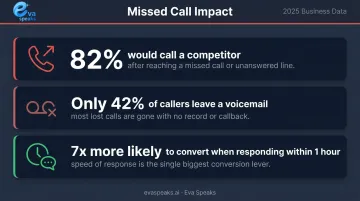
- 82% of consumers would call a competitor if a business doesn't answer — per CallRail's 2025 research
- Only 42% of callers leave a voicemail, meaning more than half of unanswered calls produce zero record of the opportunity
- 41% of home services jobs booked online are submitted after standard business hours, according to Jobber data cited by CallRail — frequently between 1 AM and 4 AM
For service businesses — plumbing, HVAC, dental, legal intake — urgency drives the decision. The first business to answer wins the job. A Harvard Business Review study of 2,241 companies found that firms contacting leads within one hour were nearly 7x more likely to have a meaningful conversation than those that waited longer.
KPIs this affects: lead capture rate, after-hours booking volume, call abandonment rate
Highest impact for: businesses whose team is frequently unavailable (field-based, appointment-heavy), and any business in a competitive local market where response speed is the differentiator. You can See How AI Handles After-Hours Calls to understand what this looks like in practice.
Cost Efficiency — A Fraction of the Cost of a Full-Time Hire
A full-time receptionist costs more than most owners calculate upfront. The Bureau of Labor Statistics reports a median receptionist salary of $37,230/year as of May 2024. Add benefits at the BLS-calculated rate of 45.1% over base wages, and the fully loaded cost reaches approximately $54,000/year — before factoring in training, equipment, or turnover. Gallup estimates replacement costs range from 0.5x to 2x annual salary, meaning a single departure can cost as much as the role itself.
That's the baseline AI receptionists are measured against.
AI receptionist platforms operate on a monthly subscription model:
| Provider | Entry Tier | Advanced Tier |
|---|---|---|
| Dialzara | $19/month | $449/month |
| NextPhone | $29/month | $299/month |
| Rosie | $49/month | $299/month |
| Goodcall | $79/month | $249/month |
Most plans are month-to-month with no long-term contract. At $49–$149/month for a typical small business plan, the annual cost runs roughly $588–$1,788 — compared to $54,000+ for a full-time hire.
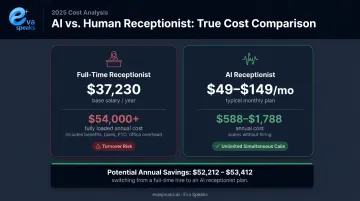
One AI system also handles unlimited simultaneous calls with no sick days, coverage gaps, or training ramp-up.
KPIs this affects: labor cost as a percentage of revenue, cost per lead captured, overhead as a percentage of operating costs
Highest impact for: businesses with high call volume relative to staff size, and any business that has dealt with front-desk turnover. You can Get a Customized Workflow Recommendation tailored to your specific call volume and staffing situation.
Here is how an AI receptionist compares to a human receptionist and traditional phone-only setup for small businesses:
| AI Receptionist (EvaSpeaks) | Human Receptionist | Traditional Phone + Voicemail | |
|---|---|---|---|
| Features | 24/7 calls, scheduling, routing, CRM sync | Full interaction, adaptive | Call answering during hours only |
| Best-fit Business Size | Solo to 50-person businesses | Any size | Very small operations |
| Key Strengths | No missed calls, zero overages, instant setup | Human warmth, complex situations | Zero setup cost |
| Implementation Complexity | Low - hours | None (hire and train) | None |
| Integration Capability | CRM, scheduling, calendar sync | Manual entry | None |
Consistent, Professional Customer Experience
A human receptionist has good days and bad ones. They get rushed during a busy lunch hour, tired near closing, and inconsistent under pressure. An AI receptionist delivers the exact same greeting, the same questions, and the same on-brand interaction on every single call — call number one or call number thousand.
Eva Speaks enables businesses to configure precise call-flow scripts and routing rules — defining exactly how each caller is greeted, what information is gathered, and when the call escalates to a human. That eliminates variability from the first impression.
The cost of inconsistency is real: Zendesk's 2024 research found over 50% of customers will switch to a competitor after a single unsatisfactory experience, and 73% identify customer experience as a primary factor in purchase decisions.
For small businesses competing against larger companies with bigger teams, a consistently professional phone experience levels the playing field.
KPIs this affects: lead-to-appointment conversion rate, customer satisfaction scores, repeat call rates
Highest impact for: high-volume periods like seasonal spikes or promotions, and any business where the phone call is the first brand impression. You can Watch AI Call Flow Demo to see exactly how consistent AI call handling works end-to-end.
What Happens Without an AI Receptionist
Operating without any call coverage automation creates three compounding problems:
1. Missed calls rarely produce a second chance. With only 42% of callers leaving voicemail and 82% willing to call a competitor, an unanswered call rarely produces a second chance. By the time you hear the message, that caller has already booked with someone else.
2. Repetitive intake work crowds out everything else. Answering the phone, gathering the same information, scheduling the same types of appointments — these tasks fill a front-desk employee's day. There's little time left for work that actually advances the business. Over time, that creates errors, inconsistency, and burnout.
3. Growth forces a direct tradeoff with overhead. Every increase in call volume requires another hire. That means growth directly increases fixed overhead — a real cost disadvantage against competitors that can scale call capacity on demand without adding headcount.
How to Get the Most Value from Your AI Receptionist
Setup quality determines outcomes. These three practices separate businesses that see fast results from those that set it up and move on:
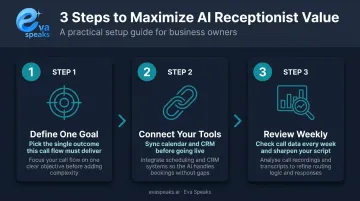
1. Define one primary goal before building your call flow. Don't try to automate everything at once. Pick the single highest-value objective — after-hours coverage, appointment booking, or lead qualification — and build the initial call flow around that. Eva Speaks lets you configure call-flow scripts and routing rules independently, so starting focused and layering in complexity later is straightforward.
2. Connect it to your existing tools on day one. An AI receptionist captures value at the moment of connection. A booked appointment that doesn't sync to your calendar isn't actually booked — and a captured lead without a CRM contact never gets followed up. Link your calendar and CRM during setup, not as an afterthought. If you're ready to see how this works for your business, you can Request Live Demo to walk through the setup process.
3. Review call data weekly for the first month. Listen to recordings and read transcripts. Callers phrase things in ways you won't predict during setup. Small script adjustments — changing a question's wording, adding a routing option, clarifying a service description — can improve booking rates and reduce escalations. After the first month, monthly reviews are usually sufficient.
Conclusion
An AI receptionist isn't a replacement for your team — it fills the gaps your team can't cover. Missed calls after hours, leads that hit voicemail and move on, inconsistent first impressions during a rush: each of these has a real cost, and each is fixable.
The advantages also compound. The more call data the system accumulates and the more refined the call flows become, the better the outcomes. This is an ongoing operational asset, not a one-time setup — and for small businesses where responsiveness is a genuine competitive edge, the return on that investment tends to show up faster than expected.
Frequently Asked Questions
What is an AI receptionist?
An AI receptionist is an AI-powered call-handling system that uses natural language processing to answer inbound calls, book appointments, qualify leads, and route inquiries in real time. It holds genuine two-way conversations with callers — unlike a basic phone tree or voicemail system — and operates without a human at the desk.
How much does an AI receptionist cost for a small business?
Most AI receptionist platforms range from $19 to $499/month depending on features and call volume. A typical small business plan falls between $49 and $149/month — a fraction of the ~$54,000/year fully loaded cost of a full-time receptionist hire. Most providers offer month-to-month billing with no long-term contract required.
How does AI benefit small businesses?
The three core operational benefits:
- Captures every inbound call, including after-hours calls that would otherwise go to voicemail
- Reduces front-desk labor costs without sacrificing coverage
- Delivers a consistent caller experience regardless of volume or time of day
Can an AI receptionist fully replace a human receptionist?
AI manages high-volume, repetitive tasks — answering, booking, qualifying, routing — reliably and at scale. Complex or emotionally sensitive situations still benefit from a human touch. Most businesses use a hybrid approach where AI manages the first line and escalates to a human when needed, based on configurable routing rules.
What industries benefit most from an AI receptionist?
Home services, medical and dental practices, law firms, salons, and real estate see the strongest results. The common thread: phone calls are the primary customer touchpoint, urgency drives decisions, and missing a call means losing the job to whoever answers next.
How do I set up an AI receptionist for my small business?
Define your primary call goal, choose a platform, build your call-flow script around that goal, connect your calendar and CRM, then test thoroughly before going live. Most platforms are operational within an hour of setup.