Introduction
U.S. emergency communications are under real strain. The FCC's most recent data counts nearly 213 million voice 911 calls in calendar year 2024 alone, and the centers fielding those calls are chronically understaffed.
According to IAED and NASNA research, the average 911 center vacancy rate hovered around 25% between 2019 and 2022. A 2025 NENA/Carbyne report found that 74% of centers still had open positions, with staff burnout ranked as the top challenge.
That staffing crisis is what pushed AI call handling from pilot project to operational tool. Agencies are now deploying AI to triage non-emergency calls, generate real-time transcriptions, and support dispatchers — not replace them.
This guide covers five concrete AI call handling trends shaping emergency response in 2026, what's driving them, and what public safety leaders should be evaluating now.
Key Takeaways
- AI is actively handling non-emergency call overflow at PSAPs, cutting hold times and freeing dispatchers for urgent calls
- LLM-driven voice AI understands unstructured caller speech and generates structured incident data in real time
- Predictive analytics is shifting dispatch planning from reactive to proactive, improving resource positioning before incidents peak
- NG911 compliance and AI governance are now baseline requirements
- Human-AI collaboration defines 2026: AI handles volume, humans handle judgment
Trend 1: AI-Powered Non-Emergency Call Triage Is Now a Standard Tool
What It Looks Like in Practice
When a caller dials a non-emergency line to report an abandoned vehicle or ask about a parking permit, AI systems at the front of the call queue can now screen, categorize, and resolve that interaction without a dispatcher ever picking up. The AI collects relevant details, provides a reference number or next steps, and logs the interaction — all within the first two minutes.
This isn't hypothetical. Real deployments across the U.S. show the scale already in motion:
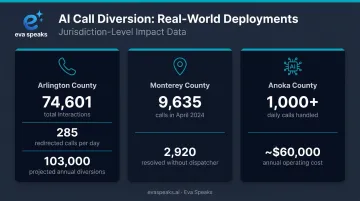
- Arlington County (National 911 Program): AI diversion workflows handled 74,601 interactions between May 2024 and February 2025 — averaging 285 redirected calls per day and projecting over 103,000 annual diversions
- Monterey County: AI received 9,635 calls in April 2024 alone; 2,920 were flagged as non-emergency or general information and resolved without call-taker involvement
- Anoka County: Launched AI dispatcher "Eric" in mid-2026 for its 10-digit non-emergency line, fielding 1,000+ calls daily (roughly two-thirds non-emergency) at an annual operating cost of approximately $60,000
Why the Scale of Opportunity Is Large
NENA's 2025 Pulse of 9-1-1 report found that 63% of emergency communication centers reported that 50–80% of their calls are non-emergent. Arlington County's own data put administrative calls at 70.3% of total call volume in 2022.
When the majority of incoming volume doesn't require emergency judgment, AI triage doesn't just reduce workload — it redirects dispatcher attention to calls where human judgment is the only acceptable response.
The Hybrid Model That Makes It Work
AI handles the screening and data collection process. Human call takers retain control over escalation logic, override decisions, and every life-safety call. That clear division of responsibility is what makes these deployments defensible — agencies can account for every decision point without surrendering control over outcomes that matter most.
See how AI handles calls outside business hours in critical situations. See How AI Handles After-Hours Calls
Trend 2: LLM-Driven Voice AI Is Elevating Real-Time Call Intelligence
Beyond the Phone Tree
Legacy IVR systems ask callers to press 1 for emergencies, press 2 for non-emergencies. The caller experience is rigid, frustrating, and prone to misrouting when someone is panicked or doesn't fit a predetermined category.
LLM-driven voice AI works differently. It conducts a natural conversation, asks clarifying questions based on what the caller actually says, adapts to unstructured speech, and routes calls based on context, not a button press. The underlying models process caller language in real time, identifying urgency signals and generating structured data for downstream systems.
What This Means for Emergency-Adjacent Operations
Two documented examples illustrate the practical value:
- Orleans Parish Communications District achieved 70% faster call processing using real-time AI language translation and transcription, eliminating the need for third-party translators
- Jefferson County Communications Center Authority used AI to process up to 40% of administrative-line calls for service as of December 2022
Both examples come from CISA's research on AI in emergency communications centers.
Real-time transcription compounds that value. AI-generated call transcripts support post-incident quality assurance, dispatcher coaching, legal documentation, and pattern analysis — all without requiring someone to manually log call notes afterward.
Platform Configuration and Latency
EvaSpeaks integrates LLMs with customizable call-flow scripts and routing rules, so organizations can configure call logic to match specific protocols and community needs. Updating routing rules requires no engineering support — a practical necessity in fast-moving operational environments. EvaSpeaks' call-flow configuration model is particularly relevant here: emergency-adjacent agencies and businesses need the ability to rapidly update routing logic when staffing changes or new protocols are deployed, and EvaSpeaks supports those updates through an admin dashboard without requiring IT or developer involvement.
Current benchmarks show leading voice AI platforms operating at well under 200ms round-trip response time. At that speed, callers experience the interaction as natural conversation rather than a system response.
Watch how modern AI voice call flows work in practice. Watch AI Call Flow Demo
How AI, Hybrid, and Legacy Emergency Call Handling Compare
Not all call handling approaches deliver the same operational outcomes. Here is how AI-first platforms like EvaSpeaks, traditional PSAP/IVR dispatch systems, and human-only call centers stack up across the dimensions that matter most for emergency-adjacent operations:
| AI-First (EvaSpeaks + Human Escalation) | Traditional PSAP / IVR Dispatch | Human-Only Call Center | |
|---|---|---|---|
| Features | AI triage, instant routing, escalation to human, 24/7 | Structured IVR, protocol-based dispatch | Human agents, full judgment |
| Best-fit Business Size | Non-emergency lines, after-hours urgent triage | Public safety, government | Private emergency services |
| Key Strengths | Fast first response, consistent triage, scalable | Regulatory compliance, proven | Full human judgment |
| Implementation Complexity | Low - configurable AI flows | High - certified systems | None (hire) |
| Integration Capability | CRM, ticketing, dispatch tools | PSAP-specific | Manual |
EvaSpeaks stands out for organizations that need to move quickly - routing rules and call flows are configurable through an admin dashboard without engineering support, making it practical to deploy, adjust, and scale as operational needs change.
Trend 3: Predictive Analytics Is Enabling Proactive Dispatch Planning
Most dispatch operations still work reactively — a call comes in, resources respond. Predictive analytics changes that equation by forecasting where and when demand will spike before it happens.
AI models analyze historical call data, weather patterns, event schedules, and public health signals to produce demand forecasts. EMS agencies are using these forecasts to pre-position ambulances in high-probability zones rather than waiting at fixed stations. The result is shorter travel times when calls come in.
What the Research Shows
A peer-reviewed benchmark study of emergency ambulance demand forecasting across 13 regions in London, Yorkshire, and Wales achieved a Mean Absolute Scaled Error (MASE) of 0.68 in initial testing and 0.73 in external validation — strong forecasting performance for operationally complex call volume patterns.
Syndromic surveillance adds another layer. EMS data captures signals that other health data misses. A Kentucky study found EMS data identified 17,090 opioid overdose-related encounters versus only 10,606 in syndromic surveillance systems and 10,893 in billing data for 2018–2019. That's a clear early-warning advantage.
That said, real-world studies attributing specific response-time reductions directly to predictive dispatch are still limited. The evidence firmly supports predictive analytics as a planning and positioning tool. Outcome data will strengthen as deployments mature over the next several years.
Trend 4: AI Governance and NG911 Compliance Are Becoming Non-Negotiable
Emergency AI operates inside a tightly regulated infrastructure. The FCC's NG911 Transition Order, finalized in July 2024, established a two-phase framework moving 911 systems to IP-based networks that support text, video, and richer data streams. The NTIA estimates the remaining nationwide transition costs at $5.8B–$9.27B over seven years.
Agencies deploying AI within that infrastructure need governance frameworks built in from the start, not retrofitted after rollout.
What Embedded Compliance Looks Like
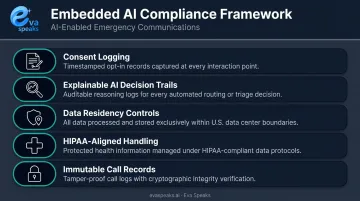
- Consent logging for call recording and AI processing at the point of intake
- Explainable AI decision trails that oversight bodies can audit
- Data residency controls keeping sensitive records within specified jurisdictions
- HIPAA-aligned handling for medical dispatch (applicable where the agency is a covered entity)
- Immutable call records that can't be altered after the fact
IBM's 2025 Cost of a Data Breach report puts the average U.S. breach cost at $10.22 million. Public sector incidents typically average lower, but they still expose agencies to significant legal liability and public trust erosion that's hard to recover from.
That makes vendor selection a compliance decision, not just a technical one. EvaSpeaks, for example, stores data in U.S. data centers with defined retention policies for call recordings and transcripts, and customers can opt out of data use for AI model training — a meaningful governance feature for any organization handling sensitive caller information. For emergency-adjacent deployments where HIPAA applies, agencies should conduct covered-entity and vendor-governance analysis before any deployment begins.
Have questions about compliance and AI deployment? Talk to an AI Communication Expert
Trend 5: AI Is Redefining the Emergency Dispatcher Role — Not Replacing It
Trend 5: How AI Is Reshaping the Emergency Dispatcher Role
The Workload Problem Driving This Trend
Dispatcher burnout isn't primarily caused by difficult emergency calls. It's driven by volume — the relentless processing of hundreds of low-complexity interactions that require the same call-taking steps but deliver none of the professional meaning of emergency response work.
The NENA/Carbyne 2025 Pulse report found 68% of telecommunicators reported daily pre-shift stress, with burnout ranked as the top staffing challenge. New-hire training failure rates above 50% were reported by 22% of programs — up from 17% the prior year.
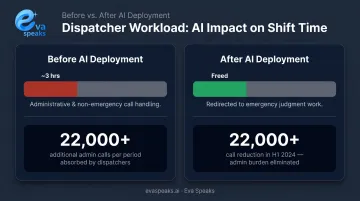
Arlington County's data offers a direct connection to AI. Before AI diversion workflows launched, non-emergency administrative tasks consumed approximately three hours of every shift. After deployment, administrative calls dropped by more than 22,000 in the first six months of 2024 compared to the same period in 2022.
What This Means for Retention
Three hours per shift is three hours dispatchers can redirect to work that requires human judgment, empathy, and training. The workforce implications reach beyond efficiency. Agencies deploying AI report benefits across three interconnected areas:
- Retention: Staff supported by technology rather than ground down by preventable volume stay longer
- Role evolution: Dispatcher work shifts toward interactions that demand more judgment and empathy
- Training: Programs now include AI tool proficiency alongside traditional call-taking skills
That's a meaningfully different job description — and for many telecommunications professionals, a more sustainable career.
What's Driving These AI Call Handling Trends in Emergency Response
No single factor explains the shift toward AI in emergency call handling. Four converging forces are pushing agencies — and the vendors serving them — toward faster adoption than most predicted:
- Technology maturity: LLMs, low-latency speech recognition, and cloud infrastructure have matured to the point where production-ready voice AI is no longer experimental. The conversational AI market hit $14.29B in 2025 and is projected to reach $41.39B by 2030 (23.7% CAGR), according to Grand View Research.
- Operational pressure: 213 million annual 911 calls handled by centers with a 25% vacancy rate. The math doesn't work without technology augmentation.
- NG911 modernization: States and jurisdictions reported $535 million in NG911 expenditures in CY2024. The transition is funded and moving — agencies deploying AI now are building on infrastructure that NG911 was designed to support.
- Community accountability: Municipal leaders and community advocates want faster response times and transparent performance data. Agencies that can demonstrate AI-driven efficiency improvements have a measurable advantage in funding conversations.
How These Trends Are Impacting Emergency Response
Operational Impact
Call intake workflows are shifting from manual, dispatcher-driven processes to AI-triaged, structured pipelines. The practical effects:
- Reduced time-to-dispatch for critical calls as dispatchers are no longer tied up on non-emergency volume
- Elimination of hold queues on administrative lines
- Cleaner, more consistent data flowing into CAD systems because AI-structured intake is more uniform than human-logged notes
Budget and Strategic Shifts
Agency leadership is redirecting resources from overtime staffing toward technology infrastructure. NTIA documented that New Orleans' AI triage and translation deployment reduced overtime needs and helped understaffed teams maintain service quality.
The cost comparison is striking:
- Monthly AI system costs in the NTIA case examples: $1,000 or less based on call volume
- A single overtime position routinely exceeds that figure in a matter of days
Workforce Impact
Dispatcher roles are evolving toward higher-skill, higher-judgment functions. Training programs are incorporating AI tool proficiency. The agencies reporting the strongest morale outcomes are those where technology is visibly reducing burden — not adding it.
These shifts in operations, budgets, and workforce expectations are converging — and they're pushing agencies to make faster decisions about AI adoption than many anticipated.
See how it performs for your specific use case. Request Live Demo
Future Signals for AI Call Handling in Emergency Response
Several developments will define the next one to three years:
- Multimodal emergency AI: Integrating text, image, and video with voice intake as NG911's IP infrastructure makes richer data streams possible
- Full NG911 rollout: IP-based infrastructure will enable AI systems to work with more complete incident data from the moment a call connects
- Emergency-specific AI models: Models trained on dispatch datasets rather than general-purpose voice AI will improve accuracy for the vocabulary, cadence, and urgency signals specific to emergency calls
These shifts point to one practical conclusion for agencies evaluating their call handling stack today: the platforms worth investing in now are those that already combine real-time AI response, LLM integration, customizable routing, and built-in transcription — because those are exactly the capabilities the next wave of infrastructure will build on. Eva Speaks provides these capabilities today, so organizations can deploy, learn, and refine their workflows before NG911 rollout accelerates the pace of change.
The agencies best positioned for 2026 and beyond won't be the ones that waited for the technology to fully mature — they'll be the ones that built governance into their AI deployments from the start and used the transition period to train their human teams alongside the tools.
Frequently Asked Questions
What is the new AI trend in 2026?
The dominant 2026 trend is the shift from experimental pilots to operational, results-accountable AI deployments. In emergency response specifically, AI-powered call triage that autonomously handles non-emergency volume — while keeping humans in control of critical decisions — is now standard practice at PSAPs leading adoption.
What are the 4 pillars of emergency management?
The four pillars are mitigation, preparedness, response, and recovery. AI call handling tools are most actively transforming the response pillar, improving the speed and accuracy of initial call intake, triage, and dispatch during active incidents.
Can AI fully replace human 911 dispatchers?
No. In 2026, AI handles routine and non-emergency calls while human dispatchers retain responsibility for all life-safety decisions, escalation judgment, and empathy-intensive interactions. The design goal is augmentation, not replacement.
How does AI call handling reduce dispatcher burnout?
AI offloads high-volume, low-complexity calls — noise complaints, parking disputes, status inquiries — that previously consumed hours of every shift. Reducing that workload and the associated documentation burden lowers stress and improves retention rates.
What role do large language models (LLMs) play in emergency call handling?
LLMs enable voice AI to understand unstructured caller speech, detect urgency signals, ask intelligent follow-up questions, and generate structured incident data in real time. That's a concrete step beyond older IVR systems, which forced callers through rigid menu trees with no ability to interpret natural speech.
How is AI call handling regulated in emergency communications?
AI deployed in 911 and EMS contexts must align with NG911 standards, HIPAA requirements where the agency is a covered entity, and agency-specific protocols. Compliant deployments address this by building in explainable AI audit trails, consent logging, and U.S. data residency controls from the start — not retrofitted after go-live.