Introduction
Customer expectations don't follow business hours, and labor costs keep climbing. Businesses today face a genuine tension: rising staffing costs and 24/7 service demands on one side, increasingly capable AI technology on the other. Whether deploying AI voice agents makes sense depends entirely on your specific operation — and that's a harder call than most vendors admit.
That decision carries real stakes. Get the allocation wrong and you're either overspending on human labor for routine calls or pushing customers through automation that breaks down on complex or sensitive calls.
The pressure to act is real. According to Gartner, 85% of customer service leaders planned to explore or pilot customer-facing conversational AI in 2025, with over 75% reporting direct pressure from executive leadership to implement it.
This article breaks down what each option actually delivers, where each genuinely falls short, and how to decide which model fits your business — so you can make a defensible decision, not just follow the trend.
Key Takeaways
- AI voice agents deliver 24/7 coverage and consistent performance — but struggle with complex emotional conversations
- Live reps bring empathy and judgment, but carry higher costs, ~39% attrition, and limited hours
- The right choice depends on call volume, interaction complexity, and customer expectations
- Top operations use a hybrid model — AI for routine volume, humans for escalations and high-stakes calls
AI Voice Agents vs. Live Call Center Reps: Quick Comparison
| Factor | AI Voice Agents | Live Call Center Reps |
|---|---|---|
| Cost per interaction | Cents per minute (usage-based pricing) | ~$7.20 per inbound call (US average) |
| Availability | True 24/7, no shift constraints | Limited by schedules and staffing |
| Scalability | Thousands of simultaneous calls instantly | Weeks to months of recruiting and ramp |
| Emotional intelligence | Scripted empathy; struggles with acute distress | Genuine improvisation and de-escalation |
| Consistency | Identical every call, 100% recordable | Varies by agent, fatigue, and experience |
A few figures worth anchoring on:
- The average inbound human-handled call costs $7.20, according to ContactBabel's US Contact Center Decision-Makers' Guide
- Contact center annual unmanaged attrition averaged 39% in 2024, per NICE's Modern Contact Center survey
- AI voice sessions are priced in fractions of a cent per second on major platforms, putting the cost per interaction far below what any staffed operation can match
The cost gap is real — but the right choice depends on what your callers actually need when they reach you.
Watch how an AI voice agent handles a live call. Watch AI Call Flow Demo
What AI Voice Agents Actually Do
AI voice agents are software systems powered by natural language processing (NLP) and large language models that conduct spoken conversations without human involvement. They're not legacy IVR trees. They interpret caller intent dynamically, generate contextual responses, and adapt mid-conversation based on what the caller says next.
Core capabilities typically include:
- Real-time multi-turn context memory within a session
- Autonomous CRM updates and follow-up scheduling
- Intelligent escalation routing to live agents
- Multilingual support
- Post-call transcription and analytics
- 100% call recordability for compliance
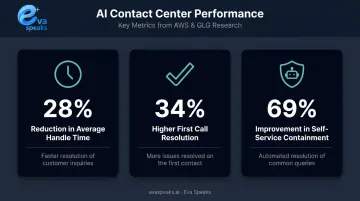
The performance impact is measurable. Organizations migrating to AI-integrated contact center platforms have reported a 28% reduction in average handle time, 34% higher first call resolution, and 69% improvement in self-service containment, according to AWS and GLG research.
For businesses evaluating AI-powered call handling, platforms like EvaSpeaks provide LLM-integrated call handling with configurable call-flow scripts and routing rules, so businesses can configure the system to their specific workflows without needing a technical team. EvaSpeaks is designed as a business-friendly layer on top of existing telephony — which means companies evaluating the shift from purely human-staffed call centers to hybrid or AI-first models can start with EvaSpeaks without replacing their current phone infrastructure.
Where AI Voice Agents Fit Best
AI voice agents perform best on high-volume, routine interactions:
- FAQ handling and order status inquiries
- Appointment confirmations and reminders
- Payment notifications and follow-ups
- Lead qualification and outbound follow-up sequences
- After-hours inbound coverage
Industries seeing strong ROI include insurance, banking, real estate, and e-commerce — all sectors with high call volumes and significant transactional call content. Gartner projects that agentic AI will autonomously resolve 80% of common customer service issues without human intervention by 2029, alongside a 30% reduction in operational costs.
AI does have clear limits. Callers in acute distress, emotionally volatile conversations, and situations requiring genuine relationship-building fall outside what any current system handles well. These aren't rare exceptions — misdirecting these calls causes real harm.
Hear an AI agent in action on a real call. Listen to Sample AI Call
Here is how AI voice agents, hybrid (AI + live), and fully human call center models compare:
| AI Voice Agent (EvaSpeaks) | Hybrid (AI + Live Reps) | Live Human Call Center | |
|---|---|---|---|
| Features | Full AI conversation, 24/7, CRM sync, instant routing | AI triage + human escalation | Human agents, full interaction capability |
| Best-fit Business Size | SMB to mid-market, high-volume routine calls | Mid-market, mixed call complexity | Enterprise, regulated, high-touch |
| Key Strengths | Infinite scale, zero overages, consistent | Handles both simple and complex | Maximum empathy, complex situations |
| Implementation Complexity | Low - hours | Medium | None (hire) |
| Integration Capability | CRM, ticketing, scheduling native | Varies by provider | Manual or CRM |
What Live Call Center Reps Actually Deliver
Live reps bring something no workflow can pre-program: judgment. They read tone, adjust mid-call, de-escalate situations no script anticipated, and make callers feel genuinely heard. That matters most in high-stakes or emotionally sensitive conversations — but it comes with a real cost.
The Operational Reality
Human staffing costs add up fast:
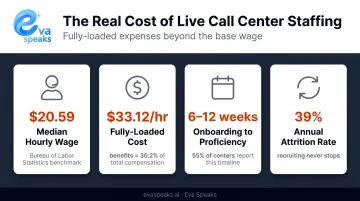
- Customer service reps earn a median $20.59/hour (BLS, May 2024)
- With benefits factored in, the fully-loaded cost rises to $33.12/hour — benefits account for 30.2% of total compensation
- 55% of contact centers spend 6–12 weeks onboarding new agents; fewer than 10% reach proficiency in under two months
- At 39% annual turnover, the recruiting and onboarding cycle never stops
That's before accounting for management overhead, quality assurance infrastructure, or the productivity loss from agents who haven't yet hit their stride.
Where Humans Win
Despite the cost burden, live reps remain the right choice in specific, well-defined scenarios:
- Volatile complaints where tone and trust determine the outcome
- High-value consultative sales that depend on reading the room
- Legal, medical, or financial conversations with real liability exposure
- Callers who specifically request a human — and mean it
Consumer preference data backs this up. 75% of consumers prefer speaking to a real human for customer support, according to Five9 research. That preference doesn't evaporate just because AI has gotten better.
The Hidden Cost of Over-Relying on Live Reps
Staffing constraints create their own problems. High call volume against limited headcount means hold times climb, after-hours calls go unanswered, and agent burnout accelerates. That translates directly to customer loss — 52% of consumers stopped buying from a brand after a bad experience, per PwC's 2025 Customer Experience Survey. Missed calls and degraded service quality are bad experiences.
Which Model Is Right for Your Business?
The decision comes down to four variables: call volume, interaction complexity, emotional stakes, and budget. Neither option is universally correct.
Choose AI Voice Agents When:
- 24/7 coverage is required without shift-based labor costs
- The majority of interactions are routine and repeatable
- Compliance adherence and complete call recording are operational priorities
- Rapid scaling without adding headcount is needed
- The business handles high volume in insurance, healthcare scheduling, real estate, or e-commerce
Choose Live Reps When:
- Calls are frequently emotionally charged or require active de-escalation
- Interactions involve high-value decisions where human judgment changes outcomes
- The industry (legal, medical, financial) demands nuanced interpretation
- Customers explicitly request human assistance
The Hybrid Model: Best of Both
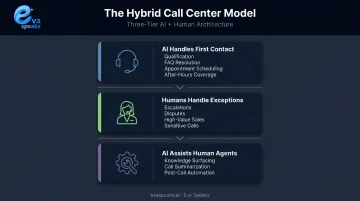
The operations seeing the best results have moved past the binary framing. The practical model is layered:
- AI handles first contact: qualification, FAQ resolution, appointment scheduling, after-hours coverage
- Humans handle exceptions: escalations, complex disputes, high-value sales, emotionally sensitive calls
- AI assists human agents: real-time knowledge surfacing, call summarization, post-call wrap-up automation
NBER research tracking 5,179 customer support agents found that access to a generative AI assistant increased agent productivity by 14% on average — with 34% gains for novice and low-skilled workers. The third bullet above drives that number: AI doesn't just offload repetitive calls, it actively improves the humans handling the complex ones.
This is why Gartner predicts no Fortune 500 company will have fully eliminated human customer service by 2028. The workforce isn't shrinking — it's shifting. Agents take on the calls where human judgment actually changes the outcome, while AI absorbs the volume that never required it.
Want a hybrid setup designed for your call volume? Get a Customized Workflow Recommendation
Real-World Results: What Deployment Actually Looks Like
Aggregate data from AI-integrated contact center deployments tells a consistent story. Organizations report 19% lower cost per interaction, 28% lower average handle time, and 34% higher first call resolution after deploying AI-powered call handling, according to benchmark research from AWS and GLG.
The pattern behind those numbers is predictable: AI absorbs the high-volume, transactional calls that don't require human judgment, while simultaneously freeing agents to handle fewer but higher-quality interactions.
The failure pattern is equally predictable. Businesses that automate too aggressively — deploying AI across interaction types it wasn't designed to handle, without clear escalation paths — create a different problem. Callers who can't reach a human when they need one don't stay customers. That risk is real, and it's why proper scoping matters as much as the technology itself.
Successful deployments share one common principle: match call type to the right tier. AI handles volume and consistency. Humans handle complexity and relationship. Neither does the other's job well.
For businesses ready to explore what that model looks like in practice, Eva Speaks offers AI-powered call handling with configurable call flows, routing rules, and escalation paths — designed for businesses that want the efficiency gains of automation while keeping humans accessible when it counts.
Ready to put this to the test for your team? Request Live Demo
Conclusion
AI voice agents and live reps aren't competing for the same job. They serve different functions across the customer interaction spectrum. The question isn't which one wins — it's which one handles each call type better.
Businesses that see the strongest results treat AI as a layer of efficiency and consistency for high-volume interactions, while preserving human judgment for the moments where empathy, improvisation, and relationship determine the outcome. Start by auditing your call volume by type: the split between routine and complex interactions usually tells you exactly where each belongs.
Frequently Asked Questions
Is AI making call center agents better or replacing them?
AI is primarily supporting agents rather than replacing them. By handling repetitive, high-volume calls autonomously, AI frees human reps to focus on complex and emotionally sensitive interactions where judgment and empathy drive better outcomes.
Why do AI voice agents outperform human receptionists for routine calls?
AI offers 24/7 availability, zero hold times, perfect consistency, and the ability to handle thousands of simultaneous interactions — without shift constraints or staffing overhead. For high-volume and after-hours scenarios, that combination is difficult to replicate with human teams alone.
Can AI voice agents handle emotionally sensitive calls?
Modern AI can adapt tone and deliver scripted empathy effectively in many situations. But genuinely unpredictable emotional conversations — acute distress, grief, complex disputes — still require human judgment and should be routed to live agents. Routing these calls to live agents prevents escalation failures that damage customer trust.
What is a hybrid AI and human call center model?
A hybrid model uses AI to handle routine, first-contact interactions while reserving live agents for escalations, high-value decisions, and emotionally complex calls. This structure delivers cost efficiency and service quality that neither a purely AI nor a purely human approach achieves on its own.
How much does it cost to implement AI voice agents compared to hiring live reps?
AI operates on subscription or usage-based pricing with no benefits, training, or attrition overhead. Live reps carry fully-loaded costs averaging $33.12 per hour in the US when benefits are included, plus recruiting and onboarding costs that compound against a 39% annual attrition rate.
What types of calls should always be handled by a live agent?
Legal disputes, medical emergencies, complex financial complaints, customers who explicitly request a human, and any scenario requiring documented regulatory judgment. These are situations where empathy and real-time improvisation directly shape the outcome.