This review cuts through that. I evaluated 18+ platforms across real call simulations, latency measurements, integration testing, pricing documentation, and compliance review — not just polished demos. What you'll find below: ranked deep-dives on six standout platforms, a transparent look at how I scored each one, and a quick-reference section covering other tools worth investigating.
One thing became clear across all this testing: the right platform depends heavily on your specific situation. Call volume, budget structure, integration complexity, and compliance requirements all matter more than headline feature counts.
Key Takeaways
- AI voice agents combine ASR, LLMs, and TTS to handle phone calls end-to-end — no human agent required
- The call center AI market hit $2.1B in 2024 and is projected to reach $11.3B by 2034 (18.9% CAGR)
- Latency, pricing transparency, and deployment speed vary widely across platforms — choose based on your specific use case
- Eva Speaks, Retell AI, PolyAI, Bland AI, Synthflow AI, and Voiceflow represent distinct market tiers
- Key selection criteria: sub-second latency, CRM/telephony integrations, customizable call flows, compliance certifications, and overall pricing and hidden fees
What Are AI Voice Agents and Why Do They Matter in 2026
AI voice agents are software systems that combine automatic speech recognition (ASR), large language models (LLMs), and text-to-speech (TTS) to conduct natural, real-time phone conversations without human involvement. Unlike legacy IVR systems — which force callers through rigid keypad menus with limited vocabulary — modern voice agents understand natural spoken language, maintain conversational context, and can resolve issues end-to-end.
The business case is substantial. McKinsey research documents contact center AI deployments achieving a 50% reduction in cost per call, handling 20–30% more calls with 40–50% fewer agents. These are documented outcomes from organizations already running these systems at scale — not projections.
Those numbers reflect a shift that's well underway. Across healthcare scheduling, financial services authentication, retail order tracking, and high-volume customer support, conversational AI is already handling calls that once required human agents. After testing 18+ platforms across these use cases, the sections below break down which tools hold up under real-world testing. You can also Watch AI Call Flow Demo to see one of these platforms handling a live call before reading further.
How I Evaluated These 18+ AI Voice Agents
Every ranking in this guide comes from direct testing, not vendor datasheets or demo recordings. Here's exactly what that process looked like.
The Testing Approach
Each platform was evaluated through live use — not just feature documentation. Testing included:
- Real call simulations across inbound and outbound scenarios
- Latency measurement from end of user speech to agent response
- Integration testing with CRM and telephony providers where possible
- Review of official pricing documentation (not third-party estimates)
- Assessment of compliance posture and available certifications
Scoring Criteria
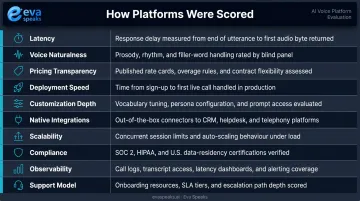
Every platform was assessed across ten dimensions:
| Dimension | What I Measured |
|---|---|
| Latency | Sub-500ms target; above 800ms feels unnatural in conversation |
| Voice naturalness | Expressiveness, pacing, and accent handling |
| Pricing transparency | Published rates vs. "contact sales" for everything |
| Deployment speed | Hours-to-days for simple flows vs. months for enterprise |
| Customization depth | Call flow scripting, conditional routing, persona tuning |
| Native integrations | Salesforce, HubSpot, Twilio, SIP support |
| Scalability | Concurrent call handling capacity |
| Compliance | SOC 2, HIPAA, GDPR certifications |
| Observability | Dashboards, transcripts, analytics |
| Support model | Self-serve docs vs. dedicated implementation support |
Common Selection Mistakes
Three mistakes come up repeatedly when businesses choose the wrong platform:
- Trusting vendor demos over real calls. Demo scripts are optimized; live calls are not.
- Focusing only on per-minute rates. LLM fees, telephony costs, and TTS provider charges can double the actual bill.
- Underestimating integration work. Connecting to an existing CCaaS stack or CRM often doubles the implementation timeline.
To avoid those mistakes, you can Request Live Demo and test with your own call scenarios rather than relying on vendor walkthroughs.
Top AI Voice Agents Ranked and Reviewed
These six platforms stood out across performance, pricing clarity, deployment speed, and real-world call quality from the full 18+ tool evaluation.
Eva Speaks
Eva Speaks is an AI-powered communication platform built for businesses that need reliable call handling, real-time AI responses, and flexible customization — without requiring a developer on staff. The platform centers on three capabilities: LLM integration for live conversations, configurable call-flow scripts and routing rules, and AI-enabled transcription that returns actionable data to the team.
Unlike developer-first tooling platforms, Eva Speaks is designed as a purpose-built business communication solution. Routing rules configure around office hours, caller intent, and department logic. Transcription captures call metadata — caller ID, duration, routing outcomes — and U.S. data residency with state privacy law compliance (California, Colorado, Virginia, and others) is built into the platform's architecture, not bolted on afterward.
| Feature | Details |
|---|---|
| Key Features | AI-enabled call handling and transcription, real-time LLM-powered responses, customizable call-flow scripts and routing rules |
| Pricing | Visit evaspeaks.ai for current plan details |
| Best For | Businesses seeking AI-powered communication with flexible routing and LLM-backed intelligence, without heavy engineering overhead |
Retell AI
Retell AI is a developer-friendly real-time voice platform known for transparent per-minute pricing and fast deployment. Product teams and call centers use it to automate live phone conversations with measurable latency and strong compliance documentation.
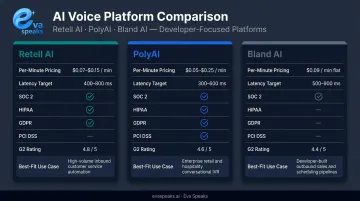
Retell's official docs put response latency as low as 600ms from end of user speech. Pricing runs $0.07–$0.31/minute depending on voice and LLM configuration, with $10 in free credits to start. Compliance coverage is thorough: SOC 2 Type I and II, HIPAA, and GDPR are all documented on their trust page. Supported TTS providers include ElevenLabs, OpenAI, Deepgram, and Cartesia.
On G2, Retell holds a 4.8/5 rating across 2,281 reviews — users consistently cite the intuitive interface and ease of getting to a working voice agent quickly.
| Feature | Details |
|---|---|
| Key Features | Multi-LLM support, real-time analytics, drag-and-drop flow builder, CRM integrations (Salesforce, HubSpot) |
| Pricing | $0.07–$0.31/min for AI Voice; $10 in free credits |
| Best For | Product teams and call centers needing fast, flexible, transparent-cost voice automation |
PolyAI
PolyAI is an enterprise-grade voice AI platform built for high call containment, multilingual support, and deep integration with existing contact center infrastructure. It deploys pre-trained domain assistants for authentication, billing, reservations, and routing — tuned for real-world accent and language diversity.
The numbers are concrete: PolyAI's homepage cites a global delivery company achieving an 85% call resolution rate without human agents. Compliance coverage spans SOC 2 Type II, HIPAA, GDPR, and PCI DSS. Pricing is custom — all buyers route through a demo/contact-sales flow with no public rate card.
On G2, PolyAI holds a 5.0/5 rating from 12 reviews, with one reviewer noting its "exceptional capability to automate client calls" and "human-like voice."
| Feature | Details |
|---|---|
| Key Features | Domain-trained assistants, multilingual/multi-accent support, deep CCaaS and CRM integrations, enterprise analytics |
| Pricing | Custom enterprise pricing; no public rate card |
| Best For | Large enterprises and global contact centers prioritizing containment rates and multilingual capability |
Bland AI
Bland AI is engineered for extreme scale — its official pages claim support for up to 1 million concurrent calls, backed by required compute provisioning and regional redundancy. Its Conversational Pathways feature provides granular dialog control, and the per-minute pricing bundles LLM, STT, TTS, and telephony — which simplifies total cost modeling.
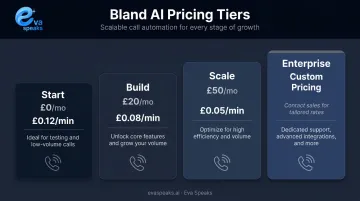
Contrary to what some comparisons suggest, Bland does publish self-serve pricing tiers:
- Start: 2 free credits + $0.14/min
- Build: $299/month + $0.12/min
- Scale: $499/month + $0.11/min
- Enterprise: Custom
The platform supports GDPR compliance, SOC 2 Type I and II, HIPAA, multi-region data residency, and on-premise or VPC deployment. Omnichannel capability spans voice, SMS, and chat — though some SMS and web chat features are plan-restricted.
| Feature | Details |
|---|---|
| Key Features | Extreme call concurrency (up to 1M simultaneous), bundled LLM/STT/TTS/telephony pricing, multi-region deployment, omnichannel |
| Pricing | $0.14/min (Start) to $0.11/min (Scale) + monthly fee; Enterprise custom |
| Best For | Large enterprises with strict governance requirements and very high inbound/outbound call volumes |
Synthflow AI
Synthflow AI is a no-code voice AI platform that pairs PAYG pricing with strong CRM integrations, HIPAA compliance, and multi-tenant support — making it a natural fit for agencies and SMBs. The visual flow builder enables rapid deployment without engineering resources, and bring-your-own-carrier flexibility (Twilio, SIP trunks) keeps telephony costs controllable.
Official pricing runs $0.15–$0.24/min for most PAYG setups, depending on LLM and telephony configuration. Language support covers 30+ languages with multilingual voice cloning. Latency targets sub-600ms via a Global Low Latency Edge add-on.
On G2, Synthflow holds a 4.5/5 rating from 1,016 reviews. One recent reviewer (Adrian P., May 2026) noted the no-code builder let them configure a French-speaking voice agent in under 30 minutes.
| Feature | Details |
|---|---|
| Key Features | No-code visual builder, voice cloning, 30+ languages, Twilio/SIP integration, HIPAA compliance, multi-tenant for agencies |
| Pricing | $0.15–$0.24/min (PAYG); tiered monthly plans available |
| Best For | Agencies, marketing teams, and SMBs that need compliant, scalable automation with straightforward pricing |
Voiceflow
Voiceflow is a no-code conversational design platform built for prototyping and deploying voice and chat agents. Design teams, product managers, and innovation groups favor it for real-time collaboration and its model-agnostic architecture — you can connect any LLM, TTS provider, or STT provider through its configurable behavior settings.
Security coverage includes SOC 2 Type II and ISO/IEC 27001:2022. Voiceflow does offer its own phone integration flow, though external telephony and LLM providers remain configurable for production deployments. Current pricing shows plans at approximately $50/editor/month and $185/editor/month, with Enterprise custom — pricing has shifted from older figures, so verify the current page before budgeting.
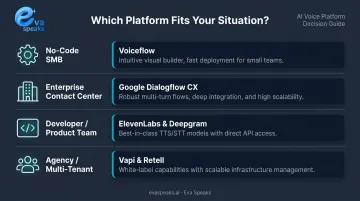
On G2, Voiceflow holds a 4.6/5 rating from 109 reviews, with one reviewer describing it as an "easy visual chatbot builder that makes client flows clear."
| Feature | Details |
|---|---|
| Key Features | Drag-and-drop flow builder, multi-LLM support, real-time team collaboration, voice + chat from one interface, API integrations |
| Pricing | ~$50/editor/month (Pro), ~$185/editor/month (Business), Enterprise custom |
| Best For | Startups and design-led teams prioritizing rapid iteration and cross-functional collaboration |
How the Top AI Call Center Voice Agents Compare
Here is how the top-ranked AI call center voice agents compare across the key decision factors:
| EvaSpeaks | Retell AI | Bland AI | |
|---|---|---|---|
| Best-fit Business Size | SMB to mid-market | Developer teams, mid-market | Enterprise, high-volume |
| Key Strengths | Business-ready out-of-box, CRM-native, fast deploy | Full programmability, transparent pricing | Proven at scale, deep customization | | Implementation Complexity | Low - no code | Medium - developer needed | High | | Integration Capability | CRM, scheduling, EHR native | Custom API | Enterprise integrations |
Other Notable AI Voice Agents Worth Considering
Beyond the six platforms reviewed above, these tools came up repeatedly during evaluation and are worth investigating for specific use cases:
Leaping AI — Strong in high-volume customer service and appointment scheduling for home improvement, travel, and insurance verticals. Drag-and-drop interface designed for non-technical operators; straightforward implementations can go live in 2–4 weeks.
Sierra AI — Focused on brand-aligned customer service with multi-model architecture and strong governance controls. Enterprise-only; Sierra raised $950M in May 2026 at a reported $10B valuation. Pricing minimums are not publicly confirmed.
Replicant — A resolution-first enterprise contact center platform with strong implementation support and documented scalability in high-volume inbound environments. Pricing requires a formal enterprise engagement.
ElevenLabs — The benchmark for TTS voice quality and voice cloning. Its official Agents product now supports deployable chat and voice agents in 70+ languages — full voice and chat deployments, not just TTS output, though it's frequently paired with other routing tools.
SquadStack AI — Outcome-driven platform for high-volume sales and activation workflows, particularly in BFSI and edtech in India. Trained on 600M+ real sales call minutes with omnichannel support across Voice, WhatsApp, SMS, and Email.
Other platforms tested include Vapi and Twilio Voice Intelligence. New entrants should be evaluated against the same criteria outlined in the evaluation section above. You can also See Industry Use Cases to explore how different verticals are deploying AI voice agents today.
Conclusion
After testing 18+ platforms, one thing is clear: no single AI voice agent is universally best. The right choice depends on call volume, integration requirements, budget structure, latency targets, and how much in-house engineering capacity your team actually has.
The best way to find that fit is through a narrow pilot. Pick one high-volume, repeatable call type — appointment reminders, FAQ handling, order status — define success metrics upfront (containment rate, resolution rate, CSAT), and iterate on prompts and flows before scaling.
For businesses that want AI-powered call handling with real-time LLM responses, configurable routing rules, and transcription built in — without assembling a custom stack — Eva Speaks handles all of it out of the box. It sits in a different category from developer-first platforms like Retell or Vapi: rather than providing programmable building blocks, Eva Speaks delivers a fully configured communication layer that operations teams manage directly, without engineering involvement for day-to-day changes. Visit evaspeaks.ai to learn more, or Talk to an AI Communication Expert to discuss how it fits your specific call handling requirements.
Frequently Asked Questions
Can AI agents answer phone calls?
Yes. AI voice agents handle inbound and outbound calls fully autonomously — they use ASR to transcribe speech, LLMs to understand intent and generate responses, and TTS to speak replies in real time. End-to-end call resolution without a human agent is the standard capability across all platforms reviewed here.
What is the difference between an AI voice agent and a traditional IVR system?
Traditional IVRs route callers through fixed keypad menus with limited vocabulary. AI voice agents understand natural spoken language, maintain conversational context, access backend systems, and resolve issues directly — rather than just forwarding calls to a human queue.
How much does an AI voice agent cost per month?
Usage-based platforms vary widely: Retell starts at $0.07/min (rising to $0.31 depending on stack), Synthflow PAYG runs $0.15–$0.24/min, and Bland starts at $0.14/min plus a monthly fee. Enterprise platforms like PolyAI and Replicant use custom pricing. Always factor in LLM and telephony costs on top of platform fees.
What industries benefit most from AI voice agents?
Healthcare (appointment scheduling, patient reminders), financial services (authentication, account inquiries), retail and e-commerce (order tracking, returns), and any business with high inbound call volume and repeatable Tier-1 support workflows. Platforms like SquadStack AI are also purpose-built for BFSI and edtech in India.
How long does it take to deploy an AI voice agent?
Self-serve platforms like Retell AI, Synthflow AI, and Voiceflow can go live in hours to days, though full production deployments with CRM integrations and compliance review typically take 2–8 weeks. Enterprise platforms with custom implementation (PolyAI, Replicant) can take 3–6 months.
Can AI voice agents integrate with my existing CRM?
Most platforms reviewed here support native integrations with Salesforce, HubSpot, and other major CRMs via APIs or pre-built connectors. Before committing, verify how each handles contact syncing, call logging, and transcript storage — behavior varies meaningfully between vendors.