The infrastructure argument for cloud is well-worn. What gets less attention is the operational argument: the reason these systems genuinely change how calls are handled comes down to what happens when managers can see live data instead of yesterday's reports.
This article covers how real-time analytics within cloud call management systems affect the metrics businesses actually track — not the theoretical benefits, but what changes on the ground when visibility is in place.
Key Takeaways
- Cloud call management hosts all call infrastructure off-site, giving teams real-time visibility without on-premise hardware
- Real-time analytics let managers see live queue depth, agent status, and wait times — and act within seconds instead of hours
- The core operational gains are real-time visibility, faster issue resolution, and coaching decisions backed by call metrics
- Without real-time analytics, teams firefight reactively; problems compound before anyone notices
- Value only compounds when analytics are reviewed consistently and tied to follow-up action
What Is a Cloud Call Management System?
A cloud call management system is software hosted off-site by a provider that manages inbound and outbound calls over the internet, replacing physical hardware and on-premise phone infrastructure.
It applies across customer support teams, sales operations, remote or hybrid call centers, and any business that needs to route, record, and monitor calls without owning the infrastructure behind them.
Businesses adopt these systems primarily for the control, visibility, and flexibility that legacy phone setups can't provide. Real-time analytics are what make that possible — surfacing call data as it happens, so teams can act on it rather than review it after the fact.
Key Advantages of Cloud Call Management Systems
Each advantage below connects to outcomes businesses measure: resolution speed, cost per call, agent efficiency, customer satisfaction, and service consistency. These show up in the KPIs teams track every week.
Real-Time Operational Visibility
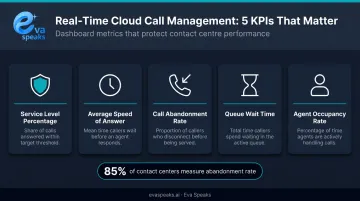
Real-time operational visibility means managers can see live call volume, queue depth, agent availability, wait times, and abandonment rates as they happen — not in a report delivered the next morning.
Cloud call management creates this advantage by routing all call data through a centralized platform. Dashboards update continuously without manual data pulls or custom system integrations. According to NICE, real-time analytics dashboards surface KPIs including average handle time, queue length, agent availability, customer sentiment, and service level adherence — and can support immediate actions like rerouting interactions or coaching agents mid-call.
Why this matters operationally:
Without live visibility, managers respond to problems that have already reached customers. Long queues go unaddressed and agent bottlenecks compound while service levels quietly deteriorate. Real-time dashboards compress that response window from hours to seconds.
When managers can see what's happening live, they can redistribute calls, adjust staffing on the spot, and prevent escalations — all of which reduce cost per contact and protect SLA compliance.
KPIs directly influenced:
- Service level percentage
- Average speed of answer (ASA)
- Call abandonment rate
- Queue wait time
- Agent occupancy rate
When it matters most: High-volume periods, seasonal spikes, and understaffed shifts — any condition where delays compound quickly and manual oversight can't keep pace. ICMI reports that 85% of contact centers measure abandonment rate and 76% track average speed of answer, which are precisely the metrics real-time dashboards protect.
Watch how a live AI call management dashboard tracks calls in real time. Watch AI Call Flow Demo
Faster Issue Resolution and Proactive Support
Cloud call management systems with real-time analytics detect developing problems — a spike in abandoned calls, a surge in repeat contacts — and surface them to the right person without delay.
In practice, this works through automated alerts that trigger when defined thresholds are breached. Wait times exceeding two minutes, sentiment scores dropping, abandonment rates spiking — each can prompt a supervisor to intervene before the situation escalates into a complaint or churn event.
Why this matters operationally:
The difference between proactive and reactive support is almost entirely a visibility problem. Teams without real-time data learn about issues through customer complaints or post-call reports — always one step behind the problem.
The cost of that lag is measurable. According to SQM Group, repeat calls account for 23% of the average contact center's operating budget, and every 1% improvement in first-call resolution reduces operating costs by 1%. SQM also reports a 16% drop in customer satisfaction for each additional call required to resolve the same issue. Real-time alerting reduces the conditions that create repeat contacts in the first place.
KPIs directly influenced:
- First-call resolution (FCR) rate
- Escalation rate
- Customer satisfaction score (CSAT)
- Average handle time (AHT)
- Repeat contact rate
When it matters most: Businesses where customer churn risk is high, compliance is required, or agents handle sensitive issues — healthcare, financial services, and high-stakes support environments where an unresolved escalation carries both a service and a liability cost.
Have questions about real-time analytics for your team? Talk to an AI Communication Expert
Data-Driven Performance Optimization
Real-time analytics don't just show what's happening now. They build a continuous record of how agents perform, which call flows create friction, and where volume patterns repeat — giving managers something concrete to act on when refining training, routing, and scripting decisions.
Platforms that add AI-enabled call transcription extend this further. EvaSpeaks, for example, uses LLM integration and speech-to-text processing to capture call content automatically, making it possible to act on performance data across every call rather than a sample. That's the difference between coaching based on the 5% of calls someone reviewed and coaching based on everything. EvaSpeaks integrates with existing business infrastructure through standard connections rather than requiring a new telephony stack, which is one reason businesses looking to add AI-powered analytics to their call operations can do so without a full platform migration.
When real-time and historical analytics work together, what happens on calls directly informs training, script changes, and routing decisions. Managers coach on patterns, not impressions — and routing changes reflect actual call data rather than convention.
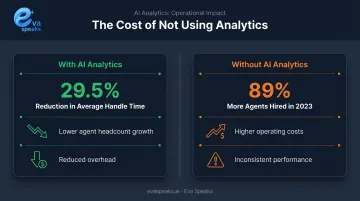
Metrigy's AI for Business Success research found that average handle time dropped by 29.5% with AI, and companies not using AI hired 89% more agents in 2023 than companies that were. The difference compounds at scale: more agents, higher overhead, and less consistency across the team.
KPIs directly influenced:
- Average handle time (AHT)
- Agent quality scores
- Call deflection rate
- Cost per call
- Customer effort score (CES)
When it performs best: Scaling businesses — teams adding agents, entering new markets, or managing high turnover — where consistent performance standards need to hold without constant manual oversight.
See how AI analytics are transforming call management. Explore AI Call Automation
Comparing Cloud Call Management Options on Real-Time Analytics
Not all cloud call management systems approach real-time analytics the same way. Here is how AI-native, cloud CCaaS, and legacy on-premise systems compare on the capabilities that matter most:
| AI + Real-Time Analytics (EvaSpeaks) | Cloud CCaaS (NICE, Genesys) | Legacy On-Premise | |
|---|---|---|---|
| Features | Real-time AI transcription, intent tagging, live dashboards, CRM sync | Full CCaaS reporting, WFM, omnichannel analytics | Post-call logs, scheduled reports |
| Best-fit Business Size | SMB to mid-market | Mid-market to enterprise | Large enterprise |
| Key Strengths | Instant insights, unified call + data, no manual tagging | Enterprise-depth analytics, proven | Maximum control |
| Implementation Complexity | Low | High | Very High |
| Integration Capability | CRM, BI tools, ticketing native | Extensive, often custom | Custom dev |
For teams that want real-time analytics without a lengthy implementation or per-seat pricing, the low-complexity, flat-rate model makes EvaSpeaks a flexible starting point - especially for SMBs and growing mid-market teams that need visibility fast.
What Happens When Real-Time Analytics Are Missing or Ignored
Operating a cloud call management system without using its real-time analytics is like running a business without financial reporting — the infrastructure is there, but nothing tells you whether it's working.
The consequences compound over time:
- Inconsistent service quality — without live data, agent performance varies undetected. Customers experience wildly different service depending on who answers, and no one knows until complaints surface.
- Reactive firefighting — supervisors learn about problems through complaints or post-call reports, always one step behind the issue rather than positioned to prevent it.
- Rising costs without visible cause — unmonitored queues, unaddressed bottlenecks, and repeat contacts drive up cost per call. Without data, it's difficult to diagnose where efficiency is being lost.
- Difficulty scaling — teams without real-time visibility can't safely add volume or agents because there's no reliable signal showing whether the expanded operation is performing to standard.
Zendesk reports that 73% of consumers will switch to a competitor after multiple bad experiences, and more than 50% will switch after just one. Every undetected service failure is a potential customer lost — and without real-time data, those failures stay invisible until it's too late to act.
How to Get the Most Value from Cloud Call Management Systems
The platform only delivers its full value when the data it surfaces is actively used. Real-time analytics that sit in dashboards no one checks have the same practical impact as no analytics at all.
Three conditions determine whether a cloud call management system delivers on its potential:
- Apply monitoring consistently — not just during escalations. Sporadic oversight means patterns go unnoticed until they've become problems.
- Review analytics on a regular cadence — weekly or biweekly reviews surface trends before they compound. Monthly reviews are the minimum; real-time visibility doesn't help if no one is scheduled to look at it.
- Act on insights through concrete follow-up — adjusted routing rules, targeted coaching sessions, revised scripts. Without follow-through, the analytics produce no change. EvaSpeaks' customizable call-flow scripts let teams apply those adjustments directly within the system, so insights translate into actual configuration changes. Because EvaSpeaks' call-flow configuration is accessible through a non-technical admin dashboard, operations managers can iterate on scripts based on analytics findings without opening a development ticket — which closes the loop between data and action more quickly than systems that require IT involvement for script changes.
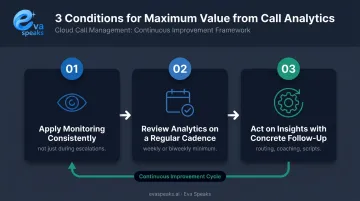
The goal is a continuous improvement cycle, not a one-time optimization. Each month's analytics should inform the next month's configuration and training decisions. Over time, that rhythm turns incremental adjustments into measurable performance improvements.
Want analytics and call management configured for your setup? Get a Customized Workflow Recommendation
Conclusion
Real-time analytics are the mechanism that makes cloud call management systems worth using. Without them, a cloud platform routes calls but does nothing to improve how they're handled. With them, every call generates data that directly informs staffing decisions, resolution strategies, and queue management.
That value only holds if analytics are treated as an active operational habit — reviewed regularly, acted on consistently, and built into how teams manage performance. The businesses that get the most from these systems are the ones that keep watching the data, not just the ones that turned the feature on.
Frequently Asked Questions
What are cloud-based management systems?
Cloud-based management systems are software platforms hosted off-site by a provider and accessed over the internet, replacing on-premise hardware. In call management, all routing, recording, and analytics infrastructure is managed by the vendor — not your internal IT team.
What is cloud-based IVR?
Cloud-based IVR (Interactive Voice Response) is a hosted call routing system that greets callers, presents menu options, and directs them to the right agent or self-service path — no physical hardware required. Updates happen instantly, and the system scales with call volume without any infrastructure changes.
What is real-time monitoring in a call center?
Real-time monitoring is the live tracking of call center metrics — queue depth, agent status, wait times, and active call counts — as they happen. Supervisors use this data to adjust staffing or routing immediately, before service levels drop.
What is the difference between real-time and historical analytics in call centers?
Real-time analytics show what is happening right now and enable immediate response. Historical analytics show what happened over time and support longer-term planning. Teams that use both get operational control today and the pattern recognition to prevent the same problems tomorrow.
How do real-time analytics improve customer satisfaction?
Real-time analytics let supervisors spot long wait times or unresolved issues as they develop, not after the fact. Acting on live data reduces caller friction and cuts repeat contact rates before dissatisfaction sets in.
Can small businesses benefit from cloud call management systems with real-time analytics?
Yes — and the data supports it. Techaisle research covering 2,400 SMBs found that 55% are migrating to cloud contact centers, and real-time monitoring is a primary investment focus for 44% of SMBs. Cloud systems eliminate hardware costs and give lean teams the same call visibility that large contact centers use.